Beyond the Hype: How Stanford’s AI Hub is Redefining the Future of K-12 Education
In the rapidly evolving landscape of educational technology, the arrival of generative AI has sparked a frantic race to integrate new tools into the classroom. Yet, for Chris Agnew, managing director of Stanford University’s AI Hub for Education, the conversation has been fundamentally misaligned. As part of the Stanford Center for Assessment, Learning, and Equity (SCALE) Initiative, Agnew is leading a charge to move beyond "shiny object" syndrome and toward a research-backed, purpose-driven integration of artificial intelligence.
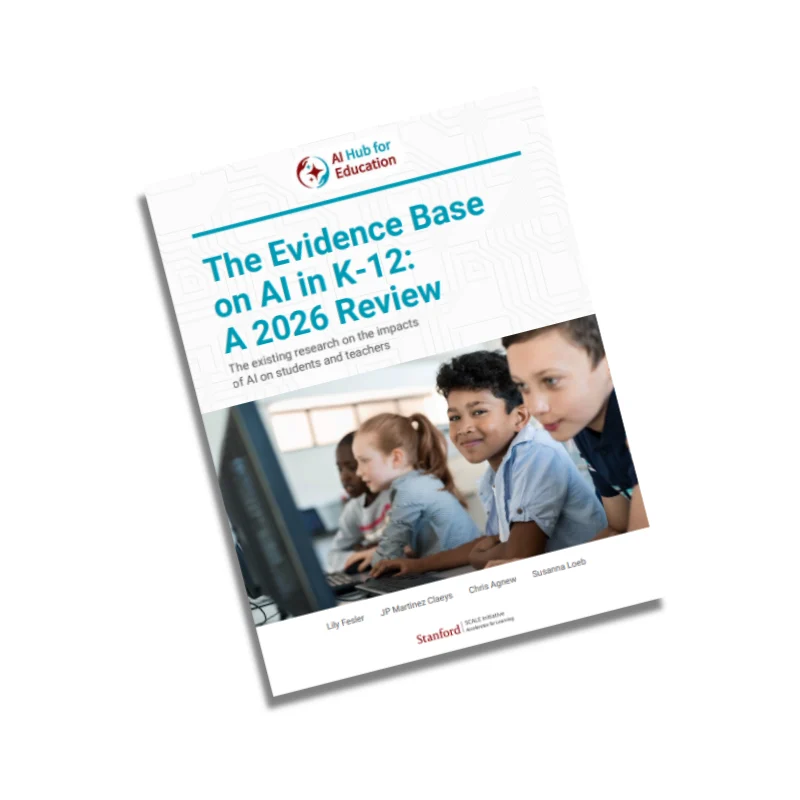
Since its inception in January 2025, the AI Hub has functioned as a critical bridge between academic rigor and practical application. By building a comprehensive repository of research and publishing foundational reports like Understanding The Evidence Base on AI in K-12 Education, the Hub is providing school leaders with the compass they need to navigate a landscape that is as promising as it is volatile.
The Genesis of the AI Hub: A Response to Systemic Barriers
The AI Hub was born from a desire to reconcile two conflicting realities: the immense, untapped potential of experiential learning and the rigid, often prohibitive structures of the traditional K-12 system.
Agnew’s perspective is informed by two decades of work in non-traditional environments—outdoor classrooms, apprenticeships, and community-based learning. "I left that space feeling frustrated," Agnew explains. "I knew that immersive, experiential learning was impactful, but it was far too expensive to be accessible to all students."
When ChatGPT and other generative AI tools entered the mainstream, Agnew recognized an inflection point. Having previously worked in ed-tech using early AI for formative assessment, he saw the potential for technology to finally lower the barriers that had historically rendered high-quality, personalized learning a luxury. The Hub was created not just to track AI trends, but to study how these tools could be leveraged to reimagine education systems that have remained largely unchanged for over a century.
Rethinking the "Tools-First" Approach
In a recent co-authored report, The Learning Experiences that Matter and AI’s Role, Agnew, along with Stanford colleagues Susanna Loeb and Cristina Barnard Gonzales, challenges the prevailing industry narrative. Most educational discourse starts with the tool: "How can we use this chatbot in the classroom?"
Agnew argues that this approach is fundamentally flawed. "It is tempting to start with the shiny object," he notes. "But that risks locking us into a system of schooling designed more than a century ago. We wanted to flip that thinking: first, decide what we want for students, then ask whether AI can help us get there."
The Ten Pillars of Success
The research team identified ten core skills linked to long-term student success—ranging from foundational academic knowledge and higher-order thinking to social-emotional intelligence and intrinsic motivation. By reviewing decades of pedagogical research, they narrowed down five "learning experiences" that effectively develop these capacities:
- Personalized Instruction
- Real-World Learning
- Student Agency
- Enriching Discussions
- Strong, Supportive Relationships with Adults
The report then pivots to a critical question: What prevents these experiences from happening at scale? The answers—rigid scheduling, narrow accountability, insufficient teacher training, and inflexible curriculum—are systemic, not technological. The Hub’s mission is to determine if AI can act as the "connective tissue" that helps schools overcome these operational bottlenecks.
AI as an Operational Force Multiplier
The potential of AI, as outlined by the Hub, lies in its ability to synthesize data and logistics in ways previously impossible. Agnew highlights three specific areas where AI could catalyze systemic change:
- Dynamic Grouping: Currently, students are grouped by age, an administrative relic. AI could synthesize assessment data with room and staffing constraints to allow for fluid, mastery-based grouping, where students shift environments based on their actual learning progress rather than a calendar date.
- Continuous Assessment: Traditional testing is too infrequent to be actionable. AI-driven formative assessment could provide teachers with a real-time "dashboard" of student progress, capturing not just the final answer, but the process—how a student revises their thinking or collaborates with peers.
- Professional Simulation: Teachers are often limited by one-off workshops. AI-powered simulation tools can allow educators to practice difficult scenarios—such as managing classroom engagement or facilitating complex discussions—repeatedly, with iterative feedback.
The Evidence Gap: What Does the Data Actually Say?
While the potential is significant, the AI Hub’s research highlights a sobering reality: the evidence base for AI in K-12 is still in its infancy. In their analysis of research conducted up to November 2025, the Hub found a stark disparity between the volume of AI hype and the volume of high-quality, causal evidence.
Key Findings from the Research
The Hub’s recent study of 355 elementary students across five after-school programs revealed a surprising hurdle: nearly half of the students never used their AI literacy tutor, even when given dedicated time to do so. Furthermore, while pairing AI with human tutors increased usage, it did not necessarily lead to improved reading achievement.
However, the findings for educators were more optimistic. The data suggests that AI is most beneficial for teachers who are less experienced or lower-rated, as it helps automate instructional feedback and streamlines administrative tasks, effectively elevating the baseline quality of teaching across the board.
The primary takeaway for school leaders? "Design matters," Agnew emphasizes. "Purposeful, curriculum-anchored AI that provides step-by-step guidance shows much greater promise than open-ended, unsupervised use."
Implications for Policy and Implementation
The current market dynamic—where schools are free to purchase tools that prioritize short-term "fixes" over long-term systemic improvement—is a significant barrier. Agnew argues that state-level intervention is essential. By pooling resources and signaling interest in specific, high-impact solutions, states can force the market to innovate in ways that align with educational goals rather than just revenue cycles.
Advice for District Leaders
When asked how superintendents should navigate the current uncertainty, Agnew offers a nuanced roadmap:
- Prioritize Educator Use: Start by leveraging AI to support teachers. Freeing up time for human interaction and surfacing better data to guide instruction is the most evidence-backed use case right now.
- Go Slow with Students: Exercise extreme caution with unsupervised student use. Any AI integration for students should be tied to specific, measurable skill-building and must be mediated by a caring adult.
- Establish Guardrails: Before any implementation, districts must ensure clear AI policies, robust data privacy, and a baseline of AI literacy for staff.
The "Screen Time" Fallacy
Perhaps the most provocative aspect of the Hub’s work is the rejection of the "screen time" debate. Agnew believes that obsessing over the number of minutes a student spends on a device misses the point of 21st-century learning.
"We are currently engaging with AI through chat interfaces, but multimodal and voice-based AI is advancing rapidly," Agnew points out. "We could soon be in a world where screen time has decreased, but engagement with technology has exploded because students are interacting via voice."
Instead of asking "How much time is too much?" school leaders should be asking about "screen value." Is the interaction developing higher-order thinking? Is it facilitating a relationship between student and teacher? Is it providing the personalization that a human teacher, stretched across thirty students, cannot provide alone?
Conclusion: A Call for Intentionality
The work of the Stanford AI Hub for Education serves as a necessary corrective to the impulsive adoption of new technology. By grounding the discourse in the fundamental purposes of schooling, Chris Agnew and his team are helping to shift the narrative from technology-as-panacea to technology-as-lever.
The path forward is not found in the latest software update, but in the careful, research-informed alignment of tools with the human-centric goals of education. For leaders ready to embrace this measured approach, the potential for a more equitable and effective school system is not just a future possibility—it is an actionable strategy for today.