The Human Equation: Why AI Integration in Higher Education Hinges on Trust, Not Tech
Main Facts: The Great Pedagogical Disconnect
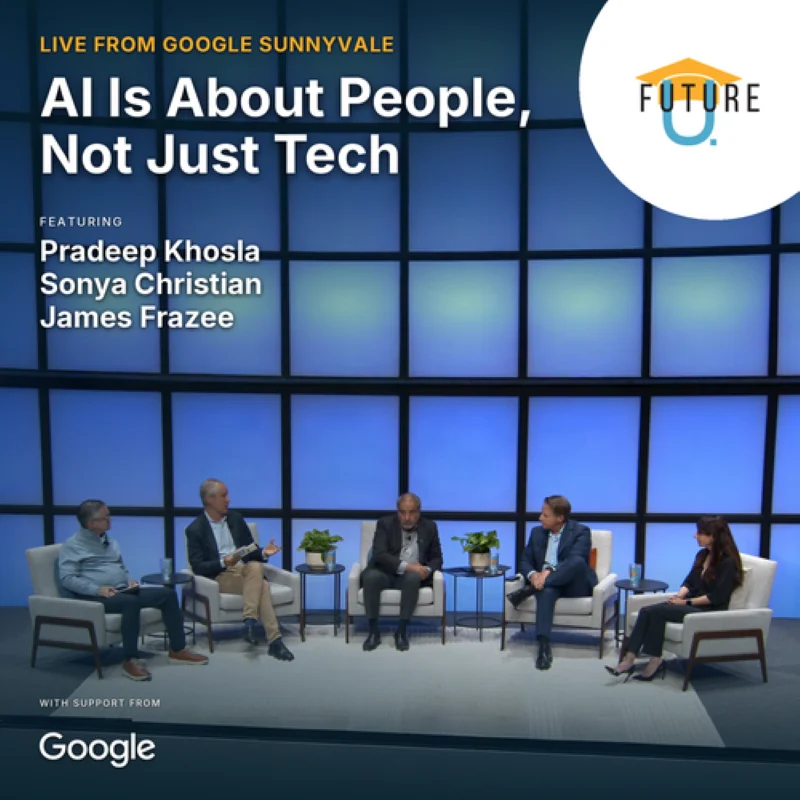
In the rapidly evolving landscape of higher education, the conversation surrounding Artificial Intelligence (AI) has shifted from a discussion about technical feasibility to a nuanced debate on institutional trust. During a live recording of the Future U podcast at Google’s Sunnyvale campus, hosts Michael Horn and Jeff Selingo dissected a critical paradox: while universities are pouring millions of dollars into digital infrastructure and sophisticated AI tools, there remains a profound disconnect between these investments and their actual application in the classroom.
The central thesis of the discussion was clear—the efficacy of AI in academia is not dictated by the sophistication of the software or the bandwidth of the campus network. Rather, it is determined by the human-centric policies that govern its use. As AI tools become ubiquitous, the lack of a cohesive, campus-wide strategy has created a "policy patchwork" that is undermining the academic experience, fostering student anxiety, and complicating the delicate relationship between faculty and their pupils.
Chronology: The Evolution of the AI Classroom Crisis
To understand the current state of affairs, one must look at the timeline of the last two years, a period defined by reactionary policies and shifting pedagogical standards.
Phase 1: The Reactive Onset (Late 2022 – Early 2023)
When generative AI tools like ChatGPT entered the mainstream, the immediate response from higher education was characterized by alarm. Universities across the globe scrambled to update academic integrity policies, with many opting for outright bans. This period was marked by fear—fear of mass plagiarism, fear of the degradation of critical thinking, and fear of an unmanageable technological disruption.
Phase 2: The Period of Ambiguity (Mid-2023 – Early 2024)
As the dust settled, the "ban-first" approach proved unsustainable. Institutions began to pivot toward localized policies, often delegating authority to individual departments or even specific professors. This created the fragmented landscape we see today, where one classroom operates as an "AI-augmented" environment while the adjacent lecture hall views the same tools as a violation of the academic honor code.
Phase 3: The Call for Cohesion (Present Day)
The current climate, as highlighted at the Google Sunnyvale summit, is one of institutional fatigue. Educators and administrators are realizing that the burden of AI policy cannot rest solely on the shoulders of the faculty. The consensus now moving forward is that universities must establish a unified "trust framework" that provides students with clarity, consistency, and a roadmap for ethical usage.
Supporting Data: The Cost of Inconsistency
While technological investment in higher education is projected to reach record highs in the coming fiscal year, data suggests that spending alone is not moving the needle on student outcomes.
The Infrastructure vs. Adoption Gap
Recent industry reports indicate that while 85% of major research universities have invested in AI-integrated learning management systems (LMS) or enterprise AI suites, student usage remains siloed. Many students report that they use AI tools for brainstorming and research independently, but hide this usage from professors due to a fear of reprisal.
The Psychological Toll
The anxiety identified by James Frazee, Vice President and Chief Innovation Officer at San Diego State University (SDSU), is backed by qualitative data. Surveys conducted among undergraduate populations show a 40% increase in "academic performance anxiety" linked specifically to the uncertainty of AI policies. Students report a "cognitive load" increase: not only must they master the subject matter, but they must also navigate the subjective—and often contradictory—ethical expectations of five or six different professors each semester.
Official Responses: The Institutional Perspective
The panel discussion at Google served as a microcosm for the broader institutional struggle to govern a technology that moves faster than the bureaucratic processes designed to regulate it.
The Perspective from San Diego State University
James Frazee provided perhaps the most poignant summary of the issue during the panel. He noted that the inconsistency of policies is not merely a logistical annoyance; it is a fundamental breach of the contract between the institution and the student.
"They can go into their 9 o’clock class and be encouraged to use AI," Frazee explained, "and they could be expelled for doing the exact same thing in their 10 o’clock class. That’s causing a great deal of anxiety and stress among our students. So, I think that element of trust is really important."
Frazee’s argument is that innovation without alignment is a recipe for institutional failure. For AI to be successfully integrated, universities must move toward a model of "supported autonomy," where students know the boundaries, but are encouraged to explore the capabilities of the tools within a safe, guided, and transparent environment.
The Role of Google and Tech Partners
Representatives from the tech sector at the summit emphasized that their role is to provide the "scaffolding." However, they acknowledged that they cannot solve the cultural problems inherent in academia. The responsibility for defining "academic integrity" in an AI-powered world, they argued, rests solely with the educators and administrators.
Implications: The Future of the University
The implications of this disconnect are significant and far-reaching, touching on the future of employment, the value of a degree, and the very definition of "learning."
1. The Redefinition of Academic Integrity
We are currently witnessing a shift from "preventative" integrity—where the goal is to stop cheating—to "developmental" integrity, where the goal is to teach students how to leverage AI ethically. If universities fail to align on this, they risk rendering their own degrees obsolete. In the professional world, AI literacy is becoming a baseline requirement; if a university education prohibits the use of these tools, it may be failing to prepare students for the modern workforce.
2. Faculty-Student Relationships as the New Frontier
The "policing" model of education—where faculty spend a significant portion of their time investigating suspected AI use—is destructive to the student-mentor relationship. When trust is replaced by suspicion, the pedagogical value of the classroom diminishes. The future of higher education lies in shifting this dynamic toward a collaborative partnership where professors guide students on how to use AI as a co-pilot, rather than as a shortcut.
3. The Need for Institutional Governance
For AI to be successfully integrated, universities must establish centralized policy frameworks that provide "guardrails" rather than "walls." This means:
- Standardization: Developing baseline policies that apply across departments, with clearly defined exceptions.
- Transparency: Requiring syllabi to explicitly state the AI policy for that course in plain language.
- Professional Development: Investing not just in hardware, but in the training of faculty so they are comfortable teaching with and alongside AI.
4. The Human Element
Ultimately, the Future U discussion underscored a fundamental truth about higher education: technology is a tool, but education is a human process. If the integration of AI leaves the student feeling alienated or anxious, the university has failed, regardless of how advanced their software or how high-tech their classrooms may be.
As the academic community looks to the next decade, the focus must shift from the "what" of technology to the "who" of the student. Building a culture of trust—one where expectations are clear, support is available, and students are treated as partners in their own technological development—will be the defining challenge for university leadership in the 21st century.
The path forward requires a level of institutional courage that is rarely seen in higher education: the courage to embrace uncertainty, to admit when old policies are no longer fit for purpose, and to prioritize the mental well-being and professional readiness of the student body over the rigid maintenance of traditional assessment models. In the era of artificial intelligence, the most valuable asset a university can possess is not its tech stack, but the trust of its students.