Beyond the Worksheet: How Project-Based Learning Unlocks True Student Potential and Prepares Them for the Real World
By Educational Insights Staff
Published: October 2023
Main Facts
For generations, the architecture of American schooling has relied on a transactional model: students complete an assignment, receive a grade or a checkmark, and move immediately to the next unit. While efficient for tracking compliance, this traditional paradigm inadvertently caps what students demonstrate they know, understand, and are capable of achieving.
According to educational experts, traditional assessments offer merely a microscopic window into a student’s true capacity. In contrast, Project-Based Learning (PBL) fundamentally alters the educational engine. By rooting instruction in complex, real-world problems, PBL fosters long-term knowledge retention, develops critical thinking, and reveals hidden student leadership and problem-solving capabilities that standard multiple-choice tests and worksheets can never capture.
As artificial intelligence advances and instantly generates raw facts on demand, the modern educational landscape demands more than rote memorization. It requires human-centric skills: curiosity, empathy, critical judgment, and the ability to navigate profound ambiguity. Proponents argue that project-based learning is no longer just an innovative pedagogical alternative; it is an essential tool for preparing students for modern civic life and the workforce.
Chronology: The Evolution of a Borderland Curriculum
To understand the profound impact of experiential learning, one must look at how project-based courses operate in practice. Dr. Ryan Sprott, Senior Director of Design and Facilitation at PBLWorks and author of Teaching Contentious Topics in a Divided Nation: A Memoir and Primer for Pedagogical Transformation, points to a transformative classroom experience from the 2015–2016 school year.
During a presidential campaign defined by intense, polarized rhetoric surrounding immigration, Sprott was teaching high school students in San Antonio, Texas. Geographically situated just a few hours from the United States–Mexico border—and intimately connected to it through family networks and regional culture—his students were inundated with daily media debates.
- Phase 1: Sparking Inquiry (Fall 2015)
Rather than ignoring the political noise or relying on static textbook chapters, the classroom confronted the issue head-on. Students began asking vital, unscripted questions: What is actually happening at the border, and what does a border truly mean? - Phase 2: Designing the Driving Question
Sprott and his colleagues structured an entire project-based course around a single, resonant driving question: "What is the purpose of a border, and what has shaped your answer to this question?" - Phase 3: Fieldwork and Stakeholder Engagement (Winter 2015)
Students lived inside this inquiry for months. The curriculum moved outside school walls: students traveled directly to the border, examined physical sections of the wall, and walked along natural riverfronts. Crucially, they conducted rigorous, firsthand interviews with real stakeholders, including Border Patrol agents, asylum seekers, local mayors, and community aid organizations. - Phase 4: Reflection and Evolution (Spring 2016)
Throughout the course, students regularly revisited the driving question at key milestones, charting how their own assumptions and critical thinking evolved. Years later, alumni of this course still cite the project as a defining milestone of their educational journeys—with several even pursuing careers in public policy and social advocacy.
Supporting Data and Classroom Observations
The limitations of traditional schooling often marginalize students who struggle with standard testing formats but thrive in dynamic environments. Project-based learning acts as an equalizer, expanding the definition of what it means to be "good at school."
Case Study A: High-Stakes Crisis Management
During the San Antonio border course, a local humanitarian aid organization reached out with an urgent request: Could students help support women and child asylum-seekers who had just been released from detention facilities?
Without hesitation, students stepped up to manage logistics, coordinate transportation, and care for young children.
- The Hidden Leader: According to classroom observations, a student who was historically quiet and unassuming in traditional, lecture-based classroom settings suddenly sprang into action. He seamlessly coordinated flight schedules with legal aid organizations, provided bilingual translation, and calmly solved high-stakes logistical problems. The authentic, high-pressure context of PBL unlocked leadership and executive-functioning capacities that traditional assignments had completely obscured.
Case Study B: Redefining the "Right Answer"
Another student had spent years suffering from academic anxiety, terrified to speak up in class because he believed he rarely possessed the "right answer."
- The Shift to Inquiry: Through project-based interviews with adults holding wildly conflicting viewpoints, his perspective shifted. Discovering that adults did not possess a single, uniform answer was intellectually liberating. He learned that real-world knowledge is not about selecting multiple-choice options, but rather about active inquiry, interpretation, and moral judgment.
According to anecdotal data collected from university professors and alumni, college students who experienced high-stakes PBL in high school display distinct advantages over their peers. They are notably more comfortable speaking up, challenging premises, and questioning professors—and they frequently report a willingness to invest personal time outside of class into complex intellectual challenges.
Official Responses and Pedagogical Insights
Educational leaders and researchers emphasize that scaling project-based learning requires a systematic shift in institutional support. It cannot succeed if individual teachers attempt to pioneer complex projects in professional isolation.
The Cognitive Engine of PBL
Why does project-based learning yield such durable cognitive results? Educators point to several core mechanisms:
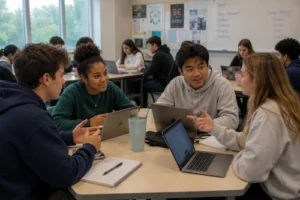
- Contextual Anchoring: Content is tied to tangible human experiences, making abstract concepts easier to retrieve from memory.
- Emotional Engagement: Wrestling with ambiguous, real-world problems stimulates deeper neurological pathways than passive listening or note-taking.
- Agency and Ownership: When students have a voice in how they investigate a problem, intrinsic motivation replaces extrinsic grade-grubbing.
District-Level Strategies for Scale
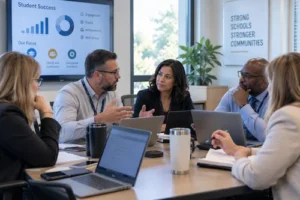
To foster a sustainable culture of project-based learning, educational leaders must establish intentional structural conditions. Experts recommend that district administrators take the following steps:
- Provide Ongoing Professional Development: Equip teachers with the facilitation skills necessary to guide open-ended inquiry rather than simply delivering lectures.
- Redefine Assessment Frameworks: Move beyond standardized testing metrics to evaluate portfolios, public presentations, and real-world problem-solving outcomes.
- Build Community Partnerships: Create institutional pipelines that connect classrooms to local businesses, civic organizations, and government agencies to ensure student work addresses authentic community needs.
Implications for the Future of Education
As the educational ecosystem grapples with the disruptive rise of generative artificial intelligence, the fundamental purpose of schooling is undergoing a historic re-evaluation. When an algorithm can instantly summarize historical facts, write code, or solve calculus equations in seconds, the ability to regurgitate information loses its market value.
Instead, the future belongs to learners who possess deep curiosity, profound empathy, and the resilience to navigate ambiguity. Project-based learning offers a blueprint for cultivating these exact traits.
By dissolving the rigid barriers between classroom walls and the outside world, PBL transforms students from passive consumers of information into active creators of solutions. As educational advocates emphasize, joyful, connected, and real-world learning is no longer an optional luxury—it is the foundational requirement for success in the next era of schooling, workforce development, and civic life.