Early Indicators, Lasting Impacts: What Kindergarten Test Scores Reveal About Third-Grade Academic Proficiency
WASHINGTON — Reaching academic proficiency in reading and mathematics by the end of third grade has long been heralded by educators, policymakers, and child development experts as a critical educational milestone. By this pivotal grade, the fundamental paradigm of schooling shifts: students transition from "learning to read" to "reading to learn," using foundational skills to process increasingly complex academic content across all subjects. Extensive longitudinal research has consistently linked third-grade achievement to later educational outcomes, including high school graduation rates and college enrollment, positioning it as a primary bellwether for long-term student success.
However, a newly published study from researchers at NWEA (Northwest Evaluation Association) reframes how educators can approach this crucial benchmark. The research demonstrates that students at risk of missing third-grade reading and math proficiency can be identified years before that benchmark is officially measured—often as early as their first days in kindergarten.
The findings offer a stark message for the education sector: a child’s academic achievement level upon entering kindergarten provides a remarkably powerful, predictive signal about future learning trajectories, making universal early screening and proactive intervention more vital than ever.
Main Facts
The NWEA study sheds light on the deep-seated connections between a child’s starting point in kindergarten and their ultimate academic standing in third grade. Among the core findings:
- High Predictive Power of Starting Points: Students who enter kindergarten at either the very top or the bottom of the achievement distribution demonstrate a high probability of remaining in those respective tiers through third grade.
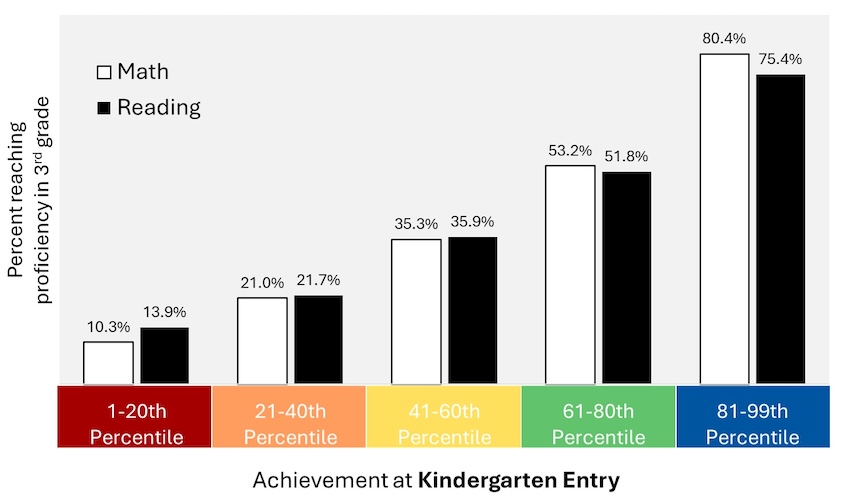
- The Odds for At-Risk Students: Children who enter kindergarten in the lowest 20th percentile face daunting odds. Only 10.3% reach proficiency in third-grade math, and a mere 13.9% hit the mark in reading.
- The Narrowing Window of Intervention: For students remaining in the bottom achievement quintile, the probability of catching up drops precipitously with each passing school term. While a kindergarten start offers a small window of hope, waiting until the end of first grade leaves only about 2% of those students reaching third-grade proficiency.
- Risk Extends Beyond the Lowest Quintile: The risk of missing proficiency is not exclusive to the bottom 20%. A majority of students starting in the bottom three quintiles fail to reach third-grade benchmarks, and even among students ranking in the 61st to 80th percentiles upon entry, only about half ultimately meet proficiency.
- Signal, Not Destiny: Researchers emphasize that kindergarten scores are diagnostic signals, not deterministic fates. Trajectories can and do change, provided schools implement timely, targeted support.
Chronology of the Research and Evolving Educational Insights
To understand the weight of these new findings, it is helpful to trace how educational research has viewed early childhood development and academic trajectories over the past several decades:
- Early 2000s – The Focus on Third Grade: Educational reform movements, heavily influenced by federal policies such as the No Child Left Behind Act, zeroed in on third grade as a non-negotiable benchmark for reading proficiency, leading to widespread adoption of high-stakes testing at that grade level.
- 2010s – The Emergence of School Readiness Data: As universal pre-K initiatives and expanded kindergarten entry assessments gained traction, researchers began amassing longitudinal data showing that children arrive at school with massive disparities in preparation, often heavily stratified by socioeconomic factors.
- 2020–2024 – Post-Pandemic Learning Gaps: Disruptions caused by the COVID-19 pandemic compounded learning disparities in early elementary grades, intensifying the urgency for educators to find reliable ways to catch students before they fall too far behind.
- Late 2024 / Early 2025 – The NWEA Study Publication: NWEA researchers released their landmark study, "Behind at the Starting Line: What Kindergarten Test Scores Tell Us About Reaching Proficiency in 3rd Grade," tracking student cohorts over multiple years to map the exact conditional probabilities of academic catch-up across various early grade milestones.
Supporting Data and Statistical Analysis
The data compiled by the NWEA research team illustrates a stark landscape of educational equity and academic momentum.
The Gradient of Kindergarten Entry
When looking at the entire student body, the odds of achieving third-grade proficiency scale directly with initial kindergarten placement:
- 1st–20th Percentile: 10.3% reach math proficiency; 13.9% reach reading proficiency.
- 21st–40th Percentile: 21.0% reach math proficiency; 21.7% reach reading proficiency.
- 41st–60th Percentile: 35.3% reach math proficiency; 35.9% reach reading proficiency.
- 61st–80th Percentile: 53.2% reach math proficiency; 51.8% reach reading proficiency.
- 81st–99th Percentile: 80.4% reach math proficiency; 75.4% reach reading proficiency.
These figures highlight a sobering reality: nearly nine out of ten students who begin kindergarten in the lowest quintile do not meet third-grade proficiency standards without intensive intervention. Furthermore, students traditionally viewed as "average" (falling in the middle quintiles) still face a coin-flip’s chance or worse of missing the third-grade benchmark.
The Shrinking Timeline for Catch-Up
Perhaps the most alarming data points from the research center on striving students trapped in the bottom quintile over time. Tracking these children term-by-term reveals how quickly the window of opportunity closes:
- Start of Kindergarten: 10.3% (math) / 13.9% (reading) ultimately reach third-grade proficiency.
- End of Kindergarten: 5.6% (math) / 7.2% (reading) ultimately reach proficiency.
- Start of First Grade: 4.7% (math) / 5.8% (reading) ultimately reach proficiency.
- End of First Grade: 2.1% (math) / 2.5% (reading) ultimately reach proficiency.
This steep drop-off demonstrates that cumulative learning deficits compound rapidly. As instruction advances, the gap between striving learners and grade-level expectations widens, making remediation exponentially more difficult with every semester that passes.
Official Responses and Expert Perspectives
The educational research community and policy advocates have responded strongly to the study’s implications, calling for a systemic shift in how schools handle assessment and resource allocation in the earliest grades.
Dr. Chase Nordengren, a senior research scientist at NWEA and co-author of the study, emphasized that the data should inspire proactive action rather than defeatism.
"For too long, the education system has operated in a reactive posture, waiting for high-stakes third-grade tests to ring the alarm bell," Nordengren noted in a companion commentary. "Our research shows that the alarm bells are actually ringing on day one of kindergarten. When we ignore those early signals, we are effectively watching the window of opportunity close in slow motion for our most vulnerable learners."
Literacy advocates point out that while billions of dollars have been poured into "science of reading" initiatives nationwide—often focusing heavily on kindergarten through third-grade literacy coaching—these programs must be paired with immediate universal screening to catch struggling readers instantly.
Concurrently, math education specialists have raised concerns regarding early numeracy. While early literacy has dominated policy discussions and legislative funding, early math interventions have historically lagged behind. Experts argue that the parallel trends found in math proficiency—where bottom-quintile students face equally dismal long-term odds—demand an equivalent investment in foundational math screening tools.
Implications for Schools, Districts, and Policy
The actionable takeaways from the NWEA study call for a fundamental restructuring of early-childhood and elementary education frameworks across the United States.
1. Universal Screening as a Standard Practice
Schools can no longer rely on teacher intuition or anecdotal observations alone to identify students needing help. Implementing universal screening instruments during the first weeks of kindergarten allows educational teams to establish an immediate baseline. This diagnostic clarity ensures that intervention resources are deployed precisely where they are needed most, rather than waiting for students to fail milestone exams years later.
2. Rigorous Progress Monitoring
Identifying a student at risk in kindergarten is only the first step. The data demonstrates that children who remain in lower achievement tiers face plummeting odds of recovery over time. Consequently, schools must implement routine progress monitoring—checking student growth multiple times per year—to evaluate whether chosen interventions are actually accelerating student learning or if instructional strategies need to be pivoted.
3. Balancing Literacy and Numeracy Investments
As states continue to mandate early literacy screening and structured literacy frameworks, educational leaders must apply the exact same rigor to early numeracy. Because math trajectory data mirrors reading data so closely, neglecting foundational math skills in kindergarten all but guarantees subsequent gaps in upper-elementary and middle-school mathematics.
4. Reframing the Narrative Around Early Achievement
Ultimately, educators must hold two truths in balance: kindergarten achievement scores are immensely powerful diagnostic tools, but they are not prophecies. Children can, do, and will overcome early deficits when schools surround them with targeted, systematic support. By acknowledging the predictive weight of early scores without viewing them as destiny, schools can transform early-grade education from a high-stakes guessing game into a proactive, equity-driven engine of student success.