The Ivory Tower’s Existential Reckoning: Why Higher Education is Facing a Perfect Storm
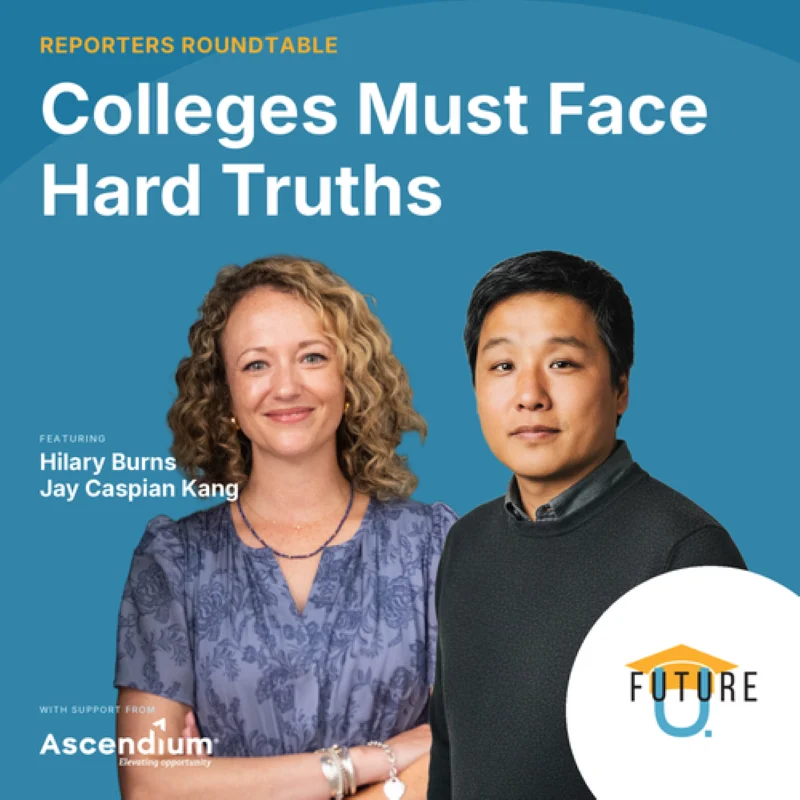
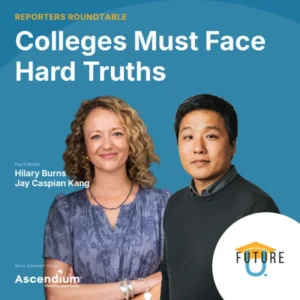
For decades, the American higher education sector operated under a convenient, almost axiomatic assumption: that a college degree was a guaranteed ticket to the middle class, and that institutions could rely on perpetual enrollment growth to fund their ambitions. However, a recent deep-dive discussion on the Future U podcast, featuring Hilary Burns of The Boston Globe and Jay Caspian Kang of The New Yorker, suggests that this era of complacency has reached a definitive, perhaps fatal, inflection point.
In a candid roundtable moderated by Michael Horn and Jeff Selingo, Burns and Kang argued that college leaders are fundamentally misreading the public mood. While university administrators and political pundits remain preoccupied with headline-grabbing culture wars, a more systemic, existential crisis is brewing in the background. Ordinary families, the lifeblood of the tuition-dependent model, are increasingly skeptical of the value proposition offered by modern higher education. As demographic cliffs loom and the disruptive potential of Artificial Intelligence (AI) reshapes the labor market, the industry is finding that its traditional strategies for growth are no longer viable.
The Core Conflict: Value, Cost, and Cultural Distraction
The primary contention raised by Burns and Kang is that the higher education sector is currently distracted by surface-level political skirmishes—debates over campus speech, DEI initiatives, and ideological posturing—while ignoring the economic realities that matter most to the average household.
For the American family, the calculation has shifted. When tuition costs rise at rates consistently outpacing inflation, and when the narrative surrounding student debt becomes a national political fixture, the "college-for-all" mantra loses its luster. "We are seeing a disconnect," noted Burns. "Institutions are looking at their internal metrics and cultural grievances, while the families they serve are looking at their bank accounts and asking if the return on investment is actually there."
This skepticism is not merely anecdotal. It is a fundamental reassessment of the value of a degree in an era where the path to professional success is becoming increasingly fragmented.
A Chronology of the Decline: From Growth to Contraction
To understand the severity of the current situation, one must look at the timeline of the industry’s trajectory over the last quarter-century.
The Era of Uninterrupted Growth (1990–2010)
During this period, higher education was defined by expansion. Low interest rates, easy access to federal student loans, and a cultural consensus that a degree was essential for economic survival fueled a boom. Colleges built amenities-heavy campuses, expanded administrative ranks, and relied on the assumption that enrollment would always trend upward.
The Great Recession and the Debt Crisis (2008–2015)
The 2008 financial crisis served as the first major warning shot. As families saw their home equity and retirement savings shrink, the scrutiny on college costs intensified. This period saw the rise of the student debt conversation, as total outstanding debt climbed past the $1 trillion mark. Universities, however, largely doubled down on tuition hikes to make up for declining state funding.
The Demographic Cliff and the Pandemic (2018–2023)
The "demographic cliff"—a sharp decline in the birth rate starting in 2008—began to loom over higher education planners. The COVID-19 pandemic accelerated the instability, forcing a mass migration to remote learning that exposed the fragility of the "campus experience" model. Suddenly, the value of paying premium tuition for a Zoom-based education was openly questioned by students and parents alike.
The AI-Driven Uncertainty (2024–Present)
We have now entered an era defined by rapid technological disruption. With the rise of generative AI, the skills once considered the "gold standard" of a liberal arts education are being challenged. Students are questioning whether four years of traditional schooling is the most efficient way to prepare for a workforce that is being rapidly reconfigured by automation.
Supporting Data: The Anatomy of a Sector in Crisis
The challenges facing higher education are not evenly distributed, but they are systemic. The data paints a stark picture for two specific segments of the market:
1. The Regional Public Crisis
Regional public universities, which have long served as the engine of social mobility, are facing a "scissors effect." On one side, state support continues to be erratic; on the other, the population of traditional college-aged students is shrinking in many parts of the country, particularly in the Northeast and Midwest. According to enrollment data, dozens of these institutions are operating at significant deficits, forced to cut academic programs just to keep their doors open.
2. The Tuition-Dependent Private Trap
Small, private, tuition-dependent colleges are arguably the most vulnerable. Unlike elite Ivy League institutions with multi-billion-dollar endowments, these schools rely almost entirely on the revenue generated by student tuition. When enrollment drops even slightly, it creates a "death spiral" where the school must raise tuition to cover costs, which in turn drives away more prospective students who find the cost prohibitive.
"We are looking at an emergency situation in a lot of these schools," Jay Caspian Kang warned during the podcast. He points out that for many of these institutions, the end is not a matter of "if," but "when."
Official Responses: The Leadership Vacuum
Perhaps the most stinging critique offered by Hilary Burns is her assessment of institutional leadership. She suggests that the current environment is characterized by a profound "leadership vacuum."
"Everyone’s kind of just ducking and hoping someone else will step up," Burns observed. Instead of engaging in transparent, difficult conversations about the future of their institutions—such as merging with other schools, downsizing, or radically rethinking the curriculum—many leaders are choosing a path of least resistance.
There is a pervasive culture of waiting for the storm to pass. Administrators often prioritize short-term survival over long-term structural reform, hoping that a surge in international enrollment or a sudden influx of government grants will fix their balance sheets. However, as Kang noted, "The enrollment problems are arriving quickly." The strategy of "ducking" is no longer a viable long-term policy.
Implications: A Bifurcated Future
The implications of this crisis suggest a fundamental shift in what "college" will look like in the United States by the middle of the 21st century.
The Preservation of the "Privilege Model"
Kang posits a sobering prediction: college as a place for open-ended, deep, and slow intellectual exploration—the classic liberal arts ideal—will likely survive, but only as a luxury good. "It will be a privilege of the wealthy," he noted. The elite, well-endowed institutions will continue to offer this experience, insulated by their massive capital reserves and their status as elite brand-name gatekeepers.
The Devaluation of the "Middle Class" Degree
For everyone else, the model is likely to become more vocational, accelerated, and utilitarian. If universities cannot prove that their degrees lead to a clear, high-paying career path, students will increasingly bypass the traditional four-year degree in favor of micro-credentials, boot camps, or employer-sponsored training programs.
The Social Cost
The societal implications of this shift are profound. If higher education is no longer seen as a public good that fosters social mobility, but rather as a risky, expensive, and potentially unnecessary luxury, the traditional American dream of the "college experience" may fade. We are witnessing the end of a social contract that tied the individual’s pursuit of a degree to the nation’s collective economic success.
Conclusion: Facing Hard Truths
The discussion on Future U serves as a clarion call to a sector that has spent far too long ignoring the ground shifting beneath its feet. The challenges of demographic decline, the economic anxiety of families, and the technological disruption of the labor market are not problems that can be solved by marketing campaigns or by winning the latest culture war.
For colleges to survive—and, more importantly, to remain relevant—they must be willing to confront the "hard truths" that Burns and Kang highlighted. This requires a shift from a growth-at-all-costs mindset to a focus on sustainability, value, and clarity of purpose.
As the sector moves forward, the institutions that survive will likely be those that stop "ducking" and start innovating. They must prove to a skeptical public that they are not just repositories of the past, but essential engines for an uncertain future. For the rest, the math is unforgiving, and the window for meaningful change is closing rapidly. The age of the ivory tower is ending; the age of institutional accountability has begun.