Radical Transformation: How Melik Peter Khoury Reshaped Higher Education at Unity Environmental University
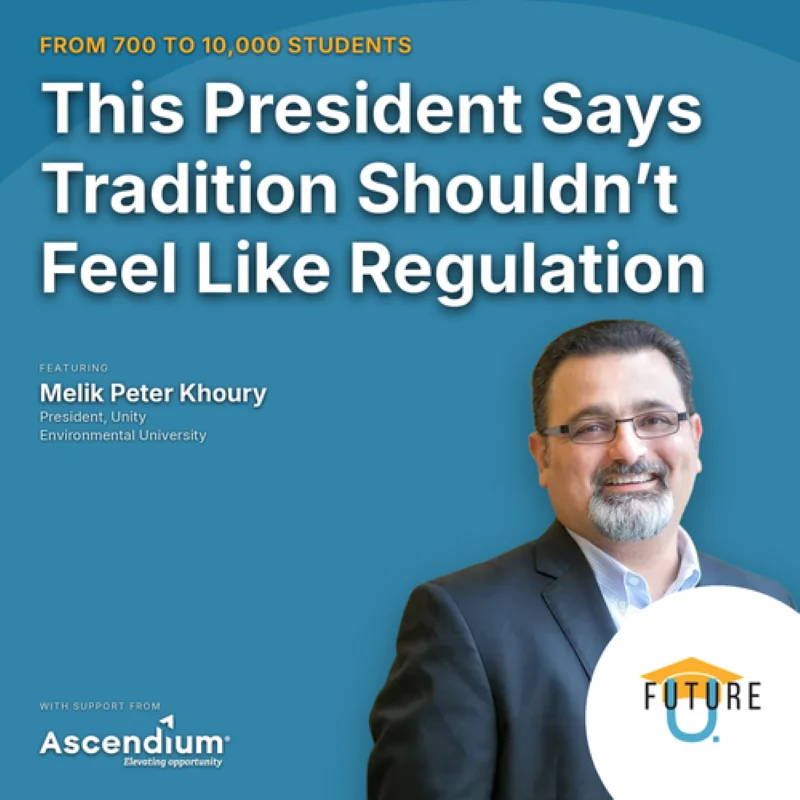
In the landscape of American higher education, small, rural private colleges are frequently depicted as an endangered species. Beset by demographic cliffs, rising operational costs, and the increasing lure of urban, prestige-heavy institutions, many such schools face an existential crisis. However, the narrative of inevitable decline is not universal. At Unity Environmental University in Maine, President Melik Peter Khoury has authored a blueprint for survival that defies traditional academic orthodoxy, shifting a struggling, 700-student campus into a robust, online-first powerhouse serving more than 10,000 learners.
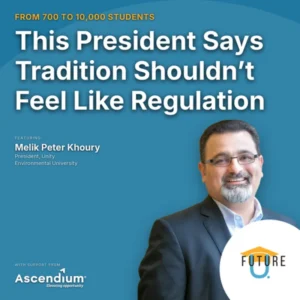
In a recent appearance on the Future U podcast, hosted by Michael Horn and Jeff Selingo, Khoury articulated a philosophy of radical pragmatism. His approach—which involves dismantling legacy governance models and prioritizing the evolving needs of the modern student over the comfort of institutional inertia—offers a provocative glimpse into the future of the American degree.
The Main Facts: A Pivot Toward Sustainability
The core of Unity’s transformation lies in a total rejection of the "place-based" mandate. For decades, Unity functioned as a traditional, small-scale environmental college in the rural Northeast. Recognizing that the institution was approaching a financial precipice, Khoury initiated a strategic overhaul that decoupled the university’s mission from its physical geography.
By investing heavily in digital infrastructure and instructional design, Unity transitioned into an online-focused institution. This move was not merely a technological upgrade; it was a fundamental shift in business model. By expanding the potential student base from a regional radius to a global digital footprint, the university achieved the scale necessary to subsidize its mission-driven research and operations. This pivot enabled Unity to transcend the limitations of its rural Maine location, proving that niche, mission-driven education can thrive if it sheds the overhead of traditional campus-centric models.
Chronology: A Decade of Disruption
The path to Unity’s current success was neither linear nor uncontroversial. The chronology of this transformation highlights a series of decisive, often painful, strategic turns.
The Era of Stagnation (Pre-2015)
Prior to the leadership shift, Unity functioned like hundreds of other rural colleges. It was heavily reliant on residential tuition, facing stagnant enrollment numbers, and struggling to justify its tuition premium in an era where digital alternatives were beginning to gain credibility. The financial model was fragile, leaving little room for investment in innovation.
The Strategic Pivot (2015–2018)
Upon taking the helm, Khoury began identifying the "sacred cows" of higher education. He initiated a rigorous review of faculty roles, questioning why traditional tenure-track models were being applied to disciplines that required agile, industry-aligned instruction. During this period, the university began to pilot distance-learning programs, testing the appetite for environmental education delivered at a distance.
The Scaling Phase (2019–2021)
The COVID-19 pandemic served as a massive, unplanned stress test for the American higher education system. While many institutions scrambled to move lectures to Zoom, Unity was already equipped for digital delivery. The university leaned into this advantage, aggressively marketing its online programs and refining its instructional design to ensure that the quality of education remained high even as the student body grew by an order of magnitude.
The Maturity of the New Model (2022–Present)
Today, Unity stands as a hybrid institution. The physical campus remains a center for research and immersive field experience, but the engine of the university is its online division. With over 10,000 students, the university has successfully diversified its revenue streams, insulating itself from the enrollment fluctuations that continue to threaten other small private colleges.
Supporting Data: The Economics of Scale
The transformation of Unity is not merely a pedagogical success story; it is a triumph of institutional economics.
- Enrollment Velocity: Moving from 700 to 10,000 students represents a growth rate rarely seen in the private non-profit sector without mergers or acquisitions. This growth was achieved primarily through the acquisition of students in non-traditional demographics—working professionals, career changers, and students seeking flexible environmental science pathways.
- Operational Efficiency: By shifting toward a distributed faculty model and centralizing administrative functions, the university lowered the cost-per-student, allowing it to maintain competitive tuition rates while simultaneously increasing investment in academic technology.
- Market Alignment: Data from the university suggests that the demand for environmental literacy is growing faster than traditional, place-based institutions can accommodate. By focusing on environmental science and sustainability, Unity carved out a "blue ocean" strategy, avoiding direct competition with massive, multi-disciplinary state universities.
Official Responses: The Philosophy of Institutional Survival
Throughout the Future U conversation, Khoury was candid about the internal friction his changes caused. He noted that the most significant obstacle to institutional survival is often the internal culture of "employee preservation."
"Tradition shouldn’t feel like regulation," Khoury argued. He contends that many colleges are failing because they prioritize the comfort of the faculty and staff status quo over the changing realities of the students they serve. By shifting the focus to "student-centricity," Khoury made decisions that prioritized the sustainability of the institution over the preservation of legacy roles.
When challenged on the role of faculty, Khoury emphasized that the role of the professor must evolve from "gatekeeper of knowledge" to "facilitator of learning." In his view, the resistance to change in academia is often a defense mechanism against a world that is moving faster than the academic calendar.
Implications: Higher Education in the Age of AI
Perhaps the most prescient portion of the discussion centered on the role of Artificial Intelligence in the classroom. While many institutions have adopted reactive policies—ranging from outright bans on tools like ChatGPT to vague, cautionary warnings—Khoury advocates for a proactive, research-led engagement.
The Obligation to Research
Khoury posits that higher education institutions have a unique social responsibility to lead the conversation on AI. "We in higher ed have an obligation to stop being afraid of it," he noted. "And start to become the organization that has the objectivity to research it, understand it, embrace it."
AI as a Tool for Equity
The implication of this stance is significant: if universities treat AI as an adversary, they alienate students who will enter a workforce that is fundamentally defined by these technologies. Conversely, if universities integrate AI into the curriculum, they can become the "truth-tellers" of the digital age. They are the ones with the academic rigor to dissect AI outputs, analyze algorithmic bias, and teach students where the technology is dangerous—and where it is a force multiplier.
The Future of the Degree
Unity’s model suggests that the future of the university degree will be defined by "agile credentialing." As AI accelerates the rate of change in the labor market, the static four-year degree may become less valuable than a series of stackable, digital-first credentials. By embracing a model that is both environmentally conscious and digitally native, Unity is preparing its students for a future where adaptability is the primary currency.
Conclusion: A Blueprint for the Future
The success of Unity Environmental University serves as a stark reminder that institutional death is not inevitable for small colleges—but irrelevance is. Melik Peter Khoury’s tenure has demonstrated that a clear-eyed assessment of market needs, combined with a willingness to dismantle outdated governance structures, can breathe new life into struggling institutions.
As higher education faces a period of unprecedented volatility, the "Unity Model" offers a compelling, if disruptive, path forward. By treating technology as a tool rather than a threat, and by prioritizing the student’s future over the institution’s past, Unity has secured its place in the academic landscape. Whether other institutions have the political will to follow this path remains the central question of our time. For now, Unity stands as a beacon—proof that with the right leadership, the ivory tower can be rebuilt into a structure that is both stable, scalable, and deeply connected to the realities of the 21st century.
To hear more from Melik Peter Khoury and the Future U hosts, listen to the full episode here.