The AI Paradox: Why Classroom Technology Succeeds in Middle School and Falters in Higher Ed
The promise of artificial intelligence in education has long been framed as a binary: either the dawn of a personalized learning utopia or the beginning of an academic integrity crisis. However, new research from the University of Maryland suggests the reality is far more nuanced. Jing Liu, director of the Center for Educational Data Science and Innovation, recently released two pivotal studies that, when viewed in tandem, dismantle the notion that AI is inherently “good” or “bad.” Instead, they reveal a technology that is highly sensitive to context, user motivation, and pedagogical integration.
As educational institutions scramble to integrate large language models and tutoring bots into their curricula, the findings from these experiments serve as a sobering reminder that the success of a tool depends less on its code and more on the human ecosystem it inhabits.
Main Facts: A Tale of Two Deployments
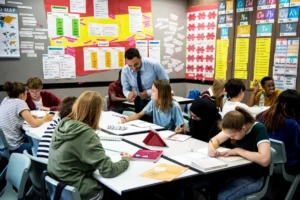
The two studies, both released in October, tracked the efficacy of AI across vastly different educational tiers. In the first instance, a math tutoring platform called "Goblins" was introduced to 6,000 middle schoolers in Deer Valley, Arizona. The software provided step-by-step guidance through a combination of text, virtual whiteboards, and spoken conversation. The results were cautiously optimistic: students who engaged with the platform consistently showed marked improvements in standardized math assessments.
In contrast, the second study examined a university-wide AI assistant deployed at the University of Maryland. Professors provided the bot with course-specific materials, including syllabi and readings, to assist students with queries. Despite the high-level intent, the results were detrimental: students in classes with the AI assistant experienced lower grades, reduced engagement with course materials, and a decline in participation in office hours and peer discussions.
These findings represent a critical juncture in ed-tech research. While the middle school experiment hints at the potential for AI to bridge learning gaps, the university study warns that without careful implementation, these same tools can actively erode the habits of mind necessary for deep learning.
Chronology of the Research
The journey toward these findings began with a deliberate effort by the University of Maryland to treat AI as a subject of rigorous empirical testing rather than a plug-and-play solution.
The Middle School Trial (2025-26 School Year)
- Rollout: Goblins was introduced to a diverse student body in Deer Valley, Arizona.
- Teacher Agency: Rather than a top-down mandate, teachers maintained control. They decided which problems to assign, ensuring the technology remained a supplement to, rather than a replacement for, classroom instruction.
- Engagement Strategy: The platform featured a cartoon avatar that allowed for verbal interaction, including multi-lingual support, which proved particularly effective for English learners and students with disabilities.
- Mid-Year Assessment: Researchers identified that students completing at least two problems per week—a specific, attainable "dosage"—correlated with higher year-end scores.
The Higher Education Experiment (Fall 2025)
- Randomized Assignment: Liu and his team randomly selected 15 professors to incorporate the university’s proprietary AI assistant, while another 15 served as a control group.
- Course Integration: The bot was embedded directly into Canvas, the university’s learning management system, providing 24/7 access to course materials.
- Observational Period: Throughout the semester, researchers tracked student interaction with the bot, overall course grades, and participation in academic activities.
- Post-Semester Analysis: By the end of the term, the data revealed that students in AI-integrated courses were performing worse than their peers, particularly those who were first-generation college students.
Supporting Data: The "Five-Percent Problem" and Performance Gaps
A recurring challenge in educational technology is the "five-percent problem"—the phenomenon where only a small fraction of students actually utilize a digital tool with the consistency required to see academic gains. The Goblins experiment highlights both the persistence and the potential mitigation of this issue.
In the middle school study, while 50 percent of the students hit the "two problems per week" threshold, only 6 percent achieved the more robust usage rate of 30 minutes per week. Despite this, the gains were statistically significant. Researchers at Accelerate, the nonprofit that commissioned the study, estimated that the performance increase equated to roughly three additional months of learning.
However, the university data paints a more concerning picture regarding equity. The AI assistant at the University of Maryland was utilized by only 15 percent of students in the experimental classes. The decline in grades for these students—an average of 0.11 points on a four-point scale—suggests that the mere presence of an AI assistant can be counterproductive.
Perhaps most alarming is the finding that the negative effects were more pronounced among first-generation college students. This data supports the hypothesis that rather than serving as an "equalizer," poorly integrated AI can widen the achievement gap by replacing the active struggle of critical thinking with the passive consumption of AI-generated answers.
Official Responses and Theoretical Interpretations
The leadership at the University of Maryland has been remarkably transparent regarding the failures of the university-level AI pilot. Provost Jennifer King Rice emphasized the danger of unintended consequences in a public statement, noting, "AI tools could exacerbate inequities in learning outcomes. That is particularly troubling to me."
Jing Liu offers a compelling theory on why the results diverged so sharply between middle school and college. In the middle school setting, teachers used the AI as a scaffolding tool—a conversational partner that helped students work through math problems. The "cartoon avatar" design created a sense of social accountability that mimicked a teacher-student relationship.
In the university setting, the assistant’s constant, passive presence on the Canvas portal likely sent an unintended signal to students: that the hard work of synthesis and problem-solving could be bypassed. Liu suggests that students likely used the university’s official bot as a gateway to more sophisticated, off-platform tools like ChatGPT or Claude, effectively outsourcing their cognitive labor to generative AI. This "offloading" of critical thinking is a well-documented hazard that can lead to atrophy in academic skills.
Implications for the Future of Ed-Tech
The contrast between these two studies provides a roadmap for the future of AI in the classroom.
1. The Necessity of Pedagogical Control
The Goblins study demonstrates that when teachers retain agency—assigning specific tasks and integrating the AI into the lesson plan—the technology functions as a force multiplier. When AI is introduced as a passive resource, as it was in the university study, it risks becoming a shortcut that degrades the educational experience.
2. The Danger of Passive Availability
Educational institutions must reconsider the "24/7 availability" model. By placing an AI assistant in the sidebar of a learning management system, universities may be unintentionally encouraging students to seek answers before they have attempted to engage with the material themselves.
3. The Need for Randomized Controlled Trials (RCTs)
The middle school results, while promising, are correlational. The students who chose to use Goblins might have been the more motivated students to begin with. As Liu notes, the field requires more randomized controlled trials to isolate the actual impact of AI from the baseline motivation of the student.
4. Equity as a Primary Metric
The fact that the university AI assistant disproportionately affected first-generation students is a warning sign. Future deployments must be evaluated not just on average performance, but on how they impact the most vulnerable students. If an AI tool requires a high degree of "digital literacy" or self-regulation to use effectively, it will almost certainly benefit students who already have those advantages, leaving others behind.
Conclusion: A Call for Caution and Transparency
The research conducted by Jing Liu and the University of Maryland is a significant service to the field of education. By making the failure of the university AI assistant public, they have provided a vital data point that contradicts the hype-driven narratives often surrounding ed-tech.
The lesson for educators, administrators, and developers is clear: AI is not a magic bullet. It is a powerful, potentially disruptive tool that requires rigorous, site-specific testing. We are currently in a transition period where the novelty of AI is masking its long-term impacts. As we move forward, the focus must shift from how we can deploy AI to how we can design environments where AI serves to challenge, rather than replace, the student’s intellect. The success of middle school math students proves that AI can work; the failure of the university pilot proves that it can also harm. The difference, it seems, lies in how we guide the student’s hand.