Beyond the Siren: Why School Safety Depends on What Happens Before the Emergency Begins
By the Editorial Staff
Published in Public Safety & Educational Leadership Journal
Main Facts: The Critical Opening Moments of a School Crisis
Imagine the opening moments of a school emergency. A teacher, caught in a high-stress environment, struggles to articulate a rapidly unfolding threat. A 911 dispatcher frantically tries to parse fragmented details from a panicked voice on the other end of the line. School administrators scramble to assess the scope of the incident, while law enforcement officers, firefighters, and emergency medical services (EMS) begin making tactical decisions based on whatever patchy information is immediately available.
In those crucial, chaotic opening seconds, the ultimate trajectory—and outcome—of the emergency is already being shaped.
For decades, the public perception of school safety has been anchored to the arrival of flashing lights and sirens. The prevailing narrative suggests that emergency response truly begins the moment police cruisers, fire engines, or ambulances pull onto a school campus. However, frontline public safety veterans know this assumption is fundamentally flawed.
According to Jason Klink, Lead Public Safety Integration Specialist at CENTEGIX and a veteran of the public safety sector with more than 30 years of experience as a firefighter, 911 dispatcher, supervisor, and emergency response technology professional, the exact opposite is true. The most effective, life-saving emergency responses begin long before an incident ever occurs. They are forged in the quiet months of peace through robust relationships, seamless communication protocols, and active coordination between schools and their surrounding communities.
To achieve this level of preparedness, educational institutions and public safety agencies must master three foundational pillars: speed, clarity, and coordination.
Chronology of a Crisis: How Seconds Dictate Survival
To understand why proactive preparation is vital, one must examine the chronological timeline of a typical school emergency. The timeline does not start when the first police car arrives; rather, it begins the split second an anomaly occurs inside a classroom or hallway.
Phase 1: Recognition and Internal Communication (Seconds 0–30)
An incident begins. Whether it is a medical emergency, an altercation, a localized fire, or an active intruder, the individuals closest to the threat must recognize it and initiate an internal alert. In traditional models, this involves a teacher finding a classroom phone, dialing an office extension, or attempting to trigger a legacy public address system. Every second spent searching for a device or trying to articulate a coherent message consumes precious time.
Phase 2: The 911 Bridge and Dispatch Triage (Seconds 30–90)
Once the alarm reaches school administration or is dialed directly to 911, the dispatch phase begins. One of the most pervasive misconceptions in public safety is that dialing 911 immediately translates to tactical action. In reality, dispatchers must actively interrogate the caller to determine what is happening, where it is happening on a sprawling campus, and what specific resources are required.
This process is inherently fraught with friction. Callers are frequently frightened, injured, or overwhelmed by adrenaline. Small, seemingly minor delays—such as struggling to describe a specific corridor, relaying information through a chain of administrative staff, or hunting for a mobile phone—accumulate rapidly.
Phase 3: Resource Mobilization and Transit (Minutes 2–10)
Only after dispatchers synthesize the incoming data can they mobilize first responders. For urban and suburban schools, transit times may be relatively short, but for rural facilities, geography poses a severe barrier. Once units are en route, they rely entirely on the quality of the data transmitted during Phase 2. If the initial location data is vague—such as simply knowing an incident is occurring "at the high school"—responders enter a state of tactical uncertainty, forced to waste critical minutes locating the precise room or courtyard.
Phase 4: Tactical Engagement and Mitigation (Minutes 10+)
First responders arrive on the scene, establish command, and execute intervention protocols. The success of this phase is almost entirely dependent on how effectively the previous three phases were executed. When speed, clarity, and coordination are optimized, responders transition instantly from arrival to resolution. When they are absent, chaos and confusion reign.
Supporting Data and Real-World Challenges
The challenges facing modern school safety are compounded by geographic realities, staffing shortages, and the inherent architectural complexity of modern educational facilities.
The Rural Divide and Staffing Realities
In rural communities across the United States, emergency response dynamics are vastly different from those in densely populated metropolitan areas. Rural schools often face profound geographic isolation and chronic public safety staffing shortages.
- Geographic Span: In many rural counties, a single law enforcement officer may be responsible for patrolling an area exceeding 100 square miles.
- Response Delays: EMS crews and fire departments may be stationed 20 to 30 minutes away from the campus.
- The Proactive Solution: Because secondary backup can be exceptionally far away, rural schools cannot afford reactive safety postures. They must rely on hyper-proactive coordination, advanced digital mapping, and clearly defined communication protocols to bridge the gap until first responders can arrive.
The Evolution of Campus Mapping
Technology has revolutionized how emergency services navigate complex environments, yet many schools still lag behind in integrating these tools. Recalling his early days in the fire service, Jason Klink notes that responders once relied entirely on bulky paper map books because GPS and mobile mapping technologies were unavailable.
"I experienced an emergency firsthand where our crew responded to a completely wrong location because an important update had not been made to our map pack," Klink recalls. "We lost valuable time simply trying to reach the right location."
In a modern school emergency, general location data is insufficient. Knowing an incident is underway at a high school campus is entirely different from knowing the exact floor, the specific classroom number, and the closest exterior access door to render aid. Modern digital mapping solutions bridge this gap, allowing dispatchers and responding agencies to visualize the campus layout in real time before their vehicles even roll onto the property.
Official Responses and Cross-Agency Collaboration
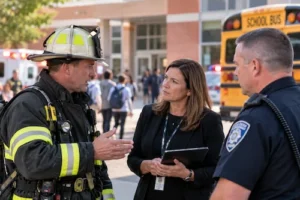
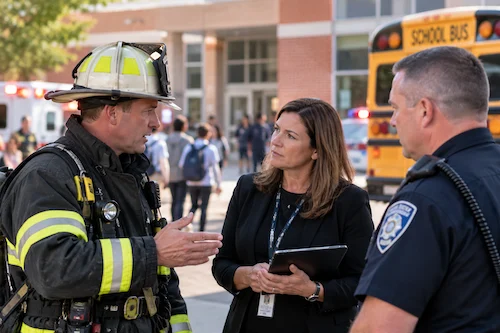
Achieving true emergency readiness requires breaking down historical silos between educational institutions and public safety agencies. Historically, schools operated independently of local police and fire departments, leading to a fragmented approach to crisis management. Today, industry experts emphasize that school safety is an interdisciplinary responsibility.
Synchronizing Multiple Responding Agencies
During a critical incident, a school campus becomes a convergence point for multiple distinct agencies:
- Local law enforcement (municipal police, county sheriff, state troopers)
- Fire and rescue personnel
- Emergency medical services (EMS) and paramedics
- School Resource Officers (SROs)
- School district administrators and principals
Each of these entities operates under unique standard operating procedures (SOPs) and tactical frameworks. Without prior coordination, simultaneous movement by these groups can lead to dangerous confusion.
When schools and public safety officials train together and share operational plans, they establish a unified language. Law enforcement knows where administrators will stage; firefighters know which access routes are designated for heavy apparatus; and dispatchers understand the specific terminology used within the school district. Operating from a single source of truth drastically reduces cognitive load during high-stress scenarios.
Implications for Educational Leaders and Policymakers
The paradigm shift from reactive crisis management to proactive community integration carries profound implications for school boards, administrators, and policymakers.
1. Relationships Over Binders
Too often, school safety compliance is treated as an administrative checkbox—exemplified by thick, dust-covered binders stuffed with emergency response plans that sit on a shelf and are reviewed once a year. Klink stresses that the strongest school safety programs are built not on paperwork, but on genuine human relationships.
Effective coordination requires schools to interact regularly with the local first responder community long before an alarm sounds. Joint walkthroughs, tabletop exercises, and open communication channels foster mutual familiarity and trust. When police officers know the layout of a middle school, when teachers recognize the local beat officers, and when dispatchers understand school facility layouts, the entire safety ecosystem functions with greater confidence.
2. Investing in Modern Communication Infrastructure
School districts must critically evaluate their current emergency communication systems. Investing in technology that reduces human error, bypasses convoluted relay chains, and instantly connects classrooms to 911 dispatch centers is no longer optional—it is a baseline requirement for modern student protection.
3. A Shared Community Responsibility
Ultimately, school safety cannot be outsourced entirely to teachers or police departments. It is a collective community responsibility. Emergencies are inherently unpredictable, but human preparation is entirely within our control. By investing in robust community partnerships, advanced communication tools, and rigorous, collaborative training, communities empower everyone involved to respond with greater speed, communicate with absolute clarity, and coordinate with unmatched effectiveness when every second counts.