Mastering the Blueprint of Instruction: A Comprehensive Guide to Effective Unit Planning

WASHINGTON — In the modern educational landscape, the quality of classroom instruction often hinges not on the improvisational charisma of the educator, but on the rigorous, methodical architecture of the lesson plan. For both novice and veteran teachers, the daunting task of structuring a cohesive unit of instruction can mean the difference between profound student engagement and systemic learning gaps.
To demystify this process, instructional experts are increasingly returning to foundational planning frameworks. By breaking down the daunting expanse of state standards, curriculum guidelines, and daily activities into manageable components, educators can build resilient pathways to student success.
Main Facts: Returning to the Fundamentals of Instructional Design
Instructional planning is undergoing a scrutinized re-evaluation as educators seek reliable methodologies to combat burnout and enhance academic outcomes. At the heart of this movement is a back-to-basics approach that operationalizes the unit-planning process into a reproducible, step-by-step formula.
The core premise is straightforward: rather than assembling daily lessons haphazardly—often the night before delivery—teachers are encouraged to anchor their units in a "backward design" framework. Popularized in the early 1990s by educational theorists Grant Wiggins and Jay McTighe in Understanding by Design, this model requires educators to establish their destination before charting the journey.
This systemic approach addresses a chronic vulnerability in modern education: the disconnect between broad academic standards and the daily classroom experience. By bridging standards, curricula, and individual units through a three-step blueprint, educators can ensure that every minute of class time serves a distinct, measurable purpose.
Chronology: The Evolution of a Unit Plan
To understand how a unit comes to life, it is helpful to trace the lifecycle of instructional design. The planning process follows a deliberate chronological sequence, moving from macro-level goals down to micro-level daily tasks.

Phase 1: Conceptualizing the Big Picture (The Macro Level)
The planning lifecycle begins well before the school year starts, typically with the examination of course goals or state standards.
- Defining Standards: Standards represent the broad declarative and procedural goals students must master (e.g., "Practice safe food handling and kitchen safety").
- Curriculum Mapping: The curriculum takes these expansive standards and clusters them into logical "units"—the overarching groups of knowledge and skills taught over several days or weeks. For instance, a semester-long cooking course might be divided into six distinct units: food safety, kitchen tools, cooking techniques, meal preparation, nutrition, and budgeting.
Phase 2: The Backward Design Sequence (The Unit Level)
Once a specific unit—such as a short, three-to-four-day module on food safety—is isolated, the backward design process kicks into gear across three distinct steps:
- Step 1: Setting Measurable Objectives. The educator defines observable student behaviors. Instead of vague concepts like "understanding safety," objectives specify actions, such as identifying cross-contamination or determining safe internal cooking temperatures.
- Step 2: Designing the Summative Assessment. Before planning a single worksheet or lecture, the teacher creates the final evaluation tool. For a food safety unit, this might be a scenario-based open-response test where students troubleshoot fictional kitchen blunders.
- Step 3: Planning the Daily Lessons. Only after the destination (the assessment) and the milestones (the objectives) are locked in does the teacher build the day-to-day learning activities.
Phase 3: Implementation and Differentiation (The Micro Level)
In the final phases of instructional rollout, teachers deliver the sequenced lessons while continuously monitoring formative progress, culminating in the summative assessment and subsequent instructional adjustments.
Supporting Data: The Anatomy of Instructional Planning
To visualize how abstract standards translate into concrete classroom practice, educational planners rely on detailed structural matrices.
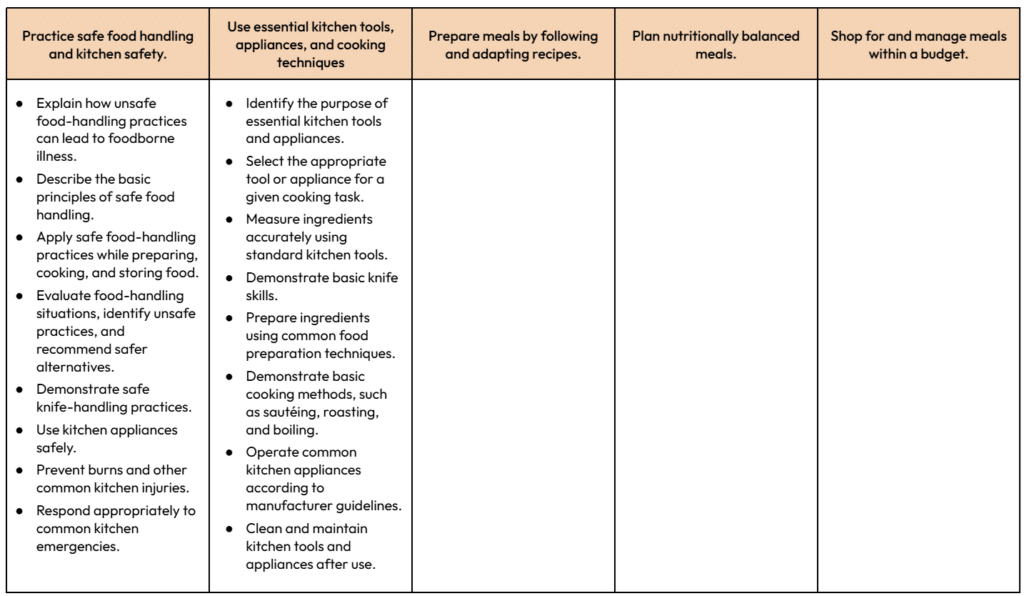
Consider a hypothetical adult education course entitled Cooking Fundamentals. The course is built around five overarching goals:
- Understanding basic kitchen safety and sanitation.
- Utilizing essential kitchen tools, appliances, and techniques.
- Preparing everyday meals independently.
- Applying basic nutritional principles to meal planning.
- Managing grocery shopping and food budgeting effectively.
When mapped onto a curriculum chart, Goal #2 alone (using kitchen tools and techniques) branches out into 15 to 30 specific appliances, alongside complex lists of mechanical skills and thermal cooking methods. Without a structural unit framework, this data deluge can easily overwhelm both teacher and learner.
By isolating a subset of these data points—specifically, the food-handling subset of Goal #1—an educator can synthesize a micro-unit. The supporting data for this targeted unit includes:
- Unit Safe Food Handling.
- Essential Question: How do your choices in the kitchen affect the safety of the food you prepare?
- Measurable Objectives: Four distinct, observable student outcomes focusing on contamination prevention, temperature control, and hygiene.
- Assessment Metric: A scenario-based analytical test measuring applied knowledge rather than rote memorization.
Official Responses and Expert Perspectives: Addressing the "Teaching to the Test" Dilemma
The adoption of backward design is not without historical debate in educational circles. Critics have long leveled a specific charge against assessment-first models: Does this constitute "teaching to the test"?
In traditional educational discourse, "teaching to the test" is viewed pejoratively. It conjures images of educators drilling students on arbitrary, external standardized tests over which teachers have no creative control, sacrificing genuine comprehension for algorithmic test-taking strategies.
However, proponents of backward design argue that the model flips this critique on its head.
"When backward design is executed effectively, we are technically ‘teaching to the test,’ yes," educational specialists note. "But that ‘test’ is a well-designed assessment we created ourselves based on high-quality learning objectives. It is a good test—so planning lessons to engineer student success on that test is not a bad thing. It’s a way to ensure that learning is actually happening."
Furthermore, pedagogical experts emphasize that the "test" in question need not be a traditional multiple-choice examination. It can manifest as a performance task, a physical demonstration, a multimedia presentation, or a collaborative project. By designing this authentic artifact first, teachers guarantee alignment between their aspirations and their execution.
Experienced educators also stress that foundational planning models are not exclusively for novices. While pre-service teachers rely on these frameworks to establish baseline competency, veteran teachers utilize structured unit planning to audit their existing materials, eliminate redundant content, and revitalize stale curricula.
Implications: The Future of Teacher Preparation and Student Achievement
The implications of disciplined unit planning extend far beyond individual lesson plans, touching upon teacher retention, instructional equity, and overall student achievement.
Combating Teacher Burnout
One of the primary drivers of educator attrition is the chronic stress of ad-hoc planning. When teachers are forced to invent daily lessons on the fly, the cognitive load accumulates rapidly, leading to exhaustion and diminished instructional quality. By establishing a repeatable, three-step unit-design process—objectives first, assessment second, lessons third—educators can reclaim their planning time and approach the classroom with intellectual confidence.
Promoting Equitable Learning Outcomes
When instruction is untethered from clear, measurable objectives and backward-designed assessments, classrooms often fall prey to "activity traps"—lessons that are engaging and fun but yield little measurable academic growth. A rigorous planning framework ensures that every student, regardless of their background, is exposed to a coherent trajectory of skill acquisition that directly targets core standards.
Professional Growth and Digital Evolution
As professional development shifts toward flexible, self-paced digital environments—exemplified by modern online professional learning initiatives—teachers increasingly have access to modular tools that deconstruct complex pedagogical theories into actionable steps. Whether through professional learning communities or self-directed coursework, the emphasis is moving away from static lesson templates and toward dynamic, responsive unit architecture.
Ultimately, mastering the lesson plan is about honoring the craft of teaching. By respecting the sequence of standards, curriculum, units, and daily lessons, educators transform the chaotic expanse of academic content into an accessible, navigable journey for every student in the room.