Beyond the Hype: Stanford’s AI Hub Challenges the Conventional Approach to Classroom Technology
In the rapidly shifting landscape of modern education, the arrival of generative AI has triggered a gold rush of technological adoption. Yet, for Chris Agnew, the managing director of Stanford University’s AI Hub for Education, the industry’s current trajectory is missing the mark. Operating under the university’s SCALE Initiative, the Hub is working to pivot the conversation from "what can these tools do?" to "what should we be accomplishing for our students?"
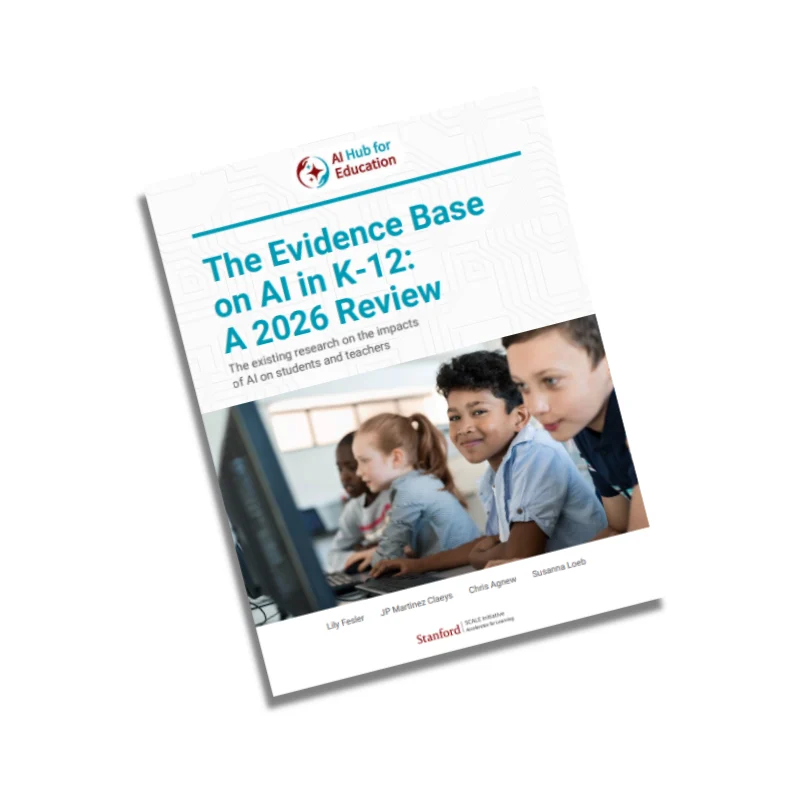
Since its founding in January 2025, the Hub has served as a critical clearinghouse for research, aiming to translate academic rigor into practical guidance for K-12 leaders navigating the AI revolution. Through its inaugural report, Understanding the Evidence Base on AI in K–12, and its recent collaborative effort, The Learning Experiences that Matter and AI’s Role, the Hub is setting a new standard for how schools should evaluate the promise—and the peril—of artificial intelligence.
The Genesis of the AI Hub: Bridging the Gap Between Experience and Tech
Chris Agnew’s path to leading the AI Hub was forged through two decades of work in non-traditional education. His career, which spanned outdoor classrooms, community-based apprenticeships, and hands-on learning environments, left him with a deep-seated frustration: the most impactful forms of education—those that are immersive, experiential, and highly personalized—are often prohibitively expensive.
"I left that space feeling frustrated," Agnew notes. "I knew that immersive, experiential, relevant learning was impactful for kids, but it’s way too expensive to be accessible to all."
When the public release of ChatGPT occurred, Agnew was already working in ed-tech, utilizing early generative tools as formative assessment mechanisms. This background provided him with a unique vantage point: he saw not just a new chatbot, but a technological lever that could finally break the structural barriers keeping high-quality, personalized education out of reach for the average public school student.
Chronology of a Shifting Paradigm
The timeline of AI integration in schools has moved with unprecedented speed, often outpacing the capacity of administrators to vet these tools effectively.
- Early 2025: The Stanford AI Hub for Education is formally established to bridge the gap between academic research and K-12 implementation.
- Mid-2025: The Hub publishes its comprehensive review of the AI research landscape, identifying a massive disparity between the abundance of post-secondary data and the scarcity of rigorous K-12 evidence.
- Late 2025: The Hub releases the first-of-its-kind, rigorous study on AI literacy tutors, tracking 355 students across five after-school programs and two school districts.
- Early 2026: Publication of The Learning Experiences that Matter and AI’s Role, co-authored with Stanford colleagues Susanna Loeb and Cristina Barnard Gonzales, marking a fundamental shift in how policymakers are asked to view AI procurement.
The "Purpose-First" Framework
Most discussions regarding AI in education follow a "tools-first" logic: a new software emerges, and districts rush to integrate it, hoping it will modernize the classroom. Agnew and his colleagues argue this is a fundamental error.
"It can be very tempting with any new tool—a chalkboard, a smartboard—to start with the shiny object and figure out all the ways it can plug in," Agnew says. "But that tools-first approach risks locking us into a system of schooling that was designed more than a century ago."
The Hub’s framework suggests starting with the fundamental question: What is school for? By isolating ten key markers of student success—including higher-order thinking, social-emotional health, and academic knowledge—the researchers identified five pillars of high-quality learning:
- Personalized Instruction
- Real-world Learning
- Student Agency
- Enriching Discussions
- Supportive Relationships with Adults
Once these goals are defined, the inquiry shifts to identify the historical constraints preventing their implementation: rigid staffing, narrow accountability metrics, and inflexible curricula. Only then, Agnew argues, should we examine how AI can solve these specific bottlenecks.
Supporting Data: What the Research Actually Says
One of the most sobering aspects of the Hub’s work is its honest assessment of the current evidence base. The research landscape is thin, particularly regarding elementary-age students.
The Hub’s recent study on AI literacy tutors yielded findings that countered many industry assumptions. In a sample of 355 elementary students, researchers discovered that nearly half of the participants never utilized the AI tutor, even when the software was integrated into their dedicated, supervised schedules. Furthermore, while pairing a student with a human tutor increased engagement with the AI, it did not lead to a statistically significant improvement in reading achievement.
However, the data for educator-facing AI is more optimistic. Research indicates that AI tools can significantly reduce the "mental load" on teachers, automating routine administrative tasks and providing feedback on instructional practices. Notably, the impact appears most significant for early-career or lower-rated educators, suggesting that AI could act as a professional equalizer.
Implications for Policy and Procurement
A major hurdle for schools is the capitalist market structure. Because school districts are individual consumers, ed-tech companies are incentivized to build tools that fit into existing, antiquated school models rather than tools that facilitate radical innovation.
"AI products are often built to fit into how schools already work because that’s what makes them adoptable," Agnew explains. "This creates a gap between what might be possible in the long run and what gets built and used today."
To remedy this, the Hub advocates for a shift in leadership. Rather than individual teachers experimenting in isolation, Agnew calls on state-level agencies to consolidate their influence. By signaling a preference for long-term, structural AI integration—such as dynamic grouping based on real-time mastery rather than birthdays—states can force the private market to innovate toward better student outcomes rather than incremental, short-term efficiency.
Expert Guidance: Action vs. Hesitation
For district leaders feeling the pressure to "do something" about AI, Agnew offers a clear roadmap:
Act Now:
- Educator Support: Lean into AI tools that save teachers time and provide meaningful, formative feedback on teaching practices. This is where the evidence base is strongest and where the risk of student harm is lowest.
- Policy and Privacy: Ensure that foundational guardrails regarding student data and clear usage policies are ironclad before allowing any AI interaction in the classroom.
- Experimentation: Run small-scale, teacher-led experiments to identify which tools actually improve classroom dynamics.
Hold Off:
- Unsupervised Student Use: Avoid deploying AI tools where students interact with the model without a "caring adult" in the loop.
- The "Panacea" Trap: Do not adopt AI under the assumption that it will solve deep-seated educational problems in isolation.
The Future: Beyond the Screen
As the industry debates the merits of "screen time," Agnew believes the conversation is fundamentally misdirected. He points to the rapid advancement of voice-based and multimodal AI as evidence that the "screen" may soon be an obsolete metric.
"We could soon be in a world where screen time has gone way down but engagement with technology has exploded because kids are interacting with AI through voice," he notes.
The ultimate challenge for the next decade of education is to move away from the binary debate of "technology versus traditionalism." Instead, by focusing on "screen value"—measuring how effectively technology enables human connection, critical thinking, and student agency—schools can begin to build a system that finally uses innovation to serve the student, rather than forcing the student to adapt to the limitations of the tool.
As Stanford’s AI Hub continues its research, its core message remains consistent: the potential of AI is not in its ability to replace the classroom, but in its capacity to finally allow us to design one that works for everyone.