The Dismantling Debate: House Committee Advances Plan to Decentralize the U.S. Department of Education
In a landmark legislative move that signals a seismic shift in the federal government’s role in schooling, the House Education and Workforce Committee voted on Wednesday to advance a 10-bill package aimed at fundamentally restructuring the U.S. Department of Education. Proponents characterize the legislation as a necessary step toward "right-sizing" the federal footprint, while critics warn it serves as a blueprint for the eventual abolition of the department, threatening to fragment critical services for students nationwide.
The bills seek to codify a series of existing interagency agreements that have already begun shifting core operational functions—such as grant management, technical assistance, and reporting requirements—from the Education Department to other federal agencies. While the legislative package does not immediately dissolve the department, it establishes a permanent legal framework for relocating its responsibilities, effectively stripping the agency of its central oversight powers.
The Core Legislative Strategy: A Move Toward Fragmentation
The strategy employed by Republican committee members is to systematically migrate specific legal and operational responsibilities out of the Education Department and into the portfolios of other federal entities. The 10-bill package specifically targets programs involving K-12 academic support, career and technical education (CTE), and the administration of the massive federal student loan portfolio.
By moving these functions, the legislation seeks to bypass the centralized bureaucracy of the Education Department. Supporters argue that this approach allows specialized agencies—which may be better equipped for specific functional tasks—to manage resources, while simultaneously reducing the department’s overall influence and scale.
Chronology of the Shift: From Informal Agreements to Statute
The legislative push follows a period of aggressive administrative action under the current administration, which has prioritized the use of interagency agreements to circumvent traditional departmental channels.
- Early Implementation: The Department of Education began utilizing interagency agreements to streamline operations, currently holding 14 such agreements across six different federal agencies. These were initially presented as efforts to reduce red tape and increase efficiency.
- The Markup Phase: On Wednesday, the House Education and Workforce Committee engaged in a day-long, contentious markup session. Republican leadership pushed the 10-bill package through the committee on a party-line vote.
- The Rejection of Guardrails: During the process, the committee’s Republican majority rejected a series of Democratic amendments. These proposed safeguards would have required the department to provide formal progress reports, establish funding guardrails, and ensure adequate staffing levels to maintain continuity during the transition of these programs.
- The Path Forward: The bills now move to the full House of Representatives for a floor vote. Should they pass the House, they face a significantly more hostile environment in the Senate.
Supporting Data and Rationale: The "Failure" Narrative
Committee Chair Tim Walberg (R-Mich.), a primary architect of the legislative package, framed the initiative as a direct response to a "failed" system that has ceased to deliver value to the American public. During the committee hearing, Walberg presented a series of sobering statistics to justify the need for structural change:
- Academic Stagnation: Walberg noted that fewer than one-third of 8th graders in the United States currently demonstrate proficiency in reading or mathematics at their respective grade levels.
- Higher Education Instability: Citing concerns over the quality and return on investment of higher education, Walberg pointed out that 40% of students fail to graduate within a six-year window.
- The Debt Crisis: The committee focused heavily on the department’s $1.7 trillion student loan portfolio, noting that over 9 million borrowers are currently in default—a statistic that Republicans argue demonstrates gross mismanagement of taxpayer funds.
"The status quo isn’t working," Walberg stated. "When the department consistently fails to improve outcomes for the students it was created to serve, we have a moral and fiscal responsibility to re-evaluate its very existence."
The Battle Over Efficacy: Conflicting Accounts
The debate during the markup session highlighted a sharp divide in how members view the efficacy of the interagency agreements already in practice.
Chair Walberg lauded the partnership between the Office of Career, Technical and Adult Education (OCTAE) and the U.S. Department of Labor. He reported that since the partnership began last year, over 5,000 payments totaling $1.5 billion have been processed for grantees.
However, Representative Suzanne Bonamici (D-Ore.) provided a starkly different account of the same partnership. According to Bonamici, the transfer of OCTAE functions to the Labor Department has resulted in "significant" funding delays that have hampered schools and programs across the country. Furthermore, she detailed reports of Education Department staff stationed at the Labor Department struggling with basic operational hurdles, including the inability to access necessary software and internet connectivity, which she described as a major disruption to day-to-day work.
Official Responses and Political Implications
The legislative package has elicited strong reactions from both sides of the aisle and from various education advocacy groups, reflecting a deeply polarized view of the role of federal oversight.
The Administration’s Stance
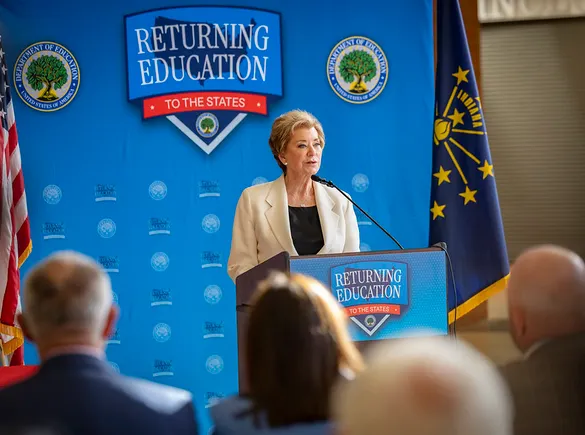
U.S. Education Secretary Linda McMahon issued a statement praising the committee’s decision. "Today’s bills move us closer to a leaner, results-driven government—one that empowers families, supports educators, and delivers better outcomes for students by ensuring each federal responsibility is carried out by the agencies best equipped to manage them," McMahon said. The administration maintains that these moves hand control back to state and local education systems.
The Opposition
Democratic leadership in the House and Senate have vowed to block the legislation. Ranking committee member Rep. Bobby Scott (D-Va.) argued that the transfers are not only "impractical" but also represent an "abdication of the federal government’s responsibility" to protect students regardless of their demographic or economic background.
Scott also drew attention to a curious omission in the bill package: the absence of provisions transferring special education and civil rights activities. While some of these functions are being shifted via interagency agreements, the committee did not codify them into law. Scott suggested that the exclusion was a calculated political move, stating, "Perhaps that’s because even my colleagues recognize how politically unpalatable such transfers would be."
In the Senate, the path for these bills appears all but blocked. Senator Patty Murray (D-Wash.) stated unequivocally on the social media platform X: "Under NO circumstances will I let these bills pass the Senate."
Broad Implications: Efficiency vs. Fragmentation
The debate over these bills has exposed a fundamental disagreement regarding the nature of bureaucracy.
Advocates, such as Jeanne Allen, CEO of The Center for Education Reform, argue that the legislation is a vital tool for stripping away "overreaching bureaucracy" that has historically stifled innovation and limited parental choice. From this perspective, the current department is a relic that serves to impede local education systems rather than support them.
Conversely, organizations like the National School Boards Association (NSBA) see the move as a dangerous trend toward administrative collapse. Verjeana McCotter-Jacobs, CEO of the NSBA, warned that the bills would "codify chaos" by rubber-stamping a fragmented federal approach. "While local school boards support efforts to streamline government, shifting core educational programs across disparate federal agencies does not eliminate bureaucracy—it fragments it," McCotter-Jacobs stated.
Conclusion: A Future in Flux
As the 10-bill package heads to the House floor, the nation is left with a stark choice between two competing visions of education governance. One vision favors a decentralized, agency-specific approach that aims to minimize federal intervention, while the other defends a centralized federal role as the essential guarantor of equity and civil rights in American schools.
With no companion legislation currently pending in the Senate and a firm veto threat from key Democratic leaders, the bills serve more as a political manifesto than an imminent policy shift. Nevertheless, the committee’s vote marks a significant escalation in the ongoing efforts to redefine the federal government’s involvement in education—a debate that is likely to intensify as the national conversation on student outcomes and administrative accountability continues to grow.