
Beyond the Binary: Reimagining the Role of Assessment in Modern Education

In the high-stakes environment of modern K-12 education, clarity is the currency of success. Educators, administrators, and policymakers are constantly seeking tools that can accurately pinpoint where a student stands and provide a roadmap for where they need to go. However, a persistent layer of confusion has clouded the discourse surrounding student assessment, particularly regarding the industry-standard distinction between "norm-referenced" and "criterion-referenced" testing.
For years, these terms have been treated as labels for specific types of tests—as if a test were born with one of these identities stamped on its cover. According to assessment experts at NWEA, this is a fundamental misconception. By shifting the focus from the "type" of test to the "utility" of the data, schools can move beyond unproductive debates and toward a more evidence-based approach to student growth.
The Myth of the "Norm-Referenced Test"
The central fact that requires clarification is this: There is no such thing as a norm-referenced or criterion-referenced test.
"Principled assessment design starts with the questions we want to answer about students," explains Adam Withycombe, principal assessment connections content designer at NWEA. "The assessment itself isn’t ‘norm’ or ‘criterion’ referenced; those distinctions come from the claims we make and the reference points we use to interpret results."
When we label a test as "norm-referenced," we are describing a specific method of interpretation. We are looking at a student’s performance in relation to a broader peer group—a snapshot that tells us how a child is performing compared to others. Conversely, a "criterion-referenced" interpretation gauges a student’s mastery against a set of fixed standards, such as state-mandated grade-level proficiency benchmarks.

The reality is that most robust, modern assessments are hybrid instruments. They utilize the same pool of questions to generate both types of insights. By decoupling the terms "norm" and "criterion" from the test itself and applying them to the measurement of data, educators gain the freedom to use assessment results for multiple, complementary purposes.
A Chronology of Assessment Evolution
The confusion between these two terms is rooted in the history of psychometrics. In the mid-20th century, assessments were largely categorized by their intended use: either to rank students (selection/placement) or to ensure mastery (curriculum-based instruction).
- The Industrial Era (Mid-20th Century): Assessments were predominantly norm-referenced, designed to compare students to the "average" to determine rank for university admissions or special programming.
- The Standards-Based Movement (1990s–2000s): With the rise of federal accountability mandates, such as the No Child Left Behind Act, the focus shifted sharply toward criterion-referenced assessments. The priority was determining whether students met specific state content standards.
- The Data-Driven Integration (2010s–Present): Modern assessment platforms, such as NWEA’s MAP Growth, emerged to bridge the gap. By leveraging large-scale data sets, these tools can provide both a norm-referenced look (to understand student trajectory) and a criterion-referenced look (to ensure alignment with state proficiency standards).
The Anatomy of Modern Measurement: Supporting Data
To understand why the "norm vs. criterion" debate is often a distraction, one must look at the data architecture behind tools like MAP Growth. Every question presented to a student is aligned to specific, individual state standards—this is the criterion-based measurement. It identifies whether the student has mastered the content required for their grade level.
Simultaneously, the resulting score—the RIT scale—is processed against the world’s largest normative data pool. This allows educators to see how that student compares to millions of peers, providing context for their academic trajectory.
The Precision-Diagnostic Balance
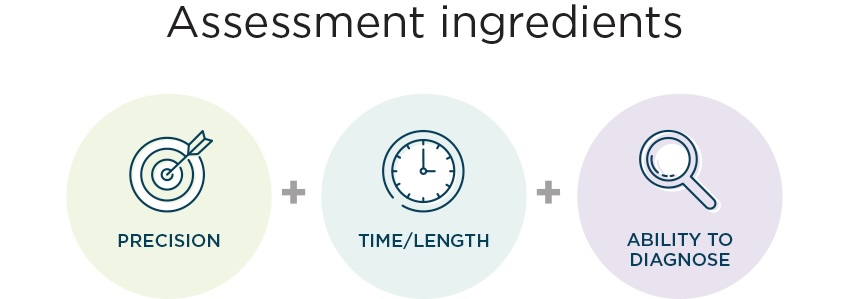
Reliability is the backbone of any valid assessment. In the world of psychometrics, designers must balance three competing factors:

- Precision: How much error is in the score?
- Time/Length: How much instructional time is lost to testing?
- Ability to Diagnose: How granular is the feedback?
Data shows that the sweet spot for this balance occurs at approximately 43 questions. If a test is too long, student fatigue compromises the data. If it is too short, the margin of error increases significantly. For instance, NWEA’s internal studies show that MAP Growth maintains a variance of roughly three points on the RIT scale, compared to 9–10 points in less precise assessments. This difference is not merely academic; a 10-point swing can be the difference between a student receiving necessary intervention services or being incorrectly placed in a general classroom.
Official Perspectives: Trust and Utility
The leadership at organizations like NWEA emphasizes that instead of obsessing over labels, administrators should be asking two critical questions: How much can I trust the assessment? and Can it effectively guide instruction?
Official policy positions suggest that trust is built through longitudinal accuracy. If a test is not reliable, it cannot be a foundation for decision-making. If an educator cannot trust that a score today will be comparable to a score tomorrow, the data becomes noise rather than signal.
Furthermore, the utility of the assessment is measured by its "instructional connectivity." A score that sits in a spreadsheet is useless. A score that acts as a key to unlock personalized learning tools, however, is a transformative asset. Currently, many large, diverse, and rural districts are using this integrated data to feed into over thirty instructional platforms, effectively automating the personalization of learning for every student.
Implications for the Classroom
What does this mean for the teacher on the front lines? It means that the "norm vs. criterion" debate is, for all intents and purposes, a false binary that hinders progress.
1. From "What" to "How"
The implication of moving beyond this binary is a shift in mindset. Teachers should stop asking, "Is this a norm-referenced test?" and start asking, "What does this data tell me about my student’s mastery, and how does this compare to their peers?" This creates a 360-degree view of the student.
2. The Power of Choice
Assessment providers are now increasingly offering an ecosystem of choices. By allowing the results of a single assessment to transfer seamlessly into diverse instructional tools, educators can customize their intervention strategies. This means that a student struggling with fractions isn’t just marked as "below grade level" (criterion) or "below their peers" (norm); they are immediately connected to a targeted instructional module that addresses their specific knowledge gap.
3. Protecting Instructional Time
By prioritizing the balance of precision and length, schools can reclaim time. When an assessment is accurate and diagnostic, teachers do not need to administer multiple, disjointed tests throughout the year. A single, well-designed, adaptive assessment can fulfill the requirements of both administrative accountability and classroom instruction.
Conclusion: Defining Your Values
As the educational landscape continues to evolve, the tools we use must be as agile as the students we serve. If we define our values as Precision, Utility, and Clarity, we find that the old debates—like the one between norm- and criterion-referenced testing—simply do not hold weight in a high-functioning classroom.
Ultimately, the most important question is not how we categorize the test, but how we use the information it provides to prepare students for their next great adventure. By focusing on reliable, actionable, and connected data, educators can stop guessing and start leading. The future of assessment is not about labels; it is about the power of the insights we choose to act upon.