NEW YORK — For decades, the standard educational narrative surrounding institutional change has featured a familiar antagonist: the resistant teacher. Whenever school districts introduce
new curricula, novel pedagogical frameworks, or systemic administrative shifts, a subset of educators invariably pushes back. Traditionally, instructional coaches and school leaders have viewed this friction through a deficit lens—diagnosing the objecting educator as uncooperative, inflexible, or simply set in their ways.
However, a paradigm-shifting new book by veteran educator, author, and consultant Elena Aguilar is challenging this orthodox view. In How to Coach Resistance: Turning Pushback Into Possibility—her ninth publication dedicated to the craft of teaching—Aguilar posits that resistance is rarely a one-sided failure of will. Instead, she argues, it is an interactive relational dynamic, a friction co-created by both the teacher and the coach.
This conceptual reframing offers profound implications for modern educational leadership, suggesting that by altering their own approaches, instructional leaders can transform adversarial pushbacks into gateways for genuine professional growth.
Main Facts: Redefining Resistance in Educational Coaching
The core premise of Aguilar’s work is that what educational leaders commonly label as "resistance" is actually a dynamic feedback loop between two participants. When a coach applies pressure by advocating for a specific change, and a teacher responds defensively, both parties enter an adversarial stance defined by mutual anxiety.
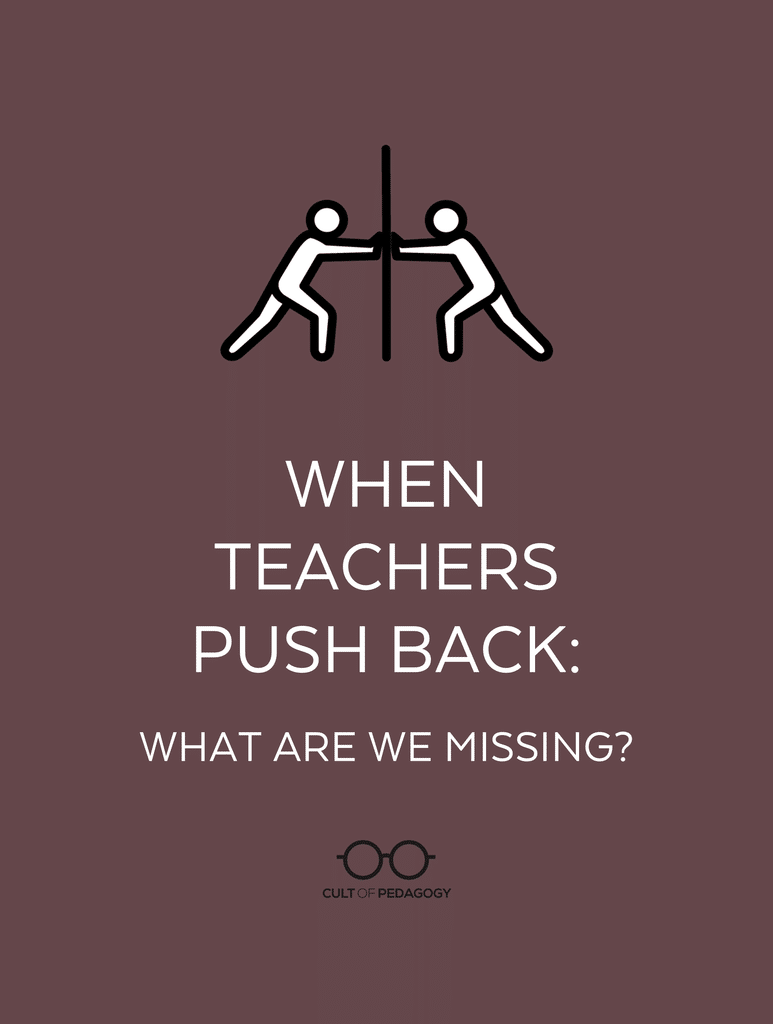
The Relational Dynamic: Resistance does not live solely inside the teacher; it is generated in the space between the coach and the coachee. Aguilar illustrates this using the physical metaphor of two hands pushing against one another. If the coach wishes to de-escalate the tension, they must simply "drop their hand"—ceasing to exert direct pressure and instead pivoting toward curiosity.
The ACE Framework: To help leaders navigate the emotional undercurrents of pushback, Aguilar introduces the ACE model: Acknowledge emotions, Cultivate compassion, and Expand the story.
The Gaps Framework: When instructional barriers persist, Aguilar identifies six distinct growth areas—skill, knowledge, capacity, will, emotional intelligence, and cultural competence—moving past the lazy assumption that an uncooperative teacher simply lacks the "will" to succeed.
Righteous Resistance: The framework explicitly validates that not all pushback is obstructionist. At times, teacher resistance is a legitimate, ethical response to policies that are pedagogically unsound or developmentally inappropriate.
Chronology: The Evolution of Elena Aguilar’s Coaching Philosophy
To understand the weight of How to Coach Resistance, it is necessary to trace Aguilar’s decades-long footprint in the educational sphere through her consulting organization, Bright Morning Consulting, and her extensive body of written work.
The Early Foundations: Long before penning her landmark texts on coaching, Aguilar spent years in classrooms and as an instructional coach in urban public schools. Witnessing firsthand the immense emotional toll taken on educators navigating top-down mandates, she recognized a glaring void in professional development: while districts provided endless technical training, they largely ignored the emotional realities of adult learning.
The Art of Coaching (2013): Aguilar published her foundational text, establishing systematic frameworks for instructional coaching. This work laid the groundwork for viewing coaching not merely as technical oversight, but as transformative, equity-centered relational work.
Onward (2018) and The PD Book (2022): Through subsequent books, Aguilar dove deeper into educator resilience, emotional exhaustion, and the design of effective professional development. She consistently built a bridge between systemic educational reform and internal emotional intelligence.
The Release of How to Coach Resistance (Fall 2026): Culminating years of observations on why standard coaching interventions stall out, Aguilar released her ninth book. The text codifies years of field research into actionable strategies for school leaders facing entrenched adult opposition, coinciding with a widespread national conversation on teacher burnout and retention.
Supporting Data: The Adult Learning Landscape and Educator Retention
While the dynamics of coaching are intensely personal, the broader systemic data surrounding school leadership, teacher autonomy, and professional burnout underscore why Aguilar’s intervention is arriving at a critical juncture.
According to recent national educational labor trends:
The Burnout Crisis: Over 40% of instructional coaches and school administrators report that managing educator resistance is one of the most mentally draining aspects of their roles, frequently leading to administrative fatigue and turnover.
The Misdiagnosis of Deficits: Studies in adult professional development indicate that upwards of 70% of initial resistance to new curricular rollouts is misdiagnosed by leadership as a "will" issue (unwillingness to change), when subsequent analysis reveals it is actually a "capacity" or "knowledge" gap (lack of appropriate training or time).
The Power of Relational Trust: Research highlighted by educational organizations demonstrates that teachers who feel psychologically safe—where their concerns are met with inquiry rather than disciplinary mandates—are nearly three times more likely to successfully implement new instructional strategies sustainably over a three-year period.
Official Responses and Expert Perspectives
The educational community has responded enthusiastically to Aguilar’s reframing of pushback, viewing it as a vital corrective to decades of compliance-driven school management.
"If you don’t want to experience resistance, drop your hand," Aguilar explained during a recent in-depth interview on the Cult of Pedagogy podcast. "Stop exerting your own pressure against their pressure. This doesn’t mean that we have to agree with them… but it means we can get curious and we can build a relationship and we can stop pushing."
Educational leadership experts have echoed these sentiments, noting that traditional top-down accountability models have historically alienated frontline teachers. By shifting the locus of control back to the coach’s own behavior, Aguilar’s methodology removes the blame dynamic.
As Aguilar notes in her text: "This is not to blame you… It is the most hopeful thing I can tell you, because it means resistance is not fixed. It is determined at least in part by what you bring into the room, and what you bring is something you can change."
Reviewers have also praised the practical utility of the ACE framework. By encouraging coaches to acknowledge raw emotions—such as fear or shame—without requiring them to act as clinical therapists, the model bridges the gap between empathy and instructional accountability. Furthermore, the introduction of the Gaps Framework has been heralded as a breakthrough for department heads and principals struggling to untangle why veteran teachers balk at cross-disciplinary reading initiatives or complex math programs. When evaluated systematically, a teacher’s refusal is often unmasked as a completely reasonable plea for foundational professional learning.
Implications: Transforming School Culture from the Inside Out
The release of How to Coach Resistance carries far-reaching implications for K-12 education, moving well beyond the traditional one-on-one coaching dynamic.
1. A Shift from Compliance to Collaboration
For generations, school reform has relied heavily on compliance models: directives are handed down from district offices, monitored by principals, and enforced by coaches. When teachers resist, administrative levers—ranging from poor performance evaluations to formal reprimands—are often pulled. Aguilar’s work suggests that this compliance model is fundamentally broken for adult learners. True instructional transformation requires shifting from a culture of compliance to a culture of partnership, where a coach signals, "I’m not here to judge you. I want to be a partner. I want to help you work through this."
2. Elevating the Emotional Intelligence of Leadership
Historically, educational leadership preparation programs have focused on logistics, budgeting, and legal compliance, treating emotional intelligence as an afterthought. Aguilar’s frameworks demand a radical upskilling of administrators and instructional coaches. Leaders must learn to regulate their own nervous systems, recognizing when their defensive posturing is exacerbating a colleague’s anxiety. Self-compassion is highlighted as a non-negotiable prerequisite; a coach who cannot speak kindly to themselves about a difficult professional day cannot authentically invite a coachee to do the same.
3. Legitimizing Institutional Critique
Perhaps the most culturally significant implication of Aguilar’s thesis is its validation of "righteous resistance." By conceding that some administrative directives are genuinely unviable, developmentally inappropriate, or pedagogically flawed, the framework gives voice to frontline educators who often feel gaslit by systemic mandates. It calls upon coaches and leaders to act as advocates, helping teachers navigate channels to push back against harmful policies rather than forcing silent compliance.
Moving Forward
Ultimately, Aguilar’s work serves as a timely reminder that schools are human ecosystems. When instructional coaches trade defensiveness for curiosity, and judgment for compassion, the entire architecture of professional development changes. Pushback ceases to be a brick wall blocking progress; instead, it becomes a flashing indicator light, pointing directly toward the exact emotional, structural, and intellectual support that educators need to thrive.