Beyond the Gateway: Rethinking Equity, Readiness, and Timing in Eighth-Grade Algebra Placement
WASHINGTON — For decades, the middle school mathematics pathway has served as one of the most consequential sorting mechanisms in American public education. At the center of this academic crossroads sits Algebra 1, universally recognized as the foundational gateway to advanced secondary coursework, college readiness, and long-term participation in science, technology, engineering, and math (STEM) fields.
Yet, year after year, school district leaders, principals, and counselors face a high-stakes dilemma: Which eighth-grade students are genuinely prepared to tackle Algebra 1, and which would benefit from a more deliberate, foundational build-up before making the leap?
Recent empirical research from the Northwest Evaluation Association (NWEA) suggests that traditional placement systems are falling short. Driven by a combination of subjective teacher recommendations, informal advocacy, and inconsistent criteria, districts nationwide are inadvertently shutting qualified students out of advanced math while pushing unprepared students into rigorous classrooms without the safety net of targeted interventions.
As educational equity takes center stage in policy debates, a growing body of data-driven research indicates that the question is no longer merely whether to accelerate or delay algebra. Instead, the focus must shift to how schools can deploy objective, evidence-based readiness benchmarks to ensure transparent, equitable access for every student.
Main Facts: The High-Stakes Calculus of Eighth-Grade Algebra
The debate over eighth-grade algebra placement is rooted in structural mathematics tracking that can alter a student’s academic trajectory before they even reach high school.
- The Gateway Effect: Algebra 1 is universally acknowledged as a critical gateway course. Success in eighth-grade algebra opens doors to advanced coursework such as Geometry, Algebra II, Precalculus, Advanced Placement (AP) Calculus, and AP Statistics. Conversely, missing this window can restrict a student’s access to rigorous high school diplomas and competitive post-secondary STEM pipelines.
- The Opportunity Gap: According to recent NWEA research analyzing national datasets, nearly one-quarter of students who are academically ready for eighth-grade algebra do not enroll in the course, even when it is readily available at their schools.
- The Flaws of Subjective Placement: Traditional course placement models have relied heavily on teacher recommendations, parent advocacy, historical enrollment patterns, and informal educator judgments. While these sources provide qualitative context, they frequently introduce implicit bias and systemic inequities, favoring students with vocal advocates over those who demonstrate objective academic readiness.
- The Objective Benchmark Alternative: To combat these disparities, researchers advocate for standardized, empirical metrics—such as those provided by the MAP Growth assessment—to define algebra readiness based on a student’s statistical probability of passing state end-of-course exams.
Chronology: How the Algebra Placement Debate Evolved
To understand the urgency of modern algebra placement reforms, it is helpful to trace how educational policy has approached middle school mathematics over the past several decades.
Late 20th Century: The Push for Acceleration
In the wake of sweeping educational reforms and global competitiveness reports, federal and state policymakers heavily pushed for the universal acceleration of middle school math. The prevailing wisdom dictated that getting students into Algebra 1 by the eighth grade was a non-negotiable prerequisite for higher education and high-tech workforce development. Schools rushed to cram advanced concepts into middle school curricula, often without establishing clear prerequisite competencies.
The 2010s: The Backlash and the Trap of Delay
As acceleration policies scaled rapidly, unintended consequences emerged. Pushing students into algebra prematurely—without adequate foundational preparation—led to soaring failure rates, widespread remediation, and plummeting student confidence. In response, many districts swung the pendulum in the opposite direction. Schools began delaying algebra enrollment for entire cohorts, operating under the assumption that an extra year of general mathematics would automatically cure foundational gaps and prepare students for rigorous high school math.
The Present Era: The Data-Driven Revolution
Today, educational researchers are leveraging longitudinal data and large-scale national studies to move beyond the simplistic binary of "accelerate versus delay." By tracking tens of thousands of students across multiple demographics, researchers are uncovering nuanced truths: delaying algebra does not automatically help struggling students catch up, and holding back ready students stunts their academic potential. Modern frameworks now emphasize precise, equitable, and objective readiness metrics to guide individualized placement.

Supporting Data: What the Research Tells Us
Recent empirical investigations conducted by NWEA researchers—utilizing national samples of approximately 55,000 students—shed light on the real-world impacts of algebra placement timing and achievement distribution.
1. Ready Students Shouldn’t Wait
A common argument for delaying algebra has been that an extra year of maturity and review benefits all students. However, the data strongly disputes this for high-achieving and on-track learners.
When researchers compared algebra outcomes for demographically and academically similar students who took the course in eighth grade versus ninth grade, those with stronger prior mathematics achievement consistently performed better when taking the course earlier. This advantage was pronounced across the upper half of the achievement distribution and reached its peak among the highest-achieving students. Delaying access for these students did not improve outcomes; rather, it curbed their academic momentum.
2. More Time Is Insufficient for Unprepared Students
Conversely, the data challenges the long-held assumption that struggling students automatically benefit from postponing algebra for a year. The NWEA study found that students in the lower half of the prior achievement distribution performed similarly whether they took algebra in eighth grade or ninth. More critically, these students generally remained below the algebra proficiency benchmark regardless of when they took the course.
This finding carries profound implications: simply delaying enrollment is never a standalone solution. Students who lack prerequisite skills require structural interventions, specialized instruction, targeted curriculum alignment, and ongoing academic support. An algebra placement decision alone cannot cure deep-seated learning gaps.
3. MAP Growth Benchmarks: Quantifying Readiness
To remove subjectivity from the equation, educational frameworks are increasingly turning to standardized assessment metrics. The MAP Growth Algebra 1 Placement Guide defines readiness through a statistical lens: a student is considered ready if they possess at least a 50% probability of reaching proficiency on their state’s Algebra 1 end-of-course (EOC) assessment.
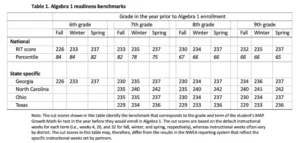
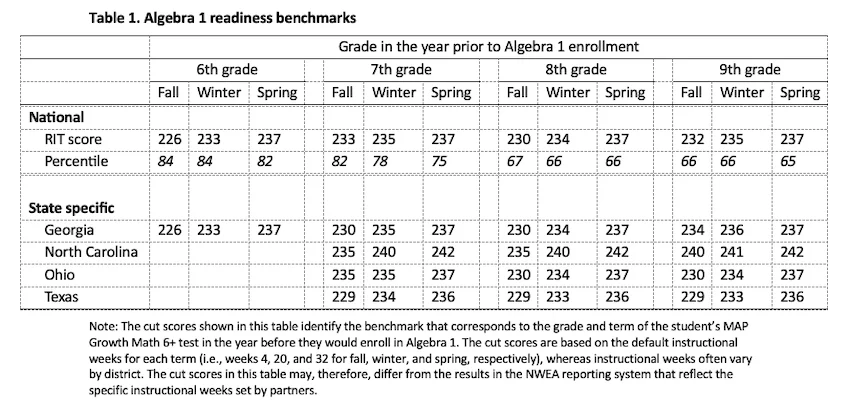
Using longitudinal data, researchers have established specific national and state-level MAP Growth RIT score benchmarks. For example, considering a student tested in the spring of seventh grade:
- National Benchmark: A RIT score of 237 (roughly corresponding to the 75th percentile).
- State-Specific Variations: While Georgia and Ohio align closely with the national benchmark, Texas utilizes a slightly lower benchmark (236), whereas North Carolina requires a higher score (242) to meet the 50% proficiency probability threshold.
Experts emphasize that these benchmarks are not rigid gates or absolute guarantees of success. Instead, they serve as objective, reliable guideposts to supplement local educator judgment and ensure that capable students are not overlooked.
Official Responses and Stakeholder Perspectives
Educational leaders, policymakers, and psychometricians are increasingly vocal about the need to reform antiquated course placement systems.

Dr. Angela Miller, a senior research scientist at NWEA, emphasizes that course placement must be reframed as an equity issue rather than merely a scheduling logistical challenge.
"Algebra placement is not simply a scheduling decision; it is an opportunity decision," notes the NWEA research team. "Thoughtful placement systems should focus on identifying readiness, expanding opportunities for qualified students, and providing meaningful supports for those who need additional preparation."
School administrators across the country are echoing these sentiments. In progressive districts adopting objective readiness protocols, superintendents report a noticeable decrease in equity gaps. By removing subjective teacher nominations—which historically suffered from unconscious bias regarding which demographics "belong" in advanced math—districts have witnessed a diversification of their eighth-grade algebra classrooms without sacrificing academic rigor.
At the same time, teacher associations and curriculum specialists stress the importance of resource allocation. Educators caution that identifying ready students via standardized tests is only half the battle; schools must simultaneously invest in robust intervention systems for students who fall below the benchmarks, ensuring that equity does not translate into setting unprepared students up for failure.
Implications for the Future of Mathematics Education
The shift toward evidence-based algebra placement carries sweeping implications for school districts, state education agencies, and higher education pipelines.
1. Reforming District Placement Policies
School districts must audit their current placement policies to eradicate reliance on informal, opaque criteria. By integrating objective diagnostic tools—such as MAP Growth readiness benchmarks—alongside local classroom performance measures, districts can establish transparent, auditable pathways that build trust among parents, students, and educators.
2. Moving Beyond Tracking to Targeted Support
For students who do not meet readiness thresholds, school leaders must discard the passive strategy of merely "waiting a year." Institutional investment must pivot toward high-dosage tutoring, co-taught algebra support classes, and enhanced foundational skill-building. The goal must be acceleration through preparation, rather than exclusion through delay.
3. Expanding the STEM Pipeline
Ultimately, getting algebra placement right has monumental downstream effects. When districts systematically identify and nurture every qualified student into eighth-grade algebra, they widen the talent pool entering advanced secondary mathematics. This ripple effect directly expands college and career readiness, fostering a more diverse and prepared generation of future innovators, scientists, and engineers.