
Beyond the Prompt: Why Modern Education Must Shift From AI Literacy to Radical Human Judgment
By eSchool Media Contributors
Published: Career Readiness & Education Insights
Main Facts: The New Reality of the AI-Driven Labor Market
As artificial intelligence systems become increasingly sophisticated, educational institutions worldwide are locked in a frantic race to integrate AI tools into their curricula. From elementary classrooms utilizing interactive chatbots to universities deploying advanced machine learning models for research, the rush to achieve "AI literacy" has become a central pillar of modern academic planning. However, educational experts and labor economists are warning that teaching students how to use AI is no longer enough.
The true differentiator in the 21st-century workplace will not be the ability to generate prompts or execute machine-assisted tasks. Instead, the competitive advantage will increasingly belong to individuals who possess superior critical judgment—those who can instantaneously evaluate whether an AI output is genuinely useful, critically incomplete, or factually dangerous.
Recent labor data underscores this urgent paradigm shift. According to the latest findings from the Stanford Digital Economy Lab, the employment landscape for young professionals is undergoing a seismic restructuring. The employment shortfall for U.S. workers aged 22 to 25 operating in highly AI-exposed occupations widened significantly, jumping from a 15 percent deficit in July 2025 data vintages to a striking 19 percent by June 2026. The underlying mechanism driving this gap is clear: the entry-level tasks that traditionally served as the foundational stepping stones for young careers—such as baseline data entry, initial research summaries, and routine drafting—are precisely the tasks that generative AI can execute first, fastest, and cheapest.
To safeguard the future workforce, schools must fundamentally evolve. Rather than treating AI merely as an instructional shortcut or a banned substance, educational systems must reposition generative AI as a "practice partner for judgment." This means shifting the pedagogical focus away from the final product—the essay, the code block, the solved equation—and toward the cognitive process of vetting, questioning, and refining machine-generated output.
Chronology: How the Educational Crisis and AI Integration Unfolded
To understand how the education sector arrived at this critical juncture, it is necessary to examine the rapid timeline of AI adoption and its subsequent impact on labor and pedagogy.
- Late 2022 – Throughout 2023: The Initial Disruption
Generative AI burst into the public consciousness with the widespread availability of large language models. Schools initially reacted with alarm, focusing heavily on academic integrity, plagiarism detection, and outright bans on AI tools in classrooms. - 2024: The Pivot to AI Literacy
As bans proved unsustainable, educational institutions shifted strategies. The consensus emerged that students needed to learn how to use AI tools responsibly. Curricula across the globe began introducing "AI literacy" modules, teaching students how to write prompts, utilize productivity extensions, and understand basic machine learning concepts. - 2025: Emerging Labor Market Realities
Economic data began reflecting the friction between automated capabilities and entry-level employment. The Stanford Digital Economy Lab released its early tracking metrics, identifying a notable employment contraction among young workers in highly AI-exposed fields, as corporations began automating entry-level administrative and analytical tasks. By mid-2025, the shortfall for young workers hit 15 percent. - 2026: The Deepening Shortfall and Pedagogical Reckoning
Data vintages released in June 2026 revealed that the employment shortfall for workers aged 22–25 in AI-vulnerable sectors expanded to 19 percent. This numerical proof forced policymakers and educators to realize that basic AI proficiency was failing to protect young graduates. The conversation shifted decisively from AI technical training to cognitive resilience and human judgment, inspiring new frameworks for K-12 and higher education reform.
Supporting Data: Economic Insights and Labor Market Vulnerabilities
The quantitative backing for this educational pivot is anchored heavily in labor economics and empirical research. The data tracking young adult employment in the United States provides a sobering look at how automation is altering career entry points.
The Stanford Digital Economy Lab Findings
The Stanford Digital Economy Lab’s ongoing monitoring of AI’s labor market footprint offers critical benchmarks for educators. When analyzing occupations characterized by high exposure to generative AI capabilities—such as junior copywriters, entry-level data analysts, administrative assistants, and junior programmers—researchers observed a widening gap in employment metrics for workers aged 22 to 25:
- July 2025 Baseline: A 15 percent employment shortfall for young workers in high-exposure roles compared to historical trends.
- June 2026 Update: A widened 19 percent shortfall, demonstrating that the displacement of entry-level tasks is accelerating rather than stabilizing.
Why Entry-Level Roles are Disproportionately Affected
The core vulnerability of young workers lies in the nature of early-career progression. Historically, professions relied on a apprenticeship model where junior employees performed routine, highly structured tasks. These tasks allowed them to build domain knowledge slowly over time.
Because generative AI excels at pattern recognition, rapid summarization, and syntax generation, it absorbs these routine entry-level tasks instantaneously. When corporations realize an AI tool can draft baseline market research reports or write foundational code templates in seconds, the demand for human junior labor to perform those specific chores plummets. Consequently, young professionals are entering a labor market where the traditional rungs of the career ladder have been sawed off, demanding that they operate with mid-level critical thinking skills right out of the gate.
Official Responses and Expert Perspectives: Rethinking Classroom Pedagogy
Educational leaders, researchers, and system administrators are actively responding to these economic signals by reimagining how daily classroom instruction should function in an AI-saturated world.
Redefining the Assignment Structure
Experts argue that traditional assignments—such as writing a standard five-paragraph essay or solving a textbook math problem with a single correct answer—are obsolete in an era where an AI can complete them in three seconds.
Instead, educators are advocating for a progressive framework where AI is explicitly invited into the workspace, but only as a sparring partner for critical thought:
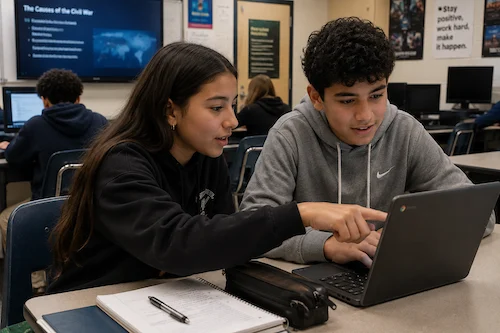
- AI as a Research Assistant: A student can use AI to summarize background information on a complex historical event. However, the graded assignment requires the student to actively identify what crucial evidence, perspectives, or marginalized voices the AI omitted.
- Challenging Assumptions: In science classrooms, AI can propose a hypothesis or a solution to a complex environmental problem. The student’s task is not to copy the answer, but to systematically test its underlying assumptions, check for logical fallacies, and run counter-simulations.
- Defending Positions: When AI drafts a persuasive argument, students must compare the machine’s sources against verified academic literature, weigh opposing economic or ethical tradeoffs, and defend a finalized, nuanced human position.
A Scalable Developmental Progression
This pedagogical shift is not designed exclusively for higher education; it requires a developmentally appropriate K-12 pipeline:
- Elementary School: Students compare an AI-generated answer with a trusted, vetted textbook passage, learning to spot factual discrepancies and explain why the texts differ.
- Middle School: Learners navigate conflicting evidence sets—some human-curated, some machine-generated—and must justify which sources they choose to trust and why.
- High School: Students tackle messy, career-connected case studies that feature no single correct answer. They are required to document their decision-making trail, explaining how they integrated AI tools without outsourcing their own independent reasoning.
Systemwide initiatives are increasingly emphasizing that career readiness is a continuous progression. Recent educational updates stress that AI should serve to strengthen rather than replace human expertise. As routine production is offloaded to algorithms, schools must reclaim instructional time to focus on the reasoning, empathy, and accountability that machines fundamentally cannot own.
Implications: Building a Resilient, AI-Proof Workforce
The ultimate goal of modern education is no longer to turn every student into a machine learning engineer or an AI specialist. Rather, the objective is far more profound: to make students harder to fool and faster to develop.
As organizations navigate the complexities of the automated labor market, the skills that command premium compensation are those deeply rooted in human agency.
Key Metrics for Future-Ready Learners
To evaluate whether educational systems are successfully adapting to this reality, schools must shift their assessment criteria. Success should be measured by a learner’s ability to:
- Rigorously verify empirical claims and challenge unchecked assertions.
- Recognize systemic exceptions, edge cases, and cultural nuances that algorithms miss.
- Proactively ask for missing information and identify what data points are absent from a dataset.
- Clearly communicate uncertainty, nuance, and probability in high-stakes environments.
- Take personal responsibility and moral ownership for a final conclusion or decision.
The Bottom Line
The best preparation for an AI-shaped labor market is not simply granting students unfettered exposure to more technology. It is providing them with deliberate, structured practice in making difficult, ethical, and analytical decisions when AI is actively sitting in the room. By transforming the classroom into an incubator for critical judgment, educators can ensure that the next generation of workers does not get replaced by the machines they use, but instead leads them with wisdom, discernment, and authority.