Beyond the Red Pen: Why Educators Must Pivot From Grading Final Products to Guiding the Writing Process
By Educational Insights Desk
Published: Fall 2024
Main Facts
In the modern classroom, the traditional red pen hovering over a finalized, stapled essay has long been the gold standard of writing instruction. However, a growing body of educational research suggests that this end-product-focused approach may be missing the forest for the trees. According to recent insights from educational experts and decades of cognitive science, prioritizing feedback on the writing process—rather than just the final product—yields exponentially better outcomes for students.
Writing is not a linear exercise of outlining, drafting, and editing in a neat, predictable sequence. Instead, it is deeply recursive. Grounded in the foundational cognitive models established by Linda Flower and John Hayes in 1981, writing requires students to fluidly shift between planning, drafting, and reviewing. When educators shift their focus to guide students through this dynamic, iterative loop—and provide formative, growth-minded feedback along the way—they foster self-regulation, support multilingual learners, and build trusting classroom cultures that dramatically improve student achievement.
Chronology: From Linear Assumptions to the Recursive Reality
To understand the modern pedagogical shift toward process-based feedback, one must examine how instructional theories have evolved over the last half-century.
- The Mid-to-Late 20th Century (The Linear Model): For decades, writing instruction followed a rigid, assembly-line structure. Students were taught to map out an outline, complete a first draft, fix mechanical errors, and produce a final second draft. Every assignment followed the exact same predictable, chronological steps.
- 1981 (The Recursive Breakthrough): Researchers Linda Flower and John Hayes revolutionized composition theory by proposing the recursive model of writing. Their cognitive research demonstrated that writers do not move in a straight line; rather, they constantly cycle through planning, goal-setting, drafting, and revising, adapting their strategies based on discoveries made mid-sentence. Over the subsequent decades, Flower and Hayes—alongside other cognitive scientists—revised their models multiple times, proving that writing is fundamentally a problem-solving act.
- The Turn of the 21st Century: Educational psychology increasingly linked academic success to self-regulation—the capacity to manage thoughts, behaviors, and environments. Researchers began identifying the cyclic feedback loops inherent in self-monitored writing.
- Present Day (The Digital and Formative Era): Today, educators balance traditional writing instruction with digital supports and AI tools. Current pedagogical frameworks, such as Douglas Fisher and Nancy Frey’s "4 C’s of Feedback" (care, credibility, clarity, and communication), emphasize building student-teacher trust and framing feedback to encourage active revision rather than passive compliance.
Supporting Data and Research
The argument for process-oriented feedback is heavily backed by quantitative and qualitative educational research:

- Self-Regulation and Feedback Loops: Studies in educational psychology indicate that proficient writing relies heavily on a student’s ability to self-regulate environment, behavior, and personal cognition. Traditional feedback methods that rely strictly on grades often short-circuit these self-reflection loops.
- Multilingual Learners and Strategy Diversity: A 2024 meta-analysis published in Education Sciences highlighted that multilingual learners employ distinct writing strategies, leveraging their full linguistic repertoires (including translanguaging) to navigate English composition. Furthermore, a broader synthesis of 25 studies revealed that non-native English speakers benefit significantly more from peer feedback and varied feedback formats (oral, written, and computer-based) than from traditional teacher corrections alone.
- The Power of Reframing: A landmark study involving seventh-grade students demonstrated the psychological impact of framing. When teachers attached a simple handwritten sticky note reading, "I’m giving you these comments because I have very high expectations and I know that you can reach them," students were 40% more likely to revise their essays and integrate the feedback. This intervention disproportionately boosted performance and trust among historically marginalized student demographics.
- Comments vs. Grades: Research consistently shows that qualitative written comments yield greater academic achievement and superior motivational outcomes compared to numeric or letter grades given in isolation. Formative feedback delivered during the active workflow helps students tie effort directly to success.
Official Perspectives and Expert Responses
Educational researchers and practitioners emphasize that the psychological framing of feedback is just as important as its technical accuracy.
Experts point out that students frequently misinterpret teacher feedback if expectations are not explicitly clarified. For instance, high school studies reveal that critiques of "word choice" are sometimes misconstrued as requests to arbitrarily use "bigger words" to impress the instructor, rather than an invitation to seek precision and clarity.
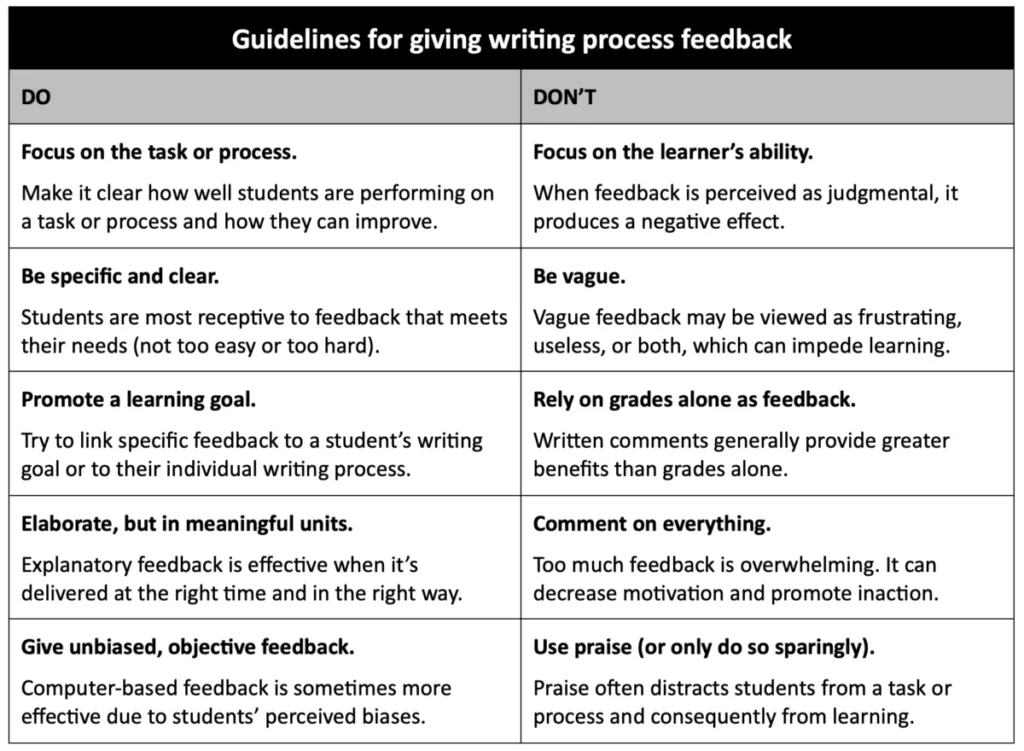
To combat these miscommunications, instructional leaders advocate for structured guidelines that steer teachers away from unhelpful habits. Educational guidelines advise educators to:
- Do: Focus on the writing task and process, be specific and clear, promote learning goals, elaborate on concepts, and provide unbiased, objective feedback.
- Don’t: Focus solely on innate learner ability, rely on vague commentary, use grades as the primary form of communication, over-correct every minor error, or rely on empty, overused praise.
By implementing frameworks that prioritize relational trust and clear communication, teachers transform feedback from a punitive grade into a collaborative dialogue.
Implications for the Future of Classrooms
The transition from product-based grading to process-based mentoring carries profound implications for schools, teachers, and students alike.

1. Transferability of Skills
When students receive guidance on how they plan, draft, and revise, those metacognitive skills naturally transfer to future writing tasks across all academic disciplines. Rather than memorizing corrections for a single essay, students develop a portable toolkit for tackling complex communication challenges throughout their academic and professional lives.
2. Practical Implementation for Educators
Classroom integration does not require an immediate, total overhaul of grading systems. Teachers can begin simply by deploying reflective self-assessments. By asking students to rate a series of process-oriented "I statements"—such as "I set clear goals before I start writing" or "I use strategies to get unstuck when I hit a mental block"—educators can spark meaningful, one-on-one writing conferences tailored to individual needs.
3. Embracing Technological Evolution
As artificial intelligence and digital writing assistants reshape the educational landscape, the mandate for process-based instruction becomes even more urgent. Modern technological supports are most effective when they do not simply write text for students, but instead encourage them to self-monitor, question, and refine their own thinking.
Ultimately, writing will always involve false starts, discarded drafts, and the cathartic urge to hit the delete button. But when educators illuminate the messy, recursive journey of writing with empathy, high expectations, and timely process-based feedback, those discarded drafts cease to be failures—they become the stepping stones to true mastery.