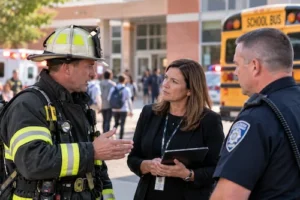
Beyond the Sirens: The Three Pillars of Modern K-12 School Safety and Emergency Response
By the Editorial Staff
Special Report on Public Safety and Educational Infrastructure
Main Facts: The Critical Opening Moments of a School Crisis
Imagine the opening seconds of a school emergency. A teacher, adrenaline surging, attempts to communicate an unfolding threat in real-time. A 911 dispatcher frantically gathers fragmented, critical information from a high-stress phone call. School administrators struggle to synthesize a chaotic ground-level situation, while police officers, firefighters, and emergency medical services (EMS) formulate tactical decisions based on whatever incomplete data is immediately available to them.
In those first, fleeting moments of an incident, the ultimate outcome of the emergency is already being shaped.
For decades, public perception has dictated that a school emergency response officially begins the moment sirens wail and police cruisers, fire trucks, or ambulances pull onto a campus. However, according to frontline public safety veterans, the exact opposite is true. The most effective, life-saving responses begin long before an emergency ever occurs. They are forged through robust community relationships, advanced communication technologies, and meticulous coordination between educational institutions and local first responders.
Industry experts emphasize that achieving peak institutional safety requires the mastery of three foundational pillars: speed, clarity, and coordination. Without these operational tenets firmly in place, even the best-resourced police and fire departments will face systemic hurdles that jeopardize student and staff safety.
Chronology: The Evolution of School Safety and the 911 Timeline
To understand how modern school safety functions, one must examine the chronological reality of how an emergency unfolds from the initial incident to the arrival of professional help.
Phase 1: Incident Recognition and the Internal Relay
The timeline begins the millisecond an emergency occurs—whether it is a medical crisis, an active threat, a severe weather event, or a structural hazard. Historically, a witness must identify the threat, locate a communication device (such as a classroom phone or personal cell phone), and dial 911. Alternatively, they may notify a school administrator, who then initiates a campus-wide announcement before calling authorities.
Each layer in this traditional internal relay introduces potential delays. Precious seconds—and sometimes minutes—are lost as information is passed through multiple intermediaries, filtered through panic, or hindered by locked doors and faulty communication hardware.
Phase 2: The 911 Dispatch Window
Once the call reaches a Public Safety Answering Point (PSAP), a 911 dispatcher enters a high-stakes information-gathering phase. A common misconception among the general public is that dialing 911 yields an immediate, automatic response. In reality, dispatchers must actively extract three vital pieces of information: what is happening, where it is happening, and what specific resources are needed.
This process is rarely instantaneous. Callers are frequently frightened, injured, panicked, or unable to accurately describe their surroundings. The dispatcher must triage the call, calm the caller, and translate verbal descriptions into actionable data that can be broadcasted to field units over the radio.
Phase 3: Resource Mobilization and Transit
Only after the dispatcher establishes the nature and location of the incident can first responders be dispatched. Officers, firefighters, and medics must acknowledge the call, don their gear, mount their vehicles, and navigate transit routes to the school campus.
In urban environments, this transit window may be relatively short, but in rural or geographically isolated districts, travel times can stretch significantly. Once on scene, responders must transition from transit to tactical execution, attempting to locate the exact seat of the emergency within a sprawling school complex.
Supporting Data and Real-World Challenges: Speed, Clarity, and Coordination
Jason Klink, Lead Public Safety Integration Specialist at CENTEGIX and a veteran of public safety with more than 30 years of frontline experience as a firefighter, 911 dispatcher, dispatch supervisor, and emergency technology professional, has witnessed the friction points in this timeline firsthand. Drawing from decades of emergency response experience, Klink outlines the systemic vulnerabilities that schools must address.
1. Speed: Shrinking the Time Between Incident and Intervention
"One of the biggest misconceptions about emergency response is assuming when someone calls 911, responders can immediately take action," Klink notes. "In reality, dispatchers must determine what is happening, where it is happening, and what resources are needed."
Even minor inefficiencies—such as searching for a misplaced phone, relaying information through multiple administrative layers, or struggling to articulate a chaotic situation—compound response times. To combat this, modern schools are increasingly adopting rapid-alert wearable technology and integrated emergency communication platforms that instantly bridge the gap between school staff and dispatch centers.
The mathematical reality is simple: the sooner first responders understand the exact parameters of a crisis, the sooner they can mobilize and deploy life-saving resources.
2. Clarity: Moving Beyond General Location Data
The transition from analog to digital mapping has revolutionized public safety, yet many schools still struggle with spatial clarity. Knowing that an emergency is occurring "at the high school" is vastly different from knowing the exact floor, wing, classroom, and nearest exterior access door required to render aid swiftly.
Klink recalls his early days in the fire service, long before smartphones and consumer mapping applications were ubiquitous. "We relied on paper map books because GPS and Google Maps were not at our fingertips," he shares. "I experienced an emergency firsthand where our crew responded to a completely wrong location because an important update had not been made to our map pack. We lost valuable time simply trying to reach the right location."
Today, modern emergency protocols require schools to collaborate directly with local GIS and public safety agencies. By providing responders with hyper-detailed digital indoor mapping and pre-planned operational data, dispatchers and field units can make informed tactical decisions before their vehicles even roll onto school grounds.
Furthermore, clarity is essential for multi-agency interoperability. During a major incident, law enforcement officers, fire personnel, EMS, school resource officers (SROs), and school administrators operate simultaneously. When all entities share a unified operational picture, inter-agency confusion drops precipitously, reducing the cognitive load on personnel during high-stress scenarios.
3. Coordination: The Power of Pre-Incident Partnerships
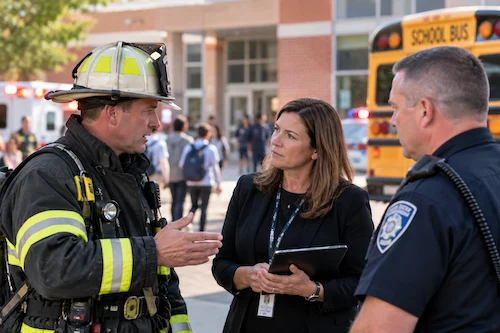
A safety binder sitting on a shelf does not stop a crisis. The most resilient school safety programs are built not on paperwork, but on active, sustained human relationships. Effective coordination requires schools to engage in regular, institutionalized interactions with the local public safety community long before an alarm sounds.
Effective coordination frameworks typically incorporate:
- Joint Training Exercises: Conducting active threat, fire, and medical drills alongside local police, fire, and EMS personnel to test response protocols in real time.
- Familiarization Tours: Hosting regular walkthroughs so that responding officers and firefighters are intimately familiar with campus layouts, blind spots, security systems, and administrative offices.
- Integrated Communication Protocols: Ensuring that school communication devices can interface seamlessly with local dispatch frequencies or emergency management software.
- Regular Stakeholder Briefings: Establishing routine dialogue between school superintendents, principals, safety directors, and local municipal emergency management officials.
These collaborative efforts foster mutual familiarity and deep trust. When first responders know the physical campus layout, school leaders understand tactical command structures, and dispatchers can harvest critical data efficiently, multi-agency teams operate with heightened confidence and synchronization.
Official Responses and Special Considerations: The Rural Safety Divide
While suburban and urban school districts often benefit from proximity to municipal police precincts and fire stations, rural communities face an entirely different set of operational challenges.
According to public safety analysts, rural schools experience acute vulnerabilities due to staffing shortages, expansive geographic territories, and extended transit windows. In some rural counties across the United States, a single law enforcement officer may be tasked with patrolling an area exceeding 100 square miles. Simultaneously, volunteer fire departments or EMS crews may be stationed 20 to 30 minutes away from the nearest campus.
In these environments, proactive coordination is not merely beneficial—it is a matter of survival. Rural schools must rely heavily on hardening their internal emergency postures, implementing advanced digital notification tools that alert authorities instantly, and establishing hyper-clear, localized response protocols that empower staff to manage initial containment until remote responders arrive.
State and federal safety agencies increasingly emphasize that rural districts must be prioritized in emergency grant funding, technological modernization, and regional planning initiatives to bridge the urban-rural safety divide.
Implications: A Shared Community Responsibility
The paradigm of school safety has shifted permanently. No longer can educational institutions view safety as a reactive box to check or delegate emergency preparation entirely to local police departments.
As Jason Klink observes, "In public safety, we often talk about situational awareness during an emergency, but effective preparation begins long before an incident occurs."
The implications of this shift are profound:
- For School Boards and Administrators: Budgetary allocations must prioritize integrated communication technologies, indoor mapping initiatives, and recurring joint training programs over superficial security theater.
- For Public Safety Agencies: Fire, EMS, and law enforcement leadership must prioritize school-specific familiarization and collaborative planning as a core operational duty rather than an auxiliary community outreach task.
- For the Broader Community: Parents, local businesses, and municipal leaders must recognize that school safety is a collective civic responsibility.
While society cannot predict or prevent every conceivable emergency, communities retain the absolute power to prepare for them. By investing in strong community partnerships, mastering the fundamentals of speed, clarity, and coordination, and leveraging modern emergency response technology, educational and public safety institutions can empower everyone involved to respond faster, communicate more clearly, and protect students when it matters most.