Mastering Instructional Design: A Comprehensive Blueprint for Effective Unit and Lesson Planning

By Education Desk
Instructional planning remains one of the most intellectually demanding and critical responsibilities educators face. Whether stepping into a classroom for the very first time with a freshly minted teaching degree or returning after decades of seasoned practice, the fundamental challenge of translating abstract educational standards into engaging, coherent daily lessons persists.
To address this evergreen challenge, educators are increasingly turning to streamlined, structured frameworks that demystify the design process. A newly launched professional development series and companion online course, Mastering the Lesson Plan, aims to provide a practical, field-tested blueprint. By breaking down the complexities of instructional design into manageable components, the initiative offers a reliable methodology for building units from scratch or revitalizing stagnant curriculum guides.
The Big Picture: Reimagining the Planning Process
At its core, effective teaching is not improvised; it is engineered. Yet, many educators—particularly new and pre-service teachers—find themselves overwhelmed by the sheer volume of content they are mandated to cover. Pacing guides, state standards, textbook chapters, and district benchmarks can create a labyrinth of competing priorities.
The newly introduced four-part instructional framework is designed to strip away the noise and return to basics. Rather than treating lesson planning as an administrative chore performed the night before delivery, the framework treats it as a strategic design process.
The strategy spans four distinct phases:
- The Big Picture & Unit Design: Establishing overall goals, organizing topics, and utilizing backward design.
- Assessment Planning: Designing balanced diagnostic, formative, and summative assessments to measure student mastery.
- Daily Lesson Construction: Translating unit goals into actionable, engaging day-to-day learning activities.
- Differentiation: Adapting instruction to ensure equitable access and challenge for diverse learners.
While these steps are foundational for novice teachers, education experts argue they are equally vital for veterans. Continuous critical reflection on how instruction is planned helps educators reinforce strengths and correct methodology drifts that inevitably occur over years in the classroom.
Defining the Terminology: Standards, Curriculum, and Units
Before an educator can successfully map out a course, a clear shared vocabulary is essential. Confusion often arises around the interchangeable use of terms like "standards," "curriculum," and "units."
To understand these distinctions, consider a hypothetical eight-week community education course titled Cooking Fundamentals, designed for adults learning to cook independently.
Standards: The Destination
The first step in any instructional design is determining the desired learning outcomes. In a self-created course, an instructor establishes broad goals independently. In a formal K-12 or higher-education system, these goals are prescribed by state, national, or local bodies—collectively known as standards.

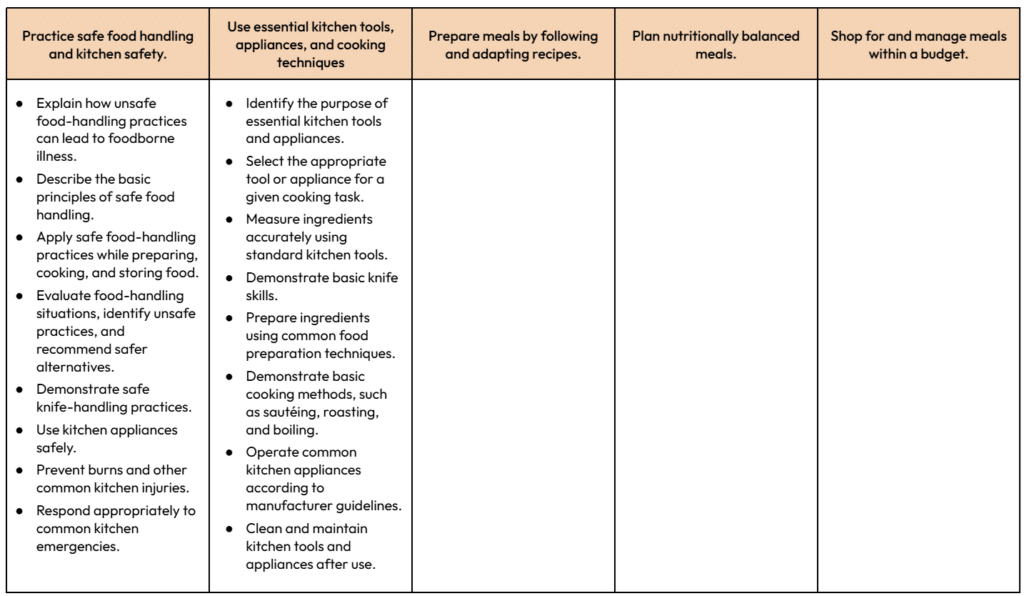
For the Cooking Fundamentals course, an instructor might establish five foundational standards:
- Mastering basic kitchen safety and food handling.
- Utilizing essential kitchen tools, appliances, and techniques.
- Preparing simple, everyday balanced meals.
- Understanding nutritional basics.
- Navigating grocery shopping and household budgeting.
These broad standards are rarely monolithic; they contain numerous subtopics and micro-skills. For instance, the standard concerning kitchen tools and techniques might encompass 15 to 30 distinct appliances, knife-handling skills, and thermal cooking methods.
Curriculum and Units: The Roadmap
While standards define what students must eventually know and be able to do, they do not dictate how to get there. That is the function of a curriculum.
A curriculum organizes and sequences the vast array of knowledge and skills found in standards documents into manageable clusters called units. A unit represents a cohesive collection of individual lessons centered on a unifying theme or skill set, typically lasting anywhere from a few days to several weeks. Across a standard academic semester, an instructor might navigate between five and ten distinct units.
While some educators receive scripted, ready-made curricula complete with textbooks and day-by-day lesson sequences, many others possess autonomy over how they group and pace topics. In our hypothetical cooking course, the instructor could organize the vast matrix of culinary skills into six thematic units:
- Food Safety
- Kitchen Tools and Appliances
- Food Prep and Cooking Techniques
- Everyday Meal Preparation
- Nutrition
- Grocery Shopping and Budgeting
By isolating one of these areas—such as Food Safety—an educator can zoom in on the specific architecture of a single instructional unit.
Chronology of Instructional Design: The Backward Design Model
Once the structural boundaries of a unit are established, the methodology of choice for effective educators is backward design, a framework popularized by Grant Wiggins and Jay McTighe in their seminal 1991 text, Understanding by Design.
Traditional lesson planning often follows a forward-moving, reactive chronology: an instructor decides what to teach on Monday, delivers the lesson on Tuesday, creates another lesson for Wednesday, and eventually scrambles to assemble a quiz at the end of the week based loosely on whatever happened to be covered.
Backward design upends this traditional chronology. Instead of starting with the daily activities, educators begin by defining the desired end results, move to determining acceptable evidence of learning, and only then plan the learning experiences and instruction.
Step 1: Setting Measurable Objectives
The first phase of backward design requires translating broad unit topics into specific, measurable learning objectives.
A common pitfall in objective-writing is the use of internal mental processes—such as "students will understand food safety" or "students will appreciate kitchen hygiene." Because understanding occurs inside a student’s mind, it cannot be directly observed or graded. Therefore, effective objectives must require students to do something observable.
Focusing on a brief, three-to-four-day sub-unit on food handling, an instructor would establish precise, observable objectives:
- By the end of this unit, students will be able to distinguish between safe and hazardous food storage temperatures.
- Students will be able to demonstrate proper handwashing and cross-contamination prevention techniques.
- Students will be able to identify signs of foodborne illness vectors in raw ingredients.
Notably, these objectives frequently mirror the language found in standard curriculum documents. When standards are crafted using actionable, observable verbs, they can be utilized directly as instructional objectives without requiring heavy rewriting.
To maintain a thematic anchor, instructors are also encouraged to establish a unit title (e.g., "Safe Food Handling") and an overarching essential question—an open-ended, thought-provoking prompt designed to frame the big-picture thinking. For this unit, the essential question might be: "How do your daily choices in the kitchen affect the safety and health of those you feed?"
Step 2: Designing the Summative Assessment
With clear, measurable objectives established, the second step requires answering a pivotal question: What evidence will prove that students have achieved these objectives?
Rather than asking what topics were covered in class, backward design prompts educators to design a high-quality summative assessment before planning a single daily lesson. This ensures absolute alignment between assessment and instruction, dispelling any criticism that the process is merely "teaching to the test." When the "test" is an authentic, well-crafted performance task or product designed by the instructor to measure genuine mastery, teaching toward it ensures student success and authentic learning.
For the short food safety unit, a comprehensive practical exam might be impractical due to time constraints. Instead, the instructor designs an open-response performance assessment. Students are presented with realistic scenarios depicting individuals preparing meals while unknowingly committing various food safety infractions. The students’ task is to:
- Identify the specific safety mistakes made in the scenario.
- Explain the biochemical or health rationale behind why each mistake poses a risk.
- Describe the corrective actions required to ensure safe preparation.
This authentic assessment requires students to transfer theoretical knowledge into analytical problem-solving, perfectly matching the unit’s objectives.
Step 3: Planning Daily Lessons and Learning Activities
Only after the destination (objectives) and the proof of arrival (assessment) are secured does the educator enter the third and final step: planning the daily lessons.
This phase involves mapping out the sequence of learning activities, direct instruction, guided practice, and formative check-ins that will systematically bridge the gap between what students currently know and what they must demonstrate on the summative assessment. Because every activity is tethered directly to the end goal, instructional time is optimized, eliminating "filler" activities and ensuring that every classroom hour moves students closer to mastery.
Supporting Data and Pedagogical Research
The emphasis on backward design and structured unit planning is heavily supported by decades of educational research regarding cognitive load and instructional alignment.
Studies in cognitive science indicate that working memory is severely limited; when instructional goals are ambiguous or disjointed, students experience cognitive overload, resulting in poor retention and superficial learning. Conversely, when units are constructed using a clear, backward-mapped trajectory, learning becomes chunked and scaffolded.
- Alignment Efficacy: Research compiled by education clearinghouses consistently demonstrates that classrooms utilizing explicitly aligned standards, assessments, and daily lessons experience higher student achievement gains compared to classrooms relying on uncoordinated lesson plans.
- Teacher Efficacy and Retention: Administrative data from school districts nationwide indicate that clear instructional frameworks and modular unit-planning tools significantly reduce burnout among early-career teachers. When instructors possess a predictable, reliable methodology for designing instruction, anxiety decreases and classroom management improves due to higher student engagement.
Official Responses and Professional Insights
The launch of the foundational planning series has drawn widespread commentary from educational leaders and classroom practitioners alike, highlighting the ongoing tension between scripted curricula and teacher autonomy.
Dr. Sarah Jenkins, a curriculum coordinator for a large metropolitan school district, emphasized the importance of balancing structure with creativity:
"Many teachers fall into the trap of viewing textbooks as the curriculum. What backward design teaches us—and what these new professional development resources reinforce—is that teachers must act as architects. Standards are the building codes, but the teacher designs the house. When educators master the art of unit planning, they reclaim their professional agency."
Experienced educators have similarly praised the return to fundamentals. Mark Thompson, a 15-year veteran science teacher, noted that seasoned educators often benefit the most from revisiting basic design principles:
"When you’ve taught a subject for over a decade, it’s easy to run on autopilot. You assume that because you understand the logic of the unit, the students do too. Going back to basics, re-evaluating our summative assessments, and ensuring every single lesson maps back to an observable objective is vital for keeping our teaching sharp and equitable."
Implications for Modern Classrooms
As educational landscapes shift to incorporate new technological tools, hybrid learning environments, and increasingly diverse student populations, the demand for robust instructional design has never been higher.
The implications of adopting a rigorous, three-step unit planning framework extend far beyond administrative compliance. They touch upon equity, student motivation, and cognitive development:
- Equitable Access: When units are planned backward from clear, rigorous assessments, expectations become transparent. Students understand precisely what success looks like, which disproportionately benefits historically marginalized learners or those requiring additional scaffolding.
- Mitigating Teacher Burnout: By designing entire units cohesively rather than inventing lessons night-to-night, educators create sustainable workflows that preserve mental health and reduce attrition rates in the profession.
- Data-Driven Responsiveness: A well-designed unit naturally incorporates diagnostic and formative checkpoints between the introduction of the material and the final summative assessment. This allows educators to pivot, remediate, or enrich instruction in real-time based on student performance data.
Ultimately, whether applied to an adult cooking fundamentals class or a high school chemistry curriculum, the principles of structured instructional design remain universal. By defining clear objectives, designing authentic assessments first, and engineering purposeful daily lessons, educators can transform chaotic content delivery into a seamless journey toward true student mastery.