The Dual-Edged Sword: Why AI in the Classroom Is Neither a Panacea nor a Poison
As the educational landscape undergoes its most significant technological shift since the introduction of the internet, the role of Artificial Intelligence (AI) has become the subject of fierce debate. For Jing Liu, director of the Center for Educational Data Science and Innovation at the University of Maryland, the promise of AI in the classroom is not a binary choice between "good" and "bad." Instead, it is a complex, evolving frontier that requires rigorous, empirical scrutiny.
In a pivotal move for the field, Liu released two separate studies in October that illustrate the paradoxical nature of current AI implementations. One study showcased how AI-driven tutoring could potentially boost middle school math performance, while the other revealed that a university-level AI assistant inadvertently hindered student engagement and depressed academic outcomes. Together, these findings serve as a sobering reminder: the effectiveness of educational technology is dictated less by the power of the code and more by the nuances of human behavior.
The Middle School Math Paradox: Engaging the "Hard-to-Reach"
The first study centered on "Goblins," an AI-powered math practice platform deployed across middle schools in Deer Valley, Arizona, during the 2025-26 academic year. The project involved 6,000 students and provided a unique look at how AI can function as an interactive pedagogical tool rather than a mere digital worksheet.
Chronology of the Goblins Experiment
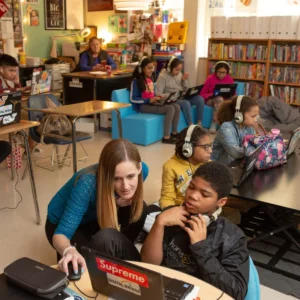
Unlike static software, Goblins utilized text chat, a virtual whiteboard, and even spoken conversation to guide students through math problems. Teachers in the Deer Valley district were given significant autonomy; they could assign specific problems, upload their own curricula, and determine which students needed extra support.
The results were statistically compelling. Students who solved at least two problems per week—totaling 50 problems over the course of the year—outperformed their peers on year-end standardized assessments. Accelerate, the nonprofit research organization behind the study, equated this growth to approximately three additional months of learning.
The Human Element in Digital Tutoring
What made Goblins stand out was its ability to bridge gaps for traditionally marginalized student populations, including English language learners and students with disabilities. The inclusion of a cartoon avatar that could hold verbal conversations—in Spanish and six other languages—created a sense of familiarity and support.
"It was like talking to your own teacher," Liu noted. This anthropomorphism appeared to be the catalyst that transformed a mundane math assignment into an interactive dialogue, increasing the likelihood that students would engage with the material.
The "Five-Percent Problem" and the Limits of Engagement
Despite the promising outcomes, the Goblins study highlights a persistent challenge in educational technology: the "five-percent problem." For years, researchers have observed that regardless of how effective a software program is, it rarely achieves widespread, consistent adoption.
Even with a platform designed to be engaging, only 6 percent of the 6,000 participating students hit the benchmark of half an hour of usage per week. This aligns with historical data from platforms like Khan Academy and IXL, where the majority of students fail to log in or engage deeply with instructional software at home. While Goblins saw half of its users hit the minimum threshold of two problems a week, the "dosage" required for deeper mastery remains elusive.
Furthermore, researchers are cautious about claiming a direct causal link. The students who chose to use Goblins more frequently may have possessed higher baseline motivation—a confounding variable that could explain the higher test scores. To isolate the true impact of the software, researchers are currently pushing for a randomized controlled trial.
When AI Access Backfires: The University Experience
While the Goblins study offers a glimmer of optimism, the findings from the University of Maryland’s own internal pilot tell a cautionary tale. Provost Jennifer King Rice, seeking to understand the potential impact of an AI course assistant before a campus-wide rollout, tasked Liu with a rigorous evaluation during the fall 2025 semester.
Experimental Design
The study was structured as a randomized controlled trial. Fifteen professors were tasked with incorporating an AI chatbot into their courses, while another 15 taught the same subjects—ranging from biology to English—without the tool. The AI assistant was integrated into the university’s Learning Management System (LMS), Canvas, providing 24/7 access to syllabus information, assignment guidelines, and conceptual explanations.
The Data: A Decline in Performance
The results were unexpected and, for the university administration, deeply concerning. The 1,100 students in classes equipped with the AI assistant saw their grades decline by an average of 0.11 points on a four-point scale. To put this in perspective, it is the difference between a solid 3.0 (a B) and a 2.9 (a low B).
Beyond the grades, the qualitative data was equally troubling. Students in the AI-enhanced sections:
- Interacted less frequently with course materials.
- Participated less in online discussion boards.
- Were less likely to attend office hours or meet with their professors and peers.
Perhaps most alarmingly, the negative impact was felt most acutely by first-generation students, suggesting that AI tools, if improperly implemented, could exacerbate existing educational inequities.
Analyzing the Failure: Unintended Consequences
Why did an AI tool intended to assist students result in a decrease in academic performance? Liu and Rice posit a theory centered on "the signal." By embedding an AI assistant into the course portal, the university implicitly signaled that AI use was an encouraged, standard practice.
Students likely interpreted this as a green light to use external, more powerful generative AI tools—such as ChatGPT, Claude, or Gemini—to generate answers rather than utilizing the university’s tool for its intended purpose of tutoring and conceptual guidance. If students offloaded their critical thinking to these external models, they effectively bypassed the cognitive struggle required for deep learning.
"AI tools could exacerbate inequities in learning outcomes," Rice noted in a statement to the university. "That is particularly troubling to me." The data suggests that when students prioritize efficiency over engagement, the result is a measurable regression in knowledge retention.
Implications for the Future of EdTech
The divergence between the middle school and university studies provides a roadmap for the future of AI in education.
1. Teacher-Led Implementation is Key
The success of Goblins suggests that AI works best when it is a scaffold for teacher-directed instruction. By allowing teachers to maintain control over the curriculum and the assignment of tasks, the AI acts as an extension of the classroom experience rather than a replacement for it.
2. Guardrails Against "Offloading"
The university study underscores the need for "cognitive guardrails." Educators must design AI tools that encourage inquiry rather than output. If a student can use a tool to generate a summary or an answer without first grappling with the concepts, the tool is likely to do more harm than good.
3. The Necessity of Pilot Programs
The University of Maryland’s decision to test the AI assistant before a full-scale deployment is a model for institutional policy. By gathering data in a controlled environment, the university was able to identify negative trends before they affected the entire student body. Transparency in these findings—even when they are negative—is essential for the maturation of the educational technology industry.
4. Addressing the Equity Gap
As the industry moves forward, developers must account for the digital divide. AI tools that are not intentionally designed to support diverse learning needs may unintentionally widen the achievement gap. Future research must focus not just on whether a tool "works" in a vacuum, but on how it is actually integrated into the daily habits of students from varying socioeconomic and academic backgrounds.
Conclusion: A Measured Path Forward
The narrative surrounding AI in education is often dominated by hyperbole—either the promise of a personalized tutor for every child or the threat of a complete erosion of academic integrity. The reality, as illustrated by the work of Jing Liu, is far more nuanced.
AI is a tool, and like any tool—from the calculator to the search engine—its impact is defined by its application. While AI has the potential to engage students who have historically fallen through the cracks, it also carries the risk of encouraging intellectual shortcuts that can hamper development.
Moving forward, the goal for educational institutions should not be to blindly adopt the latest software, but to cultivate a culture of "intentional integration." This requires a shift from focusing on the novelty of AI to focusing on the pedagogical outcomes. By prioritizing human-led instruction, setting clear boundaries for AI usage, and conducting rigorous, transparent research, schools can harness the benefits of artificial intelligence while mitigating the risks that threaten to compromise the very essence of learning.