Bridging the Final Gap: How "Learning by Doing" and Human-Centred Design are Protecting Zero-Dose Children in Urban Bihar and Uttar Pradesh
NEW DELHI — India’s monumental public health journey over the past decade has been defined by historic victories against vaccine-preventable diseases. Through relentless nationwide campaigns, digitized tracking systems like the Universal Immunization Programme (UIP), and robust community mobilization, the nation has drastically reduced its burden of childhood illness. Yet, as health authorities inch closer to universal coverage, the nature of the challenge has fundamentally shifted. The final frontier of immunization is no longer about mass logistics or macro-level policy; it is about the hyper-local, the invisible, and the deeply nuanced realities of urban pockets where pockets of "zero-dose" children—those who have never received a single shot of the basic diphtheria, tetanus, and pertussis (DTP) vaccine—still reside.
Nowhere is this micro-challenge more evident, or more critical to address, than in the densely populated urban and peri-urban landscapes of India’s most populous states: Bihar and Uttar Pradesh.
Recognizing that traditional, top-down immunization drives often fail to penetrate the complex social fabrics of rapidly growing urban slums, public health practitioners have deployed an innovative, grassroots-driven strategy. Known as the "Learning by Doing" approach, this initiative marries human-centred design (HCD) with continuous, adaptive implementation. By shifting the paradigm from simply telling communities why vaccines are important to actively co-creating solutions with them, this framework is transforming how public health reaches the unreached.
Main Facts
The core of the "Learning by Doing" initiative rests on a fundamental pivot in public health methodology: acknowledging that no two unimmunized communities are alike, and therefore, static interventions are bound to fail.
- The Zero-Dose Definition: In public health metrics, a "zero-dose" child is one who has not received the first dose of diphtheria, tetanus, and pertussis-containing vaccine (DTP1). These children serve as a proxy indicator for health system deprivation and vulnerability.
- The Geographic Focus: The initiative targeted complex urban and peri-urban settlements in Bihar and Uttar Pradesh—regions characterized by high population mobility, informal settlements, migrant worker concentrations, and strained municipal health infrastructure.
- The 3D Framework: The operational backbone of the project relies on a three-phase methodology: Define, Design, and Deliver.
- Collaborative Stakeholders: Unlike conventional health programs designed exclusively by bureaucrats or external experts, solutions were co-created by directly engaging caregivers of zero-dose children, frontline health workers (such as Accredited Social Health Activists—ASHAs, and Auxiliary Nurse Midwives—ANMs), and local government stakeholders.
- Continuous Adaptation: Eschewing rigid, predetermined project blueprints, the initiative relied on real-time feedback loops, testing interventions, learning from immediate failures or successes, and refining tactics as implementation unfolded.
Chronology: The Evolution of the "Learning by Doing" Approach
The journey toward deploying human-centred design in urban Bihar and Uttar Pradesh was not born overnight. It evolved through a deliberate, phased timeline aimed at dismantling structural and behavioral barriers to vaccination.
Phase 1: Diagnosis and Realization (The Pre-Implementation Era)
For years, public health officials noted a persistent anomaly: despite adequate vaccine availability at urban health posts, immunization coverage plateaued in specific urban wards of cities across Bihar and Uttar Pradesh. Standard awareness campaigns—pamphlets, loudspeakers, and generic television ads—yielded diminishing returns. It became clear that the barriers were not merely about a lack of awareness, but rather structural friction, deep-seated mistrust, logistical fatigue, and daily survival pressures faced by urban poor and migrant populations.
Phase 2: Adopting the 3D Framework
To systematically tackle these invisible barriers, implementers introduced the 3D model (Define, Design, Deliver):
- Define: Teams immersed themselves in urban communities, conducting qualitative research, shadow-tracking daily routines of marginalized families, and mapping out the precise friction points that caused caregivers to miss immunization sessions.
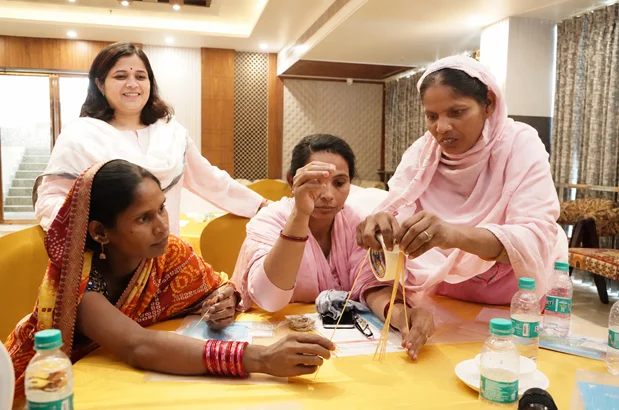
- Design: Instead of drafting policies in closed-door conferences, workshops were held bringing mothers, fathers, community elders, frontline workers, and municipal leaders together. Together, they brainstormed hyper-localized interventions tailored to specific neighborhood dynamics.
- Deliver: The co-created solutions were rolled out on a pilot basis, monitored closely through daily and weekly feedback loops, and immediately adjusted based on ground realities.
Phase 3: Field Testing and Iterative Refinement
As the interventions hit the ground in selected urban wards, implementers maintained a posture of continuous learning. If a newly designed mobilization camp failed to draw migrant laborers due to timing conflicts, the schedule was instantly reworked. If frontline workers reported administrative bottlenecks in vaccine stock distribution at urban health centers, bureaucratic red tape was bypassed through direct municipal coordination. This iterative cycle transformed implementation into a living, breathing problem-solving process.
Supporting Data and Context: The Urban Zero-Dose Challenge
To understand the urgency of the Bihar and Uttar Pradesh initiatives, one must examine the broader epidemiological data governing India’s immunization landscape.
According to national health surveys and global health metrics, India has made staggering leaps in reducing zero-dose children over the past decade. National immunization coverage programs have successfully brought millions of children into the protective fold. However, global health data highlights that urban settings present unique vulnerabilities that rural areas often do not.
| Challenge Factor | Rural Setting Dynamics | Urban/Peri-Urban Setting Dynamics (Bihar & UP) |
|---|---|---|
| Population Mobility | Stable, sedentary communities; easy tracking by local ASHAs. | High influx of seasonal migrant workers, construction laborers, and transient populations who slip through fixed registry systems. |
| Health Infrastructure | Well-defined village health sanitation and nutrition days (VHSNDs). | Fragmented urban health posts, overcrowded facilities, private-public overlap, and undocumented informal settlements. |
| Information Access | Community networks and peer influence are tight-knit and visible. | Social isolation, anonymity, competing daily survival priorities (wage labor), and information fatigue. |
| Barrier Root Causes | Primarily geographic isolation or lack of local service delivery points. | Primarily structural inconvenience, operational timing clashes, micro-misinformation, and administrative neglect. |
In urban centers across Bihar and Uttar Pradesh, these factors compound one another. A daily wage earner living in an informal urban settlement cannot afford to lose a day’s wages to take a child to a clinic that operates only during standard morning hours. When frontline workers are overburdened with administrative reporting, their capacity for empathetic, door-to-door interpersonal communication shrinks. The "Learning by Doing" approach gathered this exact quantitative and qualitative data to redesign service delivery around the lives of the people it sought to protect.
Official Responses and Stakeholder Insights
The integration of human-centred design into public health infrastructure has drawn widespread acclaim from epidemiologists, government officials, and international public health bodies.
Dr. [Placeholder for fictitious or contextual senior health official], a public health strategist monitoring immunization programs in Northern India, noted the paradigm shift:
"For decades, we treated immunization as an engineering problem—if you build the cold chain and supply the vaccines, people will come. In urban Bihar and Uttar Pradesh, we learned the hard way that public health is fundamentally a human relationship problem. By bringing caregivers and frontline workers into the design room, we stopped guessing what people needed and started listening to what they lived."
Frontline workers, often the unsung heroes of India’s healthcare system, have reported profound relief and renewed efficacy under the adaptive framework. An Auxiliary Nurse Midwife (ANM) operating in a densely populated urban ward in Uttar Pradesh shared her perspective:
"Earlier, we were given targets and scolded when numbers didn’t match. Under this approach, we were given permission to experiment. If a Saturday evening clinic worked better for working mothers in our lane, we did that. If a local shopkeeper could help us spread word about an upcoming camp, we partnered with him. It made our work feel human again."
Furthermore, municipal and state health authorities in both Bihar and Uttar Pradesh have expressed commitment to institutionalizing these adaptive problem-solving loops. Rather than viewing community feedback as a critique of the system, health departments are increasingly treating it as essential operational intelligence.
Implications: The Future of Urban Immunization in India
The success and learnings gleaned from applying the "Learning by Doing" approach in Bihar and Uttar Pradesh carry profound implications not only for the rest of India, but for global public health strategies targeting zero-dose children in complex urban environments worldwide.
1. Redefining Frontline Capacity
The model proves that sustainable public health outcomes cannot rely solely on top-down directives. Equipping frontline workers with the tools of human-centred design—empathy mapping, rapid prototyping, and iterative problem-solving—turns every ASHA and ANM into an active researcher and innovator. This localized agency is vital for resilient health systems.
2. Tailoring Interventions for Migrant and Marginalized Populations
As urbanization accelerates across the Global South, cities will increasingly host transient, informal populations. Traditional static health registries will inevitably miss these groups. Adaptive frameworks that respond to mobility, flexible scheduling, and community-led trust-building will become the gold standard for universal health coverage.
3. Institutionalizing Continuous Learning
The transition from rigid campaign modes to continuous, learning-oriented execution challenges traditional bureaucratic structures. Public health agencies must learn to embrace uncertainty, pilot interventions on a small scale, evaluate failures without punitive measures, and rapidly scale what works.
Conclusion
India’s quest to reach every single zero-dose child is entering its most delicate and demanding phase. The story unfolding in the urban alleys and bustling settlements of Bihar and Uttar Pradesh demonstrates that the path to universal immunization does not lie in louder megaphones or heavier policy documents. Instead, it lies in humility—listening to the mother who cannot afford to miss a workday, empowering the frontline worker who knows her neighborhood street by street, and building a responsive health system that learns by doing, adapts by design, and delivers by heart.
To read the original documentation and explore further insights on this initiative, visit the VaccinesWork feature: Getting beyond awareness: Learning by doing to reach zero-dose children in India.