College Enrollment and Persistence Show Promising Post-Pandemic Gains Across U.S. High Schools
By Higher Education Dive Reporting Desk
Published September 17, 2026
Main Facts
Recent data released by the National Student Clearinghouse Research Center reveals an encouraging upward trajectory in both higher education enrollment and college persistence rates among recent high school graduates. The findings, published in September 2026, point to measurable improvements across diverse educational landscapes, touching high-poverty and low-poverty high schools alike.
According to the report, the class of 2023 demonstrated notable gains in continuing their education beyond high school compared to the class of 2022. While overall improvements are described by researchers as modest, the consistency of the upward trend signals a stabilizing post-pandemic higher education environment. Most notably, graduates hailing from high-poverty high schools experienced the most substantial leaps in both immediate college entry and year-over-year persistence.
Key statistical takeaways from the report include:
- Persistence Rates in High-Poverty Schools: Among 2023 graduates from high-poverty institutions who entered higher education, 76% returned for their second year, up from 74.3% for the previous cohort.
- Persistence Rates in Low-Poverty Schools: Sophomore-year persistence for 2023 low-poverty high school graduates reached 90.6%, ticking up from 89.4% for the class of 2022.
- Two-Year Enrollment Growth: For the class of 2023, 58.7% of students from high-poverty schools enrolled in college within two years of graduation (up from 56.6% for 2022). Meanwhile, low-poverty school enrollment within two years rose from 75.9% to 77.9%.
- Urban Center Surges: Urban high schools recorded the most significant geographic increase, with 67.1% of 2023 graduates attending college within two years—a jump from 65.2% the prior year.
Chronology of Educational Recovery: From Pandemic Disruption to 2026
To fully understand the significance of the 2026 National Student Clearinghouse data, it is necessary to trace the timeline of educational disruptions and subsequent recovery efforts that have shaped the current generation of college students.
2020–2021: The Pandemic Shockwave
When the COVID-19 pandemic swept across the globe in the spring of 2020, educational systems were thrown into chaos. The high school classes of 2020 and 2021 experienced abrupt shifts to remote learning, widespread economic instability, and profound mental health challenges. Higher education enrollment plummeted nationwide as prospective students deferred college plans, questioned the value of online instruction, or entered a booming labor market that offered immediate, albeit often low-wage, employment. High-poverty districts were hit disproportionately hard, widening existing achievement and enrollment gaps.
2022–2024: The Stabilization and Re-Engagement Phase
As schools returned to in-person instruction and federal emergency relief funds (such as the Elementary and Secondary School Emergency Relief fund) poured into local districts, educators began mounting aggressive recovery campaigns. High schools implemented targeted interventions, including enhanced post-secondary counseling, expanded dual-enrollment programs, and intensive credit-recovery initiatives.
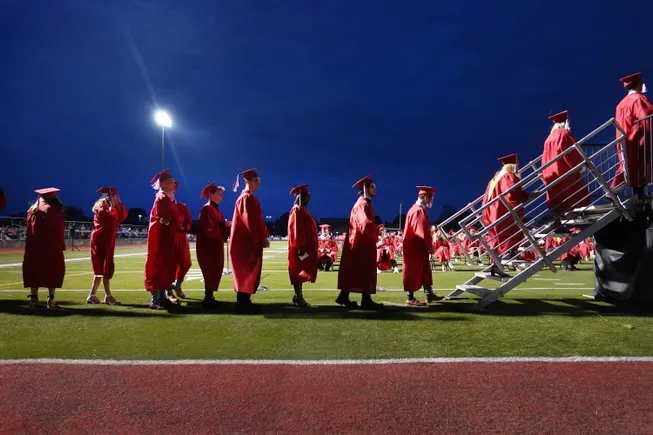
By the time the high school class of 2022 graduated, early signs of stabilization began to emerge, though enrollment numbers remained depressed compared to pre-pandemic baselines. The class of 2023—whose members spent their crucial freshman and sophomore years heavily impacted by pandemic fallout before stabilizing in their upperclassman years—began reaping the benefits of these sustained institutional supports.
2025–2026: The New Baseline of Growth
The release of the National Student Clearinghouse data in September 2026 marks a critical turning point. It provides the academic community with a clear picture of the class of 2023’s trajectory through their crucial first two years of higher education. The data suggests that the educational pipeline is not merely recovering from pandemic shocks, but is actively closing equity gaps, particularly for students from economically disadvantaged backgrounds.
Supporting Data and Demographic Breakdown
A granular analysis of the clearinghouse’s data reveals complex dynamics across socioeconomic, geographic, and institutional lines. While low-poverty schools maintain a higher absolute percentage of college-goers and persistent students, the velocity of growth among high-poverty and urban schools points to narrowing gaps.
Socioeconomic Disparities and Closing Gaps
The most striking revelation from the 2026 report is the performance of graduates from high-poverty high schools. For decades, educational researchers have documented the "poverty penalty" in higher education—a phenomenon where low-income students face insurmountable structural barriers to college access and completion.
While a substantial gap remains between low-poverty and high-poverty cohorts, the rate of improvement in high-poverty schools offers a counter-narrative of resilience:
- First-to-Second Year Persistence: High-poverty schools closed ground with a 1.7-percentage-point increase (reaching 76%), whereas low-poverty schools saw a more modest 1.2-percentage-point gain (reaching 90.6%).
- Two-Year Enrollment Windows: High-poverty schools posted a 2.1-percentage-point increase in students enrolling within two years of graduation, outpacing the 2.0-percentage-point gain seen in low-poverty settings.
Geographic Trends: Urban, Suburban, and Rural Dynamics
When examining the data through a geographic lens, urban school districts emerge as the standout performers of the 2026 dataset.
- Urban Schools: Urban districts saw the most pronounced surge, with the two-year college-going rate jumping nearly two full points to 67.1% for the class of 2023. This growth reflects heavy investments by urban school districts and municipal partnerships aimed at college and career readiness.
- Suburban Schools: Suburban districts continue to boast the highest overall college-going rates, with 70.4% of 2023 graduates entering higher education within two years. However, year-over-year growth was flat to marginal, ticking up by just 0.2 percentage points. This plateau suggests that suburban districts may be reaching a saturation point in college enrollment under current structural conditions.
- Rural Schools: Rural high schools experienced a modest uptick of 0.4 percentage points, bringing their two-year college enrollment rate to 60.9%. Rural education advocates have long pointed to unique structural challenges—such as geographic isolation, limited broadband access, and a scarcity of local higher education institutions—that continue to suppress post-secondary continuation rates.
Official Responses and Expert Analysis
The release of the Clearinghouse data has generated considerable discussion among educational policy analysts, institutional leaders, and researchers.

Matthew Holsapple, Senior Director of Research at the National Student Clearinghouse Research Center, offered a measured yet optimistic assessment of the findings. In a statement released Thursday, Holsapple emphasized that while the overall improvements across the board can be characterized as modest, they reflect a deeply encouraging macro-trend.
"What stands out most is that graduates of high-poverty high schools saw the largest gains in both enrollment and persistence," Holsapple stated.
Holsapple noted that the data invalidates fears that the pandemic permanently severed the pipeline between disadvantaged high schools and higher education. Instead, the numbers suggest that targeted interventions implemented during the recovery years are beginning to bear fruit.
Other higher education experts have weighed in on what these numbers mean for colleges and universities. Dr. Elena Vance, a higher education economist at the Brookings Institution, noted that the data underscores the importance of institutional flexibility.
"For years, higher education institutions have worried about a looming demographic cliff and declining public confidence in the value of a college degree," Vance said. "However, this data proves that demand for higher education remains remarkably resilient, particularly among students who stand to benefit the most from upward socioeconomic mobility. The challenge for colleges now is not generating initial interest, but providing the institutional scaffolding necessary to keep these students enrolled through graduation."
Meanwhile, K-12 superintendents across urban and high-poverty districts have pointed to the expansion of college-and-career counseling programs as a primary driver behind the positive metrics. Many districts utilized federal COVID-19 relief funds to hire additional guidance counselors, partner with non-profit college-access organizations, and cover application fees for low-income seniors—investments that appear to be paying long-term dividends.
Implications for the Future of Higher Education
As the education sector digests the findings of the National Student Clearinghouse Research Center report, several profound implications emerge for high schools, colleges, policymakers, and students alike.

1. Re-evaluating Equity Initiatives in K-12 Education
The disproportionate gains made by high-poverty and urban high schools provide a roadmap for future educational policy. Policymakers have long debated whether equity-focused funding should be directed toward K-12 school districts or higher education financial aid. The 2026 data suggests that robust investments at the high school level—specifically in college-readiness programming, dual-enrollment access, and advising—directly translate into higher college enrollment and persistence. Lawmakers facing the impending expiration of various state and federal recovery grants must consider how to institutionalize these successful support mechanisms.
2. The Retention Imperative for Colleges and Universities
With persistence rates climbing to 76% in high-poverty cohorts and 90.6% in low-poverty cohorts, colleges are witnessing a more academically and socially determined student body. However, as enrollment pipelines stabilize, higher education institutions must shift their focus heavily toward retention and degree completion.
First-generation and low-income students, who make up a significant portion of the high-poverty high school graduating cohorts, often require comprehensive support systems—including emergency financial aid, mental health resources, academic tutoring, and mentorship—to navigate the hidden curriculum of college life. Universities that fail to adapt their student support services risk squandering the hard-won gains made by these resilient cohorts.
3. Addressing the Rural Disconnect
While urban and suburban districts show clear positive momentum, rural high schools continue to lag in year-over-year growth. The 0.4 percentage point increase in rural college enrollment highlights a persistent geographic divide that requires specialized policy solutions. Future interventions must address the unique barriers faced by rural youth, including regional economic shifts, lack of localized transport, and an acute shortage of college-advising personnel in remote school districts.
4. Looking Ahead: Sustaining Momentum Beyond the Post-Pandemic Recovery
As the class of 2023 data becomes the new benchmark, higher education analysts are already looking ahead to subsequent cohorts. The central question facing the educational community is whether these positive trends can be sustained as temporary federal relief funds fully recede into memory.
Institutions and school districts must find permanent, sustainable funding models to maintain the counseling, financial aid, and academic support programs that drove these gains. If they succeed, the post-pandemic era may ultimately be remembered not as a period of permanent educational decline, but as a catalyst for a more equitable, resilient, and accessible American higher education system.