Mastering the Blueprint: A Professional Educator’s Guide to Backward Design and Effective Unit Planning

Effective instruction does not happen by accident. Behind every engaging classroom experience, every seamless transition, and every profound "aha!" moment lies a meticulous, intentional planning process. Yet, for many educators—ranging from pre-service teachers stepping into a classroom for the first time to seasoned veterans looking to revitalize their curricula—unit planning remains one of the most daunting aspects of the profession.
To demystify this critical phase of teaching, a comprehensive four-part instructional series has been launched to take educators back to basics. Designed to offer a practical, repeatable blueprint for building a unit of instruction from scratch, the series serves as a companion piece to the newly released self-paced online course, Mastering the Lesson Plan.
By breaking down the macro-level structure of instructional design into digestible, actionable steps, this initiative aims to empower educators to craft coherent, rigorous, and student-centered learning experiences with confidence.
Main Facts: The Anatomy of Instructional Planning
At the heart of the newly unveiled instructional framework is a return to fundamental principles. Rather than relying on trial and error or hastily thrown-together daily activities, the framework offers a structured, step-by-step methodology developed over decades of classroom experience, research, and interviews with educational experts.
The core elements of the planning framework can be summarized through three foundational distinctions and a three-step design process:

- Standards vs. Curriculum vs. Units: Standards act as the ultimate destination (the broad goals or competencies students must achieve). The curriculum acts as the roadmap, organizing and sequencing those standards into logical clusters known as units. Units themselves are collections of individual daily lessons grouped by thematic or skill-based coherence.
- The Power of Backward Design: Popularized by Grant Wiggins and Jay McTighe in their seminal 1991 text Understanding by Design, backward design flips traditional lesson planning on its head. Instead of teaching daily lessons and creating a test afterward, educators start by identifying desired results, design the summative assessment second, and plan the daily lessons last.
- The 3-Step Unit Design Process:
- Set Objectives: Write measurable, observable learning targets derived directly from standards.
- Design the Assessment: Create a rigorous, authentic summative assessment that measures whether those objectives have been met.
- Plan the Lessons: Engineer the daily activities, scaffolding, and instructional strategies required to bridge the gap between initial knowledge and final mastery.
Chronology: How the Instructional Series Unfolds
To ensure teachers can absorb and implement these methodologies without feeling overwhelmed, the instructional guide is structured as a progressive, four-week developmental sequence:
- Week 1 (The Big Picture): Establishes the macro-level overview of unit planning. It defines core educational terminology (standards, curriculum, units) and introduces the foundational mechanics of backward design using a hypothetical community education course, Cooking Fundamentals.
- Week 2 (Assessment Design): Zooms in on evaluation strategies. This segment explores how to design a comprehensive assessment plan incorporating diagnostic, formative, and summative assessments that accurately reflect student progress without relying solely on rote memorization.
- Week 3 (Daily Lesson Construction): Focuses on micro-level execution. Educators are guided through the process of translating broad unit objectives and summative assessments into cohesive, engaging day-to-day lesson plans.
- Week 4 (Differentiation and Mastery): Concludes the series by tackling the vital task of differentiating instruction. This installment provides actionable strategies for adapting lessons to meet the diverse needs of all learners within a single classroom environment.
Supporting Data: Translating Standards Into Actionable Units
To understand how abstract educational standards transform into tangible classroom experiences, the framework utilizes a practical pedagogical model: an eight-week adult education course titled Cooking Fundamentals.
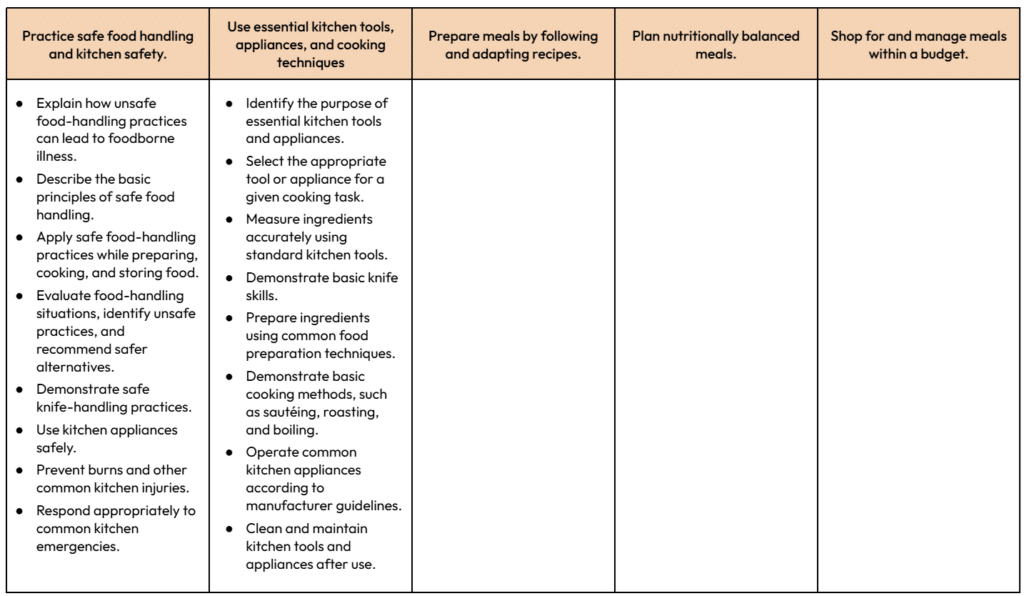
Imagine an instructor mapping out five broad course goals for novice cooks. While these goals serve as the overarching standards, they are inherently too broad to teach in a single sitting. For instance, the second standard—using essential kitchen tools, appliances, and cooking techniques—encompasses a vast inventory of 15 to 30 distinct tools, coupled with extensive lists of operational skills and culinary methods.
Faced with this wealth of information, educators must synthesize the data into logical groupings. In the Cooking Fundamentals model, the instructor organizes the overarching standards into six distinct units:
- Food Safety
- Kitchen Tools and Appliances
- Food Prep and Cooking Techniques
- Everyday Meal Preparation
- Nutrition
- Grocery Shopping and Budgeting
By isolating the first unit—Safe Food Handling—the framework demonstrates how a targeted, short-duration unit (spanning three to four days) comes to life through the three-step backward design model.
First, the instructor establishes measurable objectives: students must be able to identify cross-contamination risks, explain proper temperature thresholds, and demonstrate correct handwashing protocols. Second, the instructor designs a summative open-response test featuring real-world culinary scenarios where fictional individuals make subtle food safety errors; students must pinpoint the mistakes and correct them. Third, the instructor builds the daily lessons required to ensure students can successfully navigate those scenarios.
Official Perspectives and Expert Insight
While the methodology is rooted in established academic frameworks like Understanding by Design, its modern application emphasizes flexibility, intentionality, and professional intuition.
"What I’m sharing is a method I’ve arrived at over years of teaching and studying instructional practice, but it’s certainly not the only way to do these things," the series creator notes. "It’s been shaped by plenty of trial and error, along with more than a decade of researching effective teaching, reading widely, and interviewing classroom teachers and education experts."
Education advocates and veteran teachers have long debated the merits of "teaching to the test," a phrase that traditionally carries negative connotations of rigid, uninspired test-prep drills. However, instructional experts argue that when utilizing backward design with a well-designed assessment, the paradigm shifts entirely.
When a teacher constructs an authentic, performance-based, or scenario-driven assessment that truly measures critical thinking and application, "teaching to the test" ceases to be a negative constraint. Instead, it becomes a powerful mechanism to ensure alignment, clarity, and genuine student mastery. The assessment is no longer an arbitrary hurdle imposed from the outside; it is a thoughtful reflection of what truly matters in the curriculum.
Implications for Modern Classrooms and Professional Development
The release of this back-to-basics instructional series—and its companion self-paced professional development course, Mastering the Lesson Plan—arrives at a critical juncture in modern education.
Bridging the Gap for New Educators
For pre-service and newly minted teachers entering the profession amid unprecedented challenges, the lack of structured planning frameworks can lead to early burnout. By providing a predictable, step-by-step formula for unit construction, new teachers gain a psychological safety net. They stop guessing what to teach next and start engineering purposeful learning journeys.
Revitalizing Veteran Practice
Crucially, the creators of the framework emphasize that these principles are just as valuable for veteran educators. Over years of classroom teaching, even the most dedicated professionals can fall into routine patterns, allowing critical alignment between standards, assessments, and daily lessons to drift. Periodic re-examination of unit architecture helps experienced teachers weed out redundant activities, elevate cognitive rigor, and strengthen areas that may have weakened over time.
Shifting the Pedagogical Mindset
Ultimately, the broader implication of this planning series is a cultural shift toward intentionality in instructional design. When teachers stop planning backward from tomorrow’s worksheet and start planning forward from ultimate student mastery, the entire classroom ecosystem transforms. Lessons become more cohesive, student engagement deepens, and assessment data becomes a genuine tool for growth rather than a mere gradebook entry.
As schools nationwide continue to seek ways to maximize instructional time and elevate student outcomes, mastering the foundational art of unit planning remains one of the most powerful investments an educator can make.