Beyond the "Egg-Crate": Can Team-Based Staffing Solve the Crisis in American Education?
For over a century, the American classroom has operated under a rigid, standardized design often referred to as the "egg-crate" model: one teacher, one room, and one roster of students. While this structure has defined the K-12 experience for generations, critics have long warned that it fosters isolation, prevents professional specialization, and creates an environment where teachers are consistently overburdened with little room for meaningful career progression.
As burnout rates climb and the national teacher shortage intensifies, school districts are increasingly looking for structural alternatives. At the forefront of this movement is the "Next Education Workforce™" (NEW) model, pioneered by Arizona State University. Unlike the traditional model, this framework emphasizes team-based staffing, where groups of educators—including lead teachers, paraprofessionals, and teacher candidates—collectively share responsibility for a larger cohort of students.
A recent, comprehensive study by researchers at the Center on Reinventing Public Education (CRPE) provides the most rigorous look yet at what happens when a large, diverse Arizona school district implements this model. The findings offer a complex but promising picture: while teaming may not be a panacea for every academic challenge, it is emerging as a powerful tool for stabilizing the educator workforce and, in specific environments like middle school mathematics, demonstrably improving student achievement.
The Core Concept: Redefining the Teaching Profession
To understand the impact of the Next Education Workforce model, one must first understand its structural philosophy. It is not a rigid, top-down curriculum program; rather, it is a flexible framework that reimagines the daily life of a school.
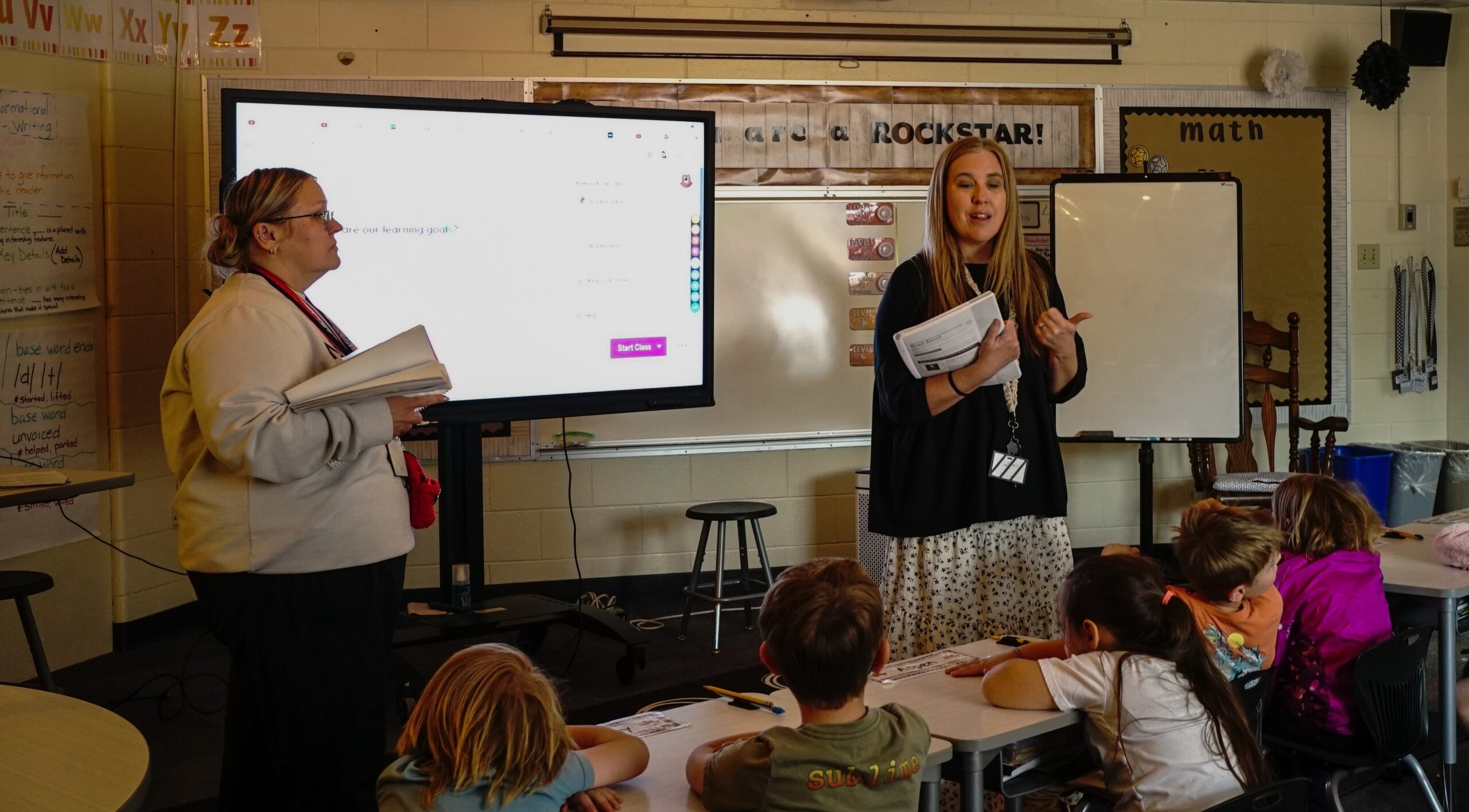
In a typical NEW environment, a team of two to six educators works together to support a shared, larger group of students. By pooling their expertise, these educators can differentiate roles—allowing some to focus on intensive small-group interventions, others on long-term planning, and others on direct instruction—according to their individual strengths.
This collaborative approach aims to address two primary systemic failures:
- Teacher Isolation: The traditional model leaves teachers to navigate the demands of a classroom alone. Teaming creates a built-in support network.
- Student Disengagement: The model aims to create a more responsive, personalized learning environment where students have access to a broader range of instructional support than a single teacher could provide alone.
A Chronology of the Study
To move beyond anecdotal evidence, researchers Mary Laski, Calen Clifton, and Dan Goldhaber conducted a five-year longitudinal study within a large Arizona school district. The district did not implement the model overnight; instead, it used a gradual rollout, phasing the Next Education Workforce model into various schools, grade levels, and subject areas over several years.
This staggered implementation provided the researchers with a unique natural experiment. By utilizing a "difference-in-differences" methodology, the team was able to compare grades that had adopted the NEW model against similar, traditionally staffed grades that had not yet transitioned. This analytical approach allows for a stronger inference of causality than simple year-over-year comparisons, isolating the specific effect of the teaming model from other variables.
Supporting Data: The Impact on Educators and Students
The researchers’ findings were bifurcated, showing clear success in teacher retention and specific academic gains, while remaining inconclusive regarding systemic improvements across all subjects.
The Educator Success Story
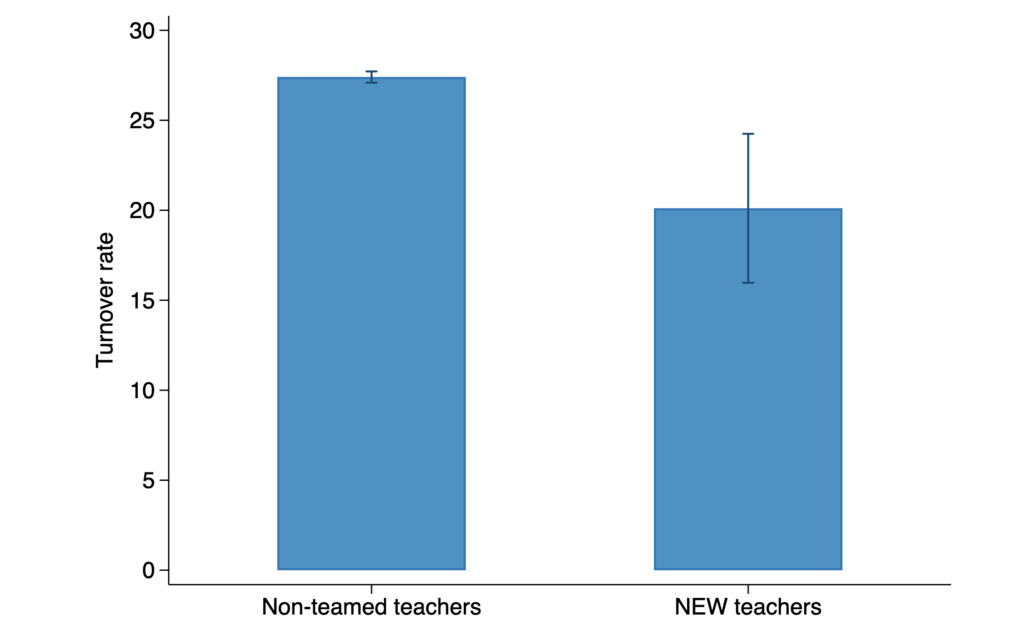
The most consistent finding across the five-year period was the positive impact on teacher stability. Teamed teachers were approximately seven percentage points less likely to leave their school compared to their non-teamed counterparts. In a district facing an annual turnover rate of roughly 27%, a seven-point reduction is a significant stabilization factor.
Furthermore, these teachers consistently earned higher evaluation ratings from their peers and administrators. This suggests that the collaborative environment not only reduces burnout but also fosters stronger instructional practices. Interestingly, these teacher-centric benefits were uniform across grade levels, even in elementary settings where overall student achievement gains were not as clear-cut.
The Middle School "Bright Spot"
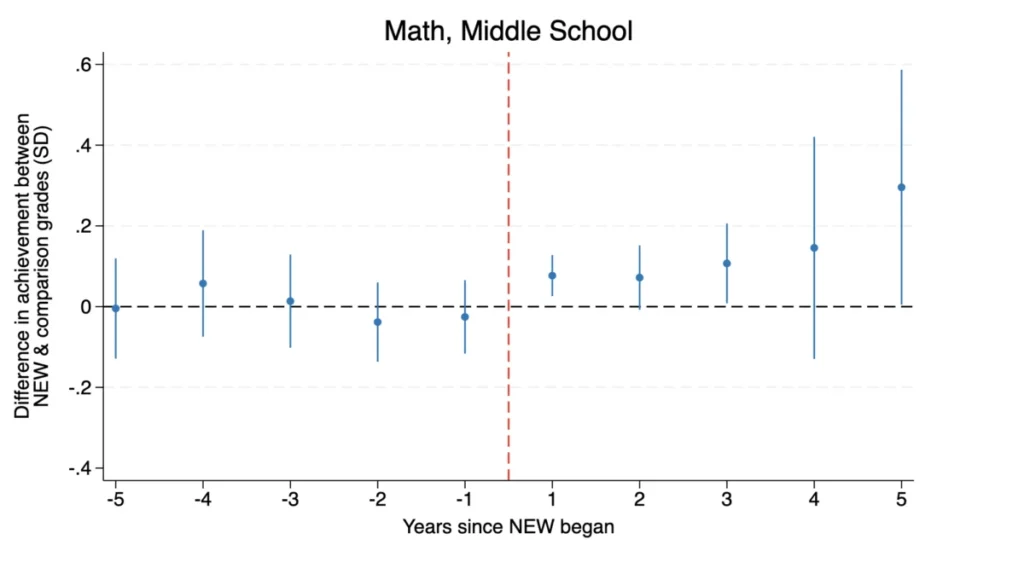
When looking at student test scores, the overall impact was varied. Across the district, there was no statistically significant change in test scores across all subjects and grades. However, middle school mathematics emerged as a clear success story.
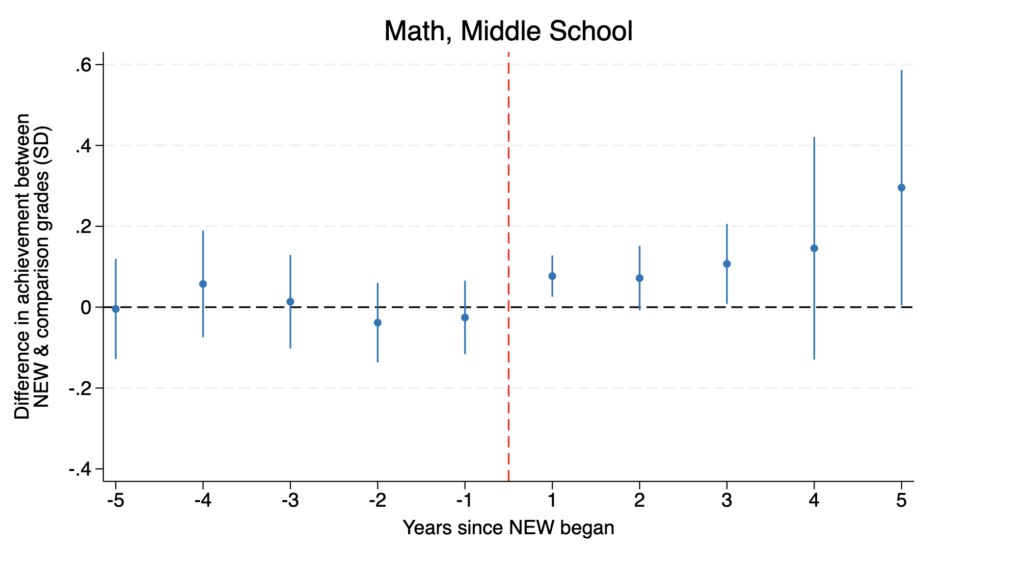
In this subject area, students in teamed classrooms saw an improvement of approximately 0.08 standard deviations. To put this in perspective, this translates to roughly two to three months of additional learning. Statistically, it is equivalent to moving a student from a classroom led by an average teacher to one led by an instructor in the top 30th percentile. This finding held up across multiple statistical models, making it the study’s most credible evidence of academic improvement.
Why Middle School Math? A Structural Explanation
The disparity in outcomes between elementary school and middle school raises a critical question: Why does teaming work better in some contexts than others?
The researchers posit that the answer lies in the existing school structure. Elementary schools are traditionally built around a "generalist" model, where one teacher covers all subjects. Layering a team-based model onto that foundation requires a massive shift in how teachers and students relate to one another. If the teaming process leads to excessive specialization or fragmented instruction, the benefits of collaboration can be negated by the loss of the foundational teacher-student bond.
Middle schools, by contrast, are usually already departmentalized. Students are accustomed to moving between different instructors. In this environment, teaming does not disrupt the core student-teacher relationship; instead, it provides the missing element of traditional middle schools: structural collaboration. It allows teachers to share the burden of student success without requiring a fundamental change in the daily student experience.
Implications for School Leaders
For district administrators and school principals, the study offers several actionable takeaways:
- Prioritize Retention as a Foundation: The evidence suggests that teaming is an effective strategy for mitigating teacher burnout. In a period of national workforce shortages, stabilizing the staff is an end worth pursuing in its own right, even before accounting for test score gains.
- Consider the "Contextual Fit": Leaders should be wary of viewing the Next Education Workforce model as a universal fix. Implementing it in elementary schools requires careful consideration of how it will impact the student-teacher relationship.
- Focus on Collaboration, Not Just Reorganization: The success in middle school math indicates that the model works best when it facilitates actual, meaningful collaboration among adults. It is not enough to simply group teachers together; the team must have the time and the mandate to work collectively on student outcomes.
- Transparency is Key: Given that results in English Language Arts (ELA) and elementary education were inconsistent, leaders should treat these areas as pilot programs, prioritizing data collection and iterative improvement rather than immediate, system-wide mandates.
The Path Forward: What We Still Don’t Know
Despite the rigor of the study, the authors acknowledge that there are still significant "known unknowns." While the quantitative data provides a clear picture of what happened, it cannot fully explain how it happened.
Future research must dive deeper into the internal dynamics of these teams. For example, what specific types of collaboration are most effective? Is it shared planning time, co-teaching, or the division of student caseloads that drives the most progress? Furthermore, understanding whether the gains in middle school math compound over time—as the data suggest, but do not yet definitively prove—remains a top priority for researchers.
As student performance and engagement metrics continue to decline nationally, the pressure on school leaders to find structural solutions is immense. The Next Education Workforce model provides a compelling, evidence-backed path toward a more sustainable and effective school system. However, the study serves as a necessary reminder that in education, there is no "silver bullet."

The model’s greatest potential lies not in its ability to magically transform schools overnight, but in its capacity to create a professional environment that respects the complexity of teaching. By shifting the burden of instruction from the individual to the team, districts may finally be moving toward a more sustainable future—one where teachers are supported, and students are the beneficiaries of that collective strength.
This report is based on the working paper "Evidence on Team-Based Teaching Models in Arizona" by Mary Laski, Calen Clifton, and Dan Goldhaber. The full study, including complete methodology and data sets, can be found via the CALDER Center. This research was supported by the Overdeck Family Foundation and Tandem Philanthropies.