Beyond the Formula: How Inquiry-Based Freewriting is Transforming Student Voice and Challenging AI Dependency in the Classroom

By Educational Research Desk
Sponsored by Renaissance and SchoolAI
Main Facts
For generations, the instruction of writing in middle and high school classrooms has been dominated by rigid frameworks, formulaic structures—such as the five-paragraph essay or the RACES writing strategy—and strict grading rubrics. While these tools were originally designed to assist educators in managing large cohorts and meeting standardized testing mandates, a growing body of pedagogical research suggests they have inadvertently created an unintended consequence: lifeless, generic student writing that treats self-expression as a transactional chore rather than a vital act of thinking.
Enter Nashwa Elkoshairi, an educator and researcher whose doctoral dissertation at the University of Central Arkansas tackles this crisis head-on. Elkoshairi’s research centers on a powerful pedagogical pivot: replacing punitive grading and rigid templates with inquiry-based freewriting. Grounded in the historical philosophies of reflective writing pioneers like Peter Elbow, Ken Macrorie, and John Dewey, Elkoshairi’s method asks students to spill their thoughts onto the page continuously without stopping to edit, polish, or plan.
When integrated with Culturally Responsive Leadership (CRL) frameworks—drawing on the scholarship of Muhammad Khalifa and others—this low-constraint writing practice has yielded dramatic results. Over a single academic year, Elkoshairi observed her students transform from struggling writers producing brief, surface-level snippets of 150 words into reflective thinkers producing over 500 words of authentic, identity-driven prose. More importantly, this shift is arriving at a critical cultural crossroads, offering a powerful antidote to student anxiety and the growing trend of outsourcing thinking to generative artificial intelligence (AI).
Chronology of an Educational Evolution
To understand how inquiry-based freewriting reshapes a classroom, one must trace the timeline of Elkoshairi’s pedagogical journey—a trajectory that spanned years of trial, academic research, and classroom experimentation.
Phase 1: The Trap of Compliance (Pre-Dissertation)
Like many educators navigating high-stakes testing environments, Elkoshairi initially relied heavily on scripted programs, strict timelines, and formulaic rubrics. Seeking to inject student voice into her virtual classroom, she initially introduced choice boards. While students could select their presentation formats, the underlying structure remained identical: rigid expectations, red-inked papers, and a focus on teacher compliance rather than genuine discovery. The student experience remained defined by stress and low confidence.
Phase 2: Academic Inquiry and Theoretical Grounding
Recognizing that students rarely experienced writing the way professional writers do—as a messy, exploratory wrestling with ideas—Elkoshairi launched her PhD dissertation. She dove deep into historical and contemporary literature on reflective thinking. She adapted the tenets of Elbow, Macrorie, and Dewey, merging them with Culturally Responsive School Leadership (CRSL) frameworks to build a classroom environment rooted in psychological safety, inclusion, and authentic belonging.
Phase 3: The Four-Week Inquiry Cycle in Action
To operationalize freewriting, Elkoshairi designed inquiry-based units anchored not by a standardized writing task, but by a compelling human driving question—such as "Why does friendship matter?"
- Week 1: Students complete an entry freewrite to establish a baseline. They then analyze informational texts regarding author perspective and authorial intent.
- Week 2: The class shifts to literary texts, examining point of view and unreliable narrators while keeping the core driving question front and center.
- Week 3: Students draft a formal narrative scene, applying the reading standards and stylistic choices they have practiced.
- Week 4: The unit culminates in an exit freewrite. Students revisit the initial driving question, leveraging personal experiences and textual evidence to synthesize how their perspectives have evolved.
Phase 4: Reflection and Cultural Validation
As the academic year progressed, students who initially resisted freewriting began to experience profound shifts in metacognition. By removing the pressure of grades, spelling conventions, and formatting traps, students unlocked deep analytical pathways, discovering insights mid-sentence that surprised even themselves.

Supporting Data and Evidence
The efficacy of inquiry-based freewriting is backed by both quantitative metrics and qualitative student testimonies gathered over the course of Elkoshairi’s implementation:
- Word Count and Depth Expansion: At the beginning of the school year, students struggled to generate even 150 words of surface-level text. By the end of the year, 100% of the cohort transitioned to transformational reflection, consistently producing essays exceeding 500 words.
- The Role of Low Constraints: Assessment of freewrites is intentionally decoupled from spelling and conventions. Students are graded strictly on two metrics: personal reflection on the topic and meeting a gradually increasing word count.
- Student Voice Breakdowns:
- On Initial Resistance: "My first freewrite was pretty short, and I didn’t really know what I was doing… I did not like them in the beginning, but the more units we went through, the better the units got, and the more I liked the freedom."
- On Metacognitive Growth: "I think they evolved to include deeper reflections on my personal feelings and opinions… with more intention and focus. I tried to not only describe my thoughts, but I started to try to analyze my thoughts deeper."
- On Discovery Through Writing: "I was sometimes go into an unexpected direction, as if the freewrite itself was leading me further and further down an unexplored alley, and I was surprised at times what thoughts came to me even as I was writing."
Official Responses and Pedagogical Insights
The movement away from formulaic writing toward inquiry-based freewriting has garnered attention for how it reframes teacher-student relationships, feedback loops, and institutional inclusivity.
Redefining Teacher Feedback
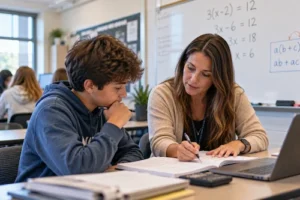
Moving away from red ink and punitive corrections, Elkoshairi adopted a relationship-driven feedback model. By greeting students by name and entering "full-on brag mode," she highlights positive cognitive leaps, naming the critical thinking moves students make unconsciously. By modeling vulnerability—sharing her own experiences and connecting with student ideas in conversation—she fosters deep relational trust.
Culturally Responsive Leadership (CRL)
Elkoshairi’s work highlights that equity in the classroom is inextricably linked to instructional design. Drawing on the work of scholars such as Dr. Muhammad Khalifa, Elkoshairi emphasizes that culturally responsive teaching begins with critical self-reflection. For Elkoshairi, this was deeply personal. Acknowledging her own background as an Egyptian woman who often felt invisible in traditional classrooms due to her name or headscarf, she credits her university mentors—Dr. Trumble, Dr. Wake, Dr. Herring, and Dr. Dailey from the University of Central Arkansas—with providing the academic visibility that shaped her philosophy.
"For much of my schooling, I moved through classrooms feeling largely invisible," Elkoshairi notes. "Their support shaped my confidence, my thinking, and my path forward. I wouldn’t be where I am today—or who I am—without them."
Broader Implications for Education
The implications of inquiry-based freewriting extend far beyond middle school English language arts classrooms. As educators grapple with shifting technological landscapes and systemic challenges, this pedagogical approach offers vital solutions across multiple fronts.
Dismantling AI Dependency
In an era marked by the rapid proliferation of generative artificial intelligence and plummeting student attention spans, educators face an unprecedented crisis: students turning to AI not out of laziness, but out of a deep-seated belief that their own voices are inadequate. By validating lived experiences and using accessible entry points, inquiry-based freewriting reassures students that their thinking matters. When writing becomes a meaningful space for self-discovery rather than a formulaic compliance check, students reclaim ownership over their intellect.
Scalability Across Content Areas
Because inquiry-based freewriting centers on conceptual big ideas rather than isolated technical tasks, it can be seamlessly adapted across all academic disciplines. By anchoring units with driving questions, teachers in any subject can prompt students to map their evolving understanding:
- Mathematics: "How do numbers help us understand the real world?" or "What makes a mathematical proof convincing?"
- Science: "How do systems maintain balance?" or "What stories do ecosystems tell about change?"
- Social Studies: "Whose voices shape history?" or "What causes communities to fracture or unite?"
- CTE and STEM: "How does failure drive innovation?" or "What is the ethical responsibility of a creator?"
- Arts and Physical Education: "How does art communicate what words cannot?" or "What defines teamwork under pressure?"
Cultivating Lifelong Thinkers
Ultimately, Elkoshairi’s four-year journey—culminating in a 275-page dissertation and tested by a resilient cohort of eighth graders—delivers a clear, resounding takeaway for the modern educational ecosystem. When educators relinquish rigid control and learn to genuinely trust their students’ capacity to think, classrooms transform from sterile compliance factories into vibrant incubators of human agency. By giving students the room to write without fear, teachers are not just improving writing fluency—they are empowering a generation to carry their authentic voices far beyond the school walls.