Beyond the Four-Year Myth: Why America’s Rigid High School Graduation Standards Fail Half a Million Students
By Educational Policy and Practice Desk
Published in partnership with eSchool Media Contributors
Every year, as summer approaches, the headlines trumpet a familiar and reassuring milestone: approximately 87 percent of American high school seniors successfully graduate four years after entering the ninth grade, according to data from the National Center for Education Statistics (NCES). To the public, this figure represents the gold standard of educational efficacy. It implies that the machinery of public education is functioning smoothly, pushing the vast majority of the nation’s youth across the finish line on a neat, predictable schedule.
Yet, hidden behind that encouraging national average is a sobering reality. That remaining 13 percent represents roughly 500,000 students nationwide who do not complete high school with their original cohort each year. Under the rigid accountability metrics established by the No Child Left Behind Act of 2001 and reinforced by the Every Student Succeeds Act (ESSA), these 500,000 teenagers—and the public schools that serve them—are officially cataloged as failing.
According to decades of frontline educational experience, however, this strict adherence to a four-year timeline is fundamentally flawed. For hundreds of thousands of vulnerable young people, the four-year graduation rate is not a measure of academic success or institutional quality; rather, it is a blunt, unforgiving instrument that penalizes students for navigating complex, chaotic, and often hostile life circumstances completely beyond their control.
Main Facts: The Human Cost of the Four-Year Mandate
The traditional high school model assumes a linear, uninterrupted progression through adolescence. It presumes stable housing, consistent nutrition, English proficiency, uninterrupted mental health, and foundational academic continuity from kindergarten onward. But for a half-million students annually, that presumption is a fantasy.
Data consistently shows that students who miss the four-year graduation mark are frequently grappling with compounding obstacles:
- Severe, early-grade learning gaps in literacy and mathematics that went unnoticed or unaddressed for years.
- Extreme residential instability, with some vulnerable youths experiencing so many upheavals that they are forced to change schools 11 or 12 times in a single academic year.
- Socioeconomic pressures, including teenage parenthood, homelessness, or the necessity of working full-time day jobs simply to help support their families.
- Language and cultural barriers that impede traditional classroom integration.
When these students fall behind, the standard four-year accountability framework brands them as dropouts or academic failures. Rather than receiving a safety net, they are often pushed to the margins of the educational system, bearing a modern-day "scarlet letter" for circumstances that made pursuing an education exponentially more difficult.
Chronology: The Anatomy of a Hidden Crisis
To understand how a student slips through the cracks of the traditional American high school, one must look beyond quantitative metrics and examine the lived experiences of these young people.
Consider the trajectory of a student named Anthony. Standing six-foot-three as a high school junior, Anthony cut an imposing figure. He was a recognized leader within a local neighborhood gang, yet paradoxically, he possessed an unblemished attendance record. Anthony never missed a day of school. He was consistently present, attentive, and actively engaged in class discussions—particularly in world history, a subject he genuinely loved. To his teachers, he appeared to be a strong student navigating urban complexities with resilience.
Then came a pivotal moment in class. A teacher asked Anthony to read a specific textbook passage aloud to support a point he had just made during a discussion. Instead of complying, Anthony deliberately used explicit profanity, ensuring he would be immediately removed from the classroom.
When administrators investigated the disciplinary infraction, Anthony broke down in tears. The hardened gang leader admitted a deeply guarded secret: "I can’t read."
Anthony’s story is far from an isolated anomaly. It illustrates a pervasive timeline of systemic failure:
- Early-Grade Foundations (Grades K–3): A student falls behind in foundational reading or math skills, often due to chronic absenteeism, school mobility, or under-resourced elementary schools.
- The Masking Phase (Grades 4–8): Realizing they cannot read or compute at grade level, clever students learn to compensate. They memorize spoken instructions, participate orally to mask written illiteracy, and avoid situations that expose their vulnerabilities.
- The High School Collision (Grades 9–11): Academic demands shift drastically from learning-to-read to reading-to-learn. Textbooks become denser, standardized testing intensifies, and life pressures mount.
- The Crisis Point (Grade 12 and Beyond): Confronted with the imminent realization that they lack the credits or foundational skills to graduate in four years, students either act out to save face, quietly disengage, or drop out entirely.
Supporting Data: Rethinking the Timeline and the Metrics
Educational leaders who have spent decades inside public school systems argue that redefining success requires radically rethinking how alternative high schools and accountability systems operate.
While traditional comprehensive high schools are built around a four-year arc, alternative education programs find that their students typically require five to eight years to successfully complete their secondary credentials. Unfortunately, legacy accountability systems are rarely designed to recognize or reward this extended pathway.
A handful of progressive states are beginning to model policy changes that reflect the realities of modern student populations. Ohio, for instance, established a pioneering Dropout Prevention and Recovery report card. This framework evaluates schools based on fifth- through eighth-year graduation rates and utilizes a value-added statistical model to explicitly recognize and reward academic growth over time.
Furthermore, innovative structural partnerships are emerging nationwide. Programs like Acceleration Academies collaborate directly with local school districts to reengage students who have already abandoned their education. These partnerships utilize a flexible, student-centered model designed to help over-age and under-credited youth complete their coursework.
A critical structural component of successful alternative models is that students remain on their home school district’s official roster until they graduate, ensuring that public education funding follows the student. This financial mechanism incentivizes traditional districts to proactively refer vulnerable teenagers to specialized programs rather than watching them quietly vanish from the system.
Official Responses and Policy Implications
As the educational landscape evolves, superintendents, researchers, and policymakers are grappling with the profound implications of moving away from the four-year graduation rate as the sole indicator of institutional success.
1. Flexible Scheduling and Nontraditional Hours
Schools catering to alternative pathways must recognize that time management cannot be one-size-fits-all. Because many at-risk students maintain daytime employment to sustain their households, flexible scheduling—including evening and summer sessions—is non-negotiable.
2. Streamlining the Academic Journey: The Single-Class Model
For students who have been out of school for months or years, the sheer volume of high school graduation requirements can feel like an inescapable black hole. To combat this paralysis, progressive alternative programs have adopted a single-class intensive model.
Instead of forcing a student to juggle six or seven subjects across a standard semester or trimester, students focus intensively on one class at a time for a compressed four-week period. This focus allows them to master necessary competencies without cognitive overload, fostering early academic wins that rebuild shattered self-confidence.
3. Redefining Chronic Absenteeism Through Empathy
In traditional schooling environments, a missed day triggers an automated, punitive warning letter or an unexcused absence mark designed to protect institutional compliance metrics. In successful alternative models, the paradigm is entirely relational.
When a student misses a day, teachers do not merely log an absence; they pick up the phone or send a text message: "Where have you been? Are you okay? Do you need help?" This outreach communicates genuine investment rather than bureaucratic surveillance.
A Vision for the Future: Redefining Educational Success
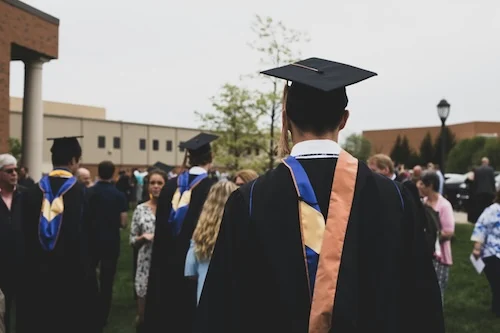
The ultimate validation of these student-centered reforms is visible in alternative graduation ceremonies across the country.
At a recent graduation ceremony for an acclaimed alternative program in DeKalb County, Georgia, the atmosphere was a profound testament to the power of flexible education. Teachers celebrated students not merely for hitting an arbitrary four-year benchmark, but for demonstrating grit, resilience, and raw talent in the face of immense adversity.
During the ceremony, one educator addressed a graduate who had initially suffered from crippling self-doubt: "You didn’t have me as your teacher yet. You didn’t know what you could accomplish."
The post-graduation outcomes were equally striking. While some graduates crossed the stage to accept traditional college scholarships, others proudly walked toward guaranteed trade apprenticeships. Seated in the audience alongside proud parents, friends, and faculty were central office administrators from the DeKalb County School District, enthusiastically applauding young people whom the system might have otherwise discarded.
Conclusion
For hundreds of thousands of American youths, success cannot and should not be boxed into a strict four-year window. If a young person earns their high school diploma in six or eight years and goes on to build a stable, rewarding career, that outcome must be celebrated as a resounding triumph of public education.
Rather than viewing the 500,000 students who miss the four-year mark each year as a tragic, unfixable statistic, educators and policymakers have a moral imperative to change the conversation. The path forward begins with a simple, human commitment: meeting students exactly where they are, acknowledging their unique struggles, and saying, "Let’s see what we can do. Together."
Contributions and editorial oversight provided by Dr. Donna Lawlor Wright, Senior Advisor at ERDI and Lead Superintendent at AASA, the School Superintendents Association. Dr. Wright has previously served as Director of Schools for Wilson County, Assistant Superintendent for Williamson County, and Deputy Director of Schools for Knox County.