Beyond the Grid: Rethinking the Multiplication Table as a Multi-Use Mathematical Instrument
WASHINGTON — In the modern mathematics classroom, educational tools often suffer from a severe case of utilitarian pigeonholing. Much like a culinary gadget relegated to a single, hyper-specific chore, foundational learning aids are frequently deployed for one baseline task and then filed away. A clock tells time; a ruler measures linear distance; and a multiplication table, for generations of students, has served as little more than a static reference sheet for rote computation—a paper-based crutch to be memorized, leaned on, and eventually discarded.
Educational specialists and curriculum designers are now pushing back against this limited framework. Drawing inspiration from discovery-based learning models, mathematics educators are advocating for a paradigm shift: treating the humble multiplication table not as a "unitasker," but as a dynamic, multifaceted instrument capable of unlocking conceptual fluency, geometric reasoning, and number theory across elementary and middle school grades.

Main Facts: Reframing a Classroom Staple
For decades, the standard 10×10 or 12×12 multiplication grid has been introduced through direct instruction. Students are handed a completed matrix, told to study it like a deck of flashcards, and expected to commit its intersections to memory through sheer repetition.
Proponents of exploratory mathematics argue that this approach bypasses the rich conceptual landscape hidden within the grid’s rows and columns. By shifting away from traditional memorization and toward a discovery-learning model, educators can utilize the multiplication table as an interactive laboratory. When students construct, color-code, and interrogate the table themselves, the grid transforms into a visual map displaying the commutative property, area models, prime and composite numbers, divisibility rules, and set theory.

This methodology aligns with broader educational efforts to redefine mathematical fluency. Rather than equating fluency solely with speed and rote recall, contemporary standards emphasize conceptual understanding, strategic competence, and adaptive reasoning—traits that active engagement with a multiplication grid naturally cultivates.
Chronology of an Educational Evolution
The movement to repurpose foundational classroom tools has evolved alongside a broader push for inquiry-based STEM instruction over the past decade.
- Phase One (Traditional Rote Era): Historically, multiplication tables were introduced in the late primary grades (around Grade 3) as memory aids. Pedagogical approaches prioritized fast, accurate recall of products to prepare students for multi-digit multiplication and division algorithms.
- Phase Two (Visual and Area Models): As common-core and inquiry-based standards gained traction in the 2010s, educators began incorporating visual models—such as base-ten blocks and array drawings—to explain why multiplication works, though these tools often lived entirely separately from the multiplication grid itself.
- Phase Three (The Multi-Use Paradigm – Current Era): Contemporary mathematics frameworks are now merging these concepts. Educators are instructing teachers to use the multiplication table as the primary visual array model, bridging the gap between skip-counting, geometry, and higher-order number theory from second grade through middle school.
Supporting Data and Pedagogical Frameworks
Implementing a discovery-based approach to the multiplication table involves targeted strategies divided by developmental milestones. Educational researchers emphasize that the power of the grid lies in its inherent mathematical patterns.
Lower Elementary (Grades 2–4): Building Foundations
- Starting Blank: Rather than distributing a completed grid, educators suggest handing students an empty table. By starting with blank cells, students rely on skip-counting strategies, organically recognizing connections between rows and columns.
- Defining the Layout: Once skip-counting lists are established, students label the row and column headers, formalizing the transition into a standard multiplication layout.
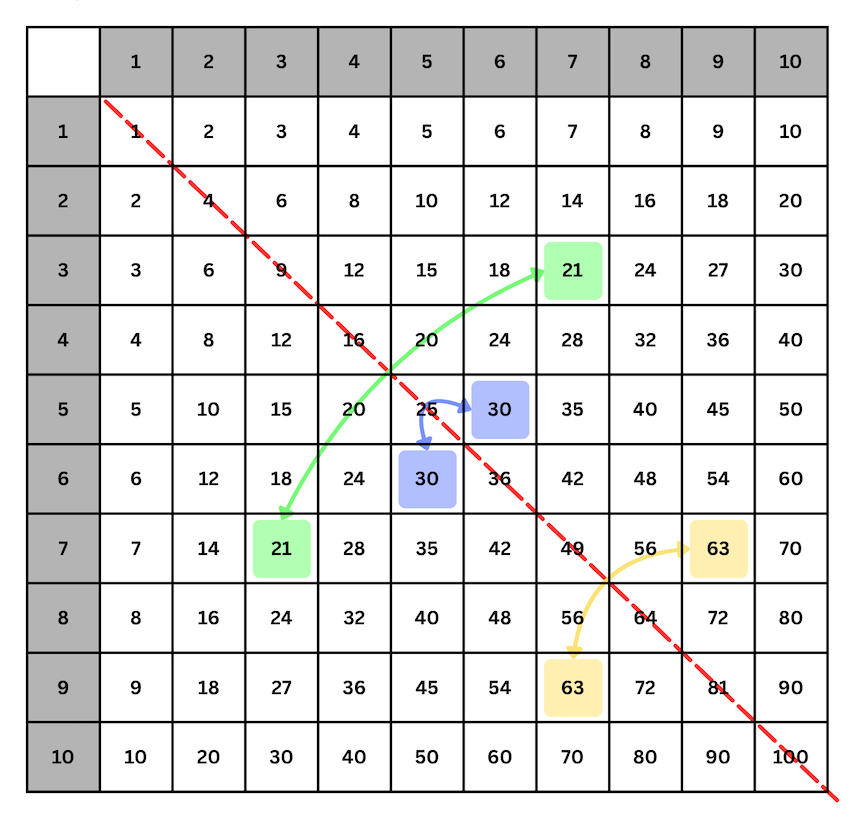
- The Commutative Property: When students analyze the diagonal axis running from $1 times 1$ to $10 times 10$, they discover that products mirror each other (e.g., $3 times 7$ and $7 times 3$ both yield 21). This visual symmetry provides an intuitive introduction to the commutative property.
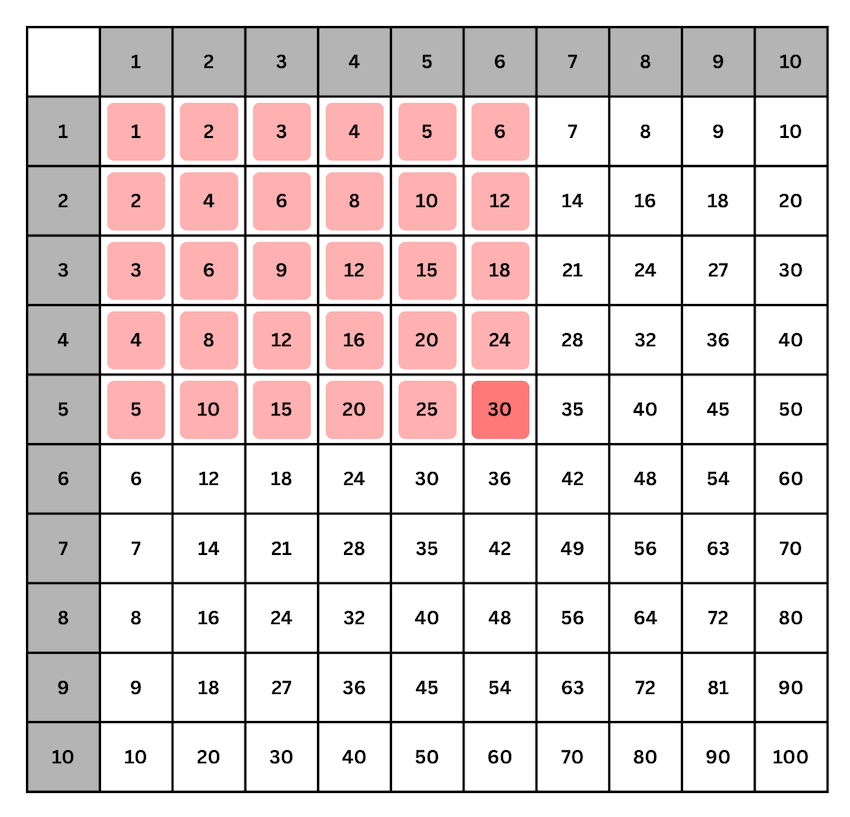
- Area Models: By coloring rectangular blocks originating from the top-left corner, students physically see that the product in the bottom-right cell matches the geometric area of the shaded rectangle, linking arithmetic to early geometry.
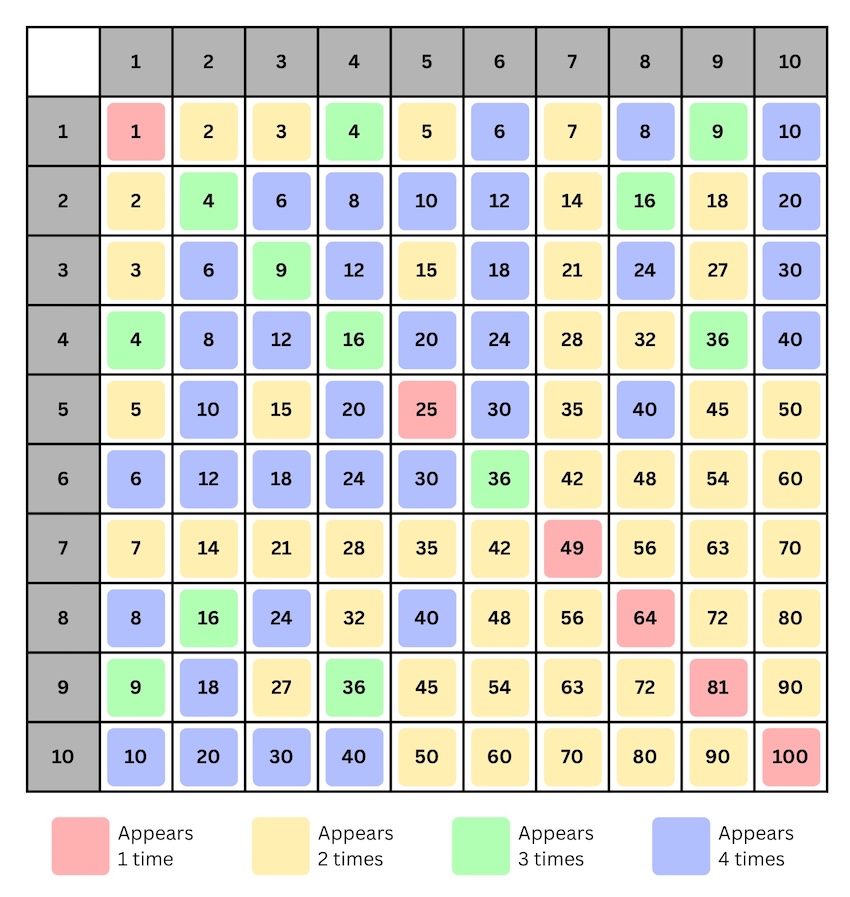
- Frequency Analysis (Mode): Color-coding products based on how many times they appear on the grid reveals asymmetrical distributions—highlighting that numbers like 36 appear multiple times due to diverse factor pairs, while others appear only once (perfect squares) or twice (products of distinct prime pairs).
Upper Elementary and Middle School (Grades 4–8): Advanced Number Theory
- Primes, Composites, and Parity: Upper-grade students can examine extended tables to isolate numbers with unique factor counts. This visual mapping clarifies the definition of prime numbers (exactly two factors) and composite numbers (more than two factors), while setting zero and one apart as unique numerical entities.
- Divisibility Rules: By analyzing rows such as the sixes, students observe that every product is both even (divisible by two) and a multiple of three, prompting deeper investigations into composite divisibility rules.
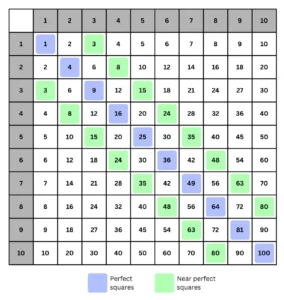
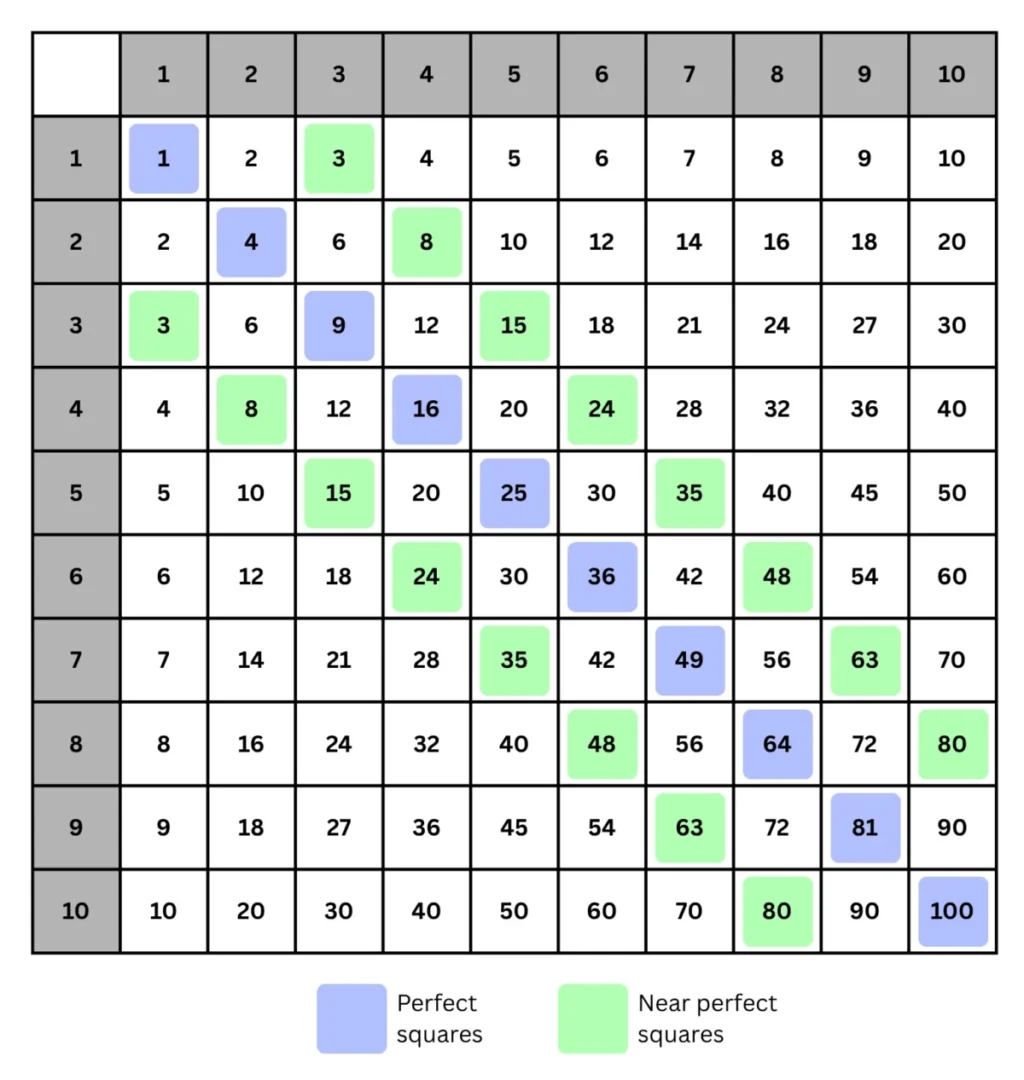
- Near-Perfect Squares: Instructors can direct students to examine diagonals adjacent to the perfect squares (e.g., $4 times 6 = 24$, sitting right next to the square $5 times 5 = 25$). This visual pattern demonstrates algebraic relationships useful for rapid mental math and binomial expansion concepts later on.
- Set Theory and Venn Diagrams: The multiplication table is essentially a collection of intersecting number sets (even numbers, multiples of specific integers, square numbers). Using Venn diagrams to sort data from the table introduces students to set theory and multidimensional relationships long before formal algebra instruction begins.
Official Responses and Expert Perspectives
Math coaches and curriculum specialists emphasize that changing how tools are used in the classroom fundamentally alters student identity and confidence in mathematics.
"When we treat math tools as single-use items, we inadvertently teach children that mathematics is a collection of isolated facts to be memorized," notes a curriculum specialist focused on elementary numeracy. "When we open up tools like the multiplication table to inquiry, investigation, and open-ended questioning, we send a completely different message: math is something you do, something you investigate, and something you can figure out yourself."
Educational psychologists point out that visual and tactile manipulation reduces cognitive anxiety associated with timed math tests. By allowing students to discover rules—such as the identity property or factor relationships—on their own terms, long-term retention and conceptual flexibility significantly improve.
Implications for Future Classrooms
The shift toward multi-use mathematical tools carries broad implications for curriculum design, teacher professional development, and student assessment.
- Curriculum Design: Textbook publishers and digital platforms are increasingly moving away from static worksheets, integrating interactive, customizable grids where students can toggle overlays, highlight factors, and test geometric hypotheses.
- Teacher Professional Development: Educators require training not just in delivering content, but in facilitating open-ended inquiry. Asking effective guiding questions—such as "Why do certain products only appear in specific rows?"—requires a shift from authoritative lecturing to collaborative facilitation.
- Long-Term Mathematical Fluency: By establishing deep conceptual roots in elementary school, students enter middle and high school with an intuitive grasp of factoring, fractions, ratios, and algebraic variables.
Ultimately, educators argue that the lessons learned from rethinking the multiplication table should extend to every item in the classroom manipulatives cabinet. From protractors and fraction tiles to base-ten blocks, every tool holds the potential to serve as a bridge into deeper mathematical reasoning—provided teachers are willing to look past its most basic, single-use application.