Beyond the "Shiny Object": Stanford’s AI Hub Rethinks the Future of K-12 Education
In the rapidly evolving landscape of educational technology, the arrival of generative AI has triggered a gold rush of adoption, often driven by the excitement of novelty rather than pedagogical strategy. However, at Stanford University’s AI Hub for Education—a cornerstone of the SCALE (Stanford Center for Assessment, Learning, and Equity) Initiative—the approach is decidedly more measured.
Led by Managing Director Chris Agnew, the Hub is working to bridge the chasm between cutting-edge technological capability and the practical realities of the classroom. By shifting the conversation from "what can AI tools do?" to "what are our schools trying to achieve?", the Hub is attempting to steer policymakers and educators toward a more intentional, evidence-based integration of AI.
The Genesis of the AI Hub
The Stanford AI Hub for Education was established in January 2025 with a clear, ambitious mandate: to act as a clearinghouse for academic research and a compass for school leaders navigating an increasingly complex technological landscape.
Chris Agnew, who spent two decades working in non-traditional learning environments—including outdoor education and community-based apprenticeships—brings a unique perspective to the role. His career was defined by the belief that immersive, experiential learning is transformative, yet often restricted by its high cost and logistical demands. When ChatGPT debuted, Agnew saw a potential catalyst for change. He realized that AI might finally offer the infrastructure to scale those high-impact experiences, removing the barriers that have historically kept them out of reach for most students.
Chronology of a Shifting Landscape
The development of the Hub’s research agenda has been rapid, matching the pace of AI innovation itself:
- January 2025: The AI Hub for Education is officially founded under the SCALE Initiative.
- Mid-2025: The Hub begins building a comprehensive repository of academic research regarding AI’s impact on learning.
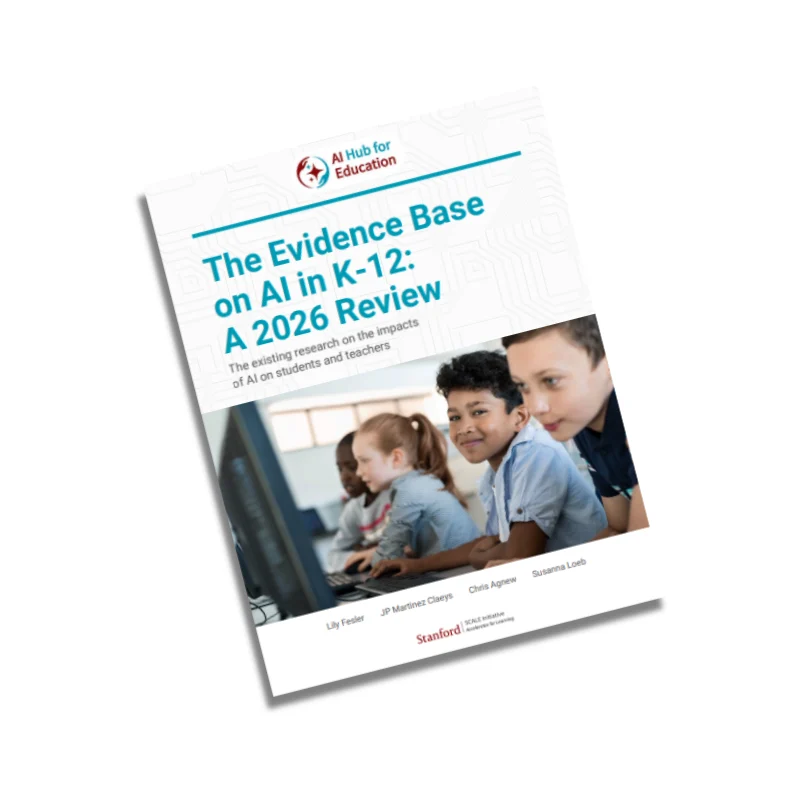
- Late 2025: Publication of Understanding The Evidence Base on AI in K–12 Education, a foundational report identifying key trends and critical gaps in existing research.
- Early 2026: Release of The Learning Experiences that Matter and AI’s Role, co-authored by Agnew, Susanna Loeb, and Cristina Barnard Gonzales. This report serves as a manifesto for the "learning-first" approach to technology.
- Present Day: The Hub continues to facilitate rigorous, controlled studies, including recent evaluations of AI literacy tutors in primary school settings.
The "Learning-First" Framework
The central pillar of the Hub’s philosophy is a rejection of the "tools-first" mentality that has historically dominated ed-tech adoption. Agnew argues that when we introduce new technology simply because it is new, we risk merely digitizing century-old, ineffective systems.
Instead, the Hub’s research team began by asking, "What is school for?" Through a synthesis of existing literature, they identified ten skills linked to long-term success, including academic mastery, higher-order thinking, social-emotional intelligence, and intrinsic motivation.
Their research concluded that five specific learning experiences best develop these capacities:
- Personalized instruction tailored to the individual pace.
- Real-world learning that connects theory to practice.
- Student agency, allowing learners to drive their own discovery.
- Enriching discussions that foster communication.
- Strong, supportive relationships with adult mentors.
By identifying the historical barriers to these experiences—such as rigid scheduling, narrow accountability metrics, and insufficient teacher support—the Hub has positioned AI not as a replacement for the classroom, but as an administrative and pedagogical lubricant that can make these high-value experiences achievable at scale.
Supporting Data: What the Evidence Says
The Hub’s recent reports offer a sobering look at the current state of AI integration. Their analysis of research up to November 2025 reveals that the evidence base is, as of now, surprisingly thin.
The Student Context
In a rigorous study involving 355 elementary students across two school districts, the Hub found that nearly 50% of students failed to engage with AI literacy tutors, even when dedicated time was provided in their schedules. Furthermore, while pairing students with human tutors increased engagement, it did not significantly boost reading achievement.
Key takeaway: AI appears to be most effective when it provides step-by-step, curriculum-anchored support rather than open-ended interaction.
The Educator Context
The results for teachers are more promising. Research indicates that AI can significantly reduce time spent on administrative tasks and provide automated feedback that enhances teaching quality. Notably, the data suggests that these benefits are most pronounced for less experienced educators, who can use AI to "level up" their instructional facilitation and classroom management skills.
Implications for Policy and Innovation
The current market for ed-tech is driven by capitalistic incentives that prioritize short-term, incremental improvements over long-term structural change. Companies build tools that fit into existing school workflows because that is where the revenue lies.
Agnew contends that this creates a dangerous "innovation gap." He suggests that the solution lies in the hands of state-level policymakers. By signaling interest in high-impact, long-term AI applications, states can steer the private market to develop solutions that don’t just replicate the status quo, but fundamentally enhance it.
Recommendations for School Leaders
For superintendents and district leaders, the Hub offers a tiered strategy:
- On Educator Use: Lean in. Focus on AI tools that assist teachers with data synthesis, lesson planning, and professional practice simulation. This is where the evidence is strongest, and where adult discernment can mitigate risks.
- On Student Use: Proceed with caution. Limit unsupervised AI use. The most promising applications involve AI providing targeted practice on specific skills, with the results immediately funneled to a teacher who can intervene with human support.
Addressing the "Screen Time" Debate
As society grapples with the rise of AI, the debate has often been reduced to a simple binary: more screens versus fewer screens. Agnew argues that this is a category error.
"We need to move from a lens of screen time to a lens of screen value," Agnew notes. With the advent of multimodal and voice-based AI, it is entirely possible to envision a future where students engage with sophisticated, intelligent systems without ever staring at a traditional screen. By focusing on the value of the interaction—the development of critical thinking, agency, and social skills—educators can bypass the tired, unproductive arguments of the past.
Conclusion: A Future of Intentionality
The Stanford AI Hub for Education is not advocating for a technological utopia, nor is it suggesting that AI is a magic bullet. Instead, it is calling for a return to pedagogical fundamentals. If AI is to fulfill its promise, it must be deployed not as an end in itself, but as a scaffold for the human relationships and deep learning experiences that have always been the true markers of educational success.
For district leaders and policymakers, the message is clear: the technology is moving fast, but the strategy must be deliberate. By prioritizing "what we want for kids" over the allure of the next upgrade, schools can navigate the AI revolution to build a more responsive, equitable, and effective system for the next generation of learners.