
Mastering the Blueprint of Instruction: A Comprehensive Guide to Backwards Design and Unit Planning

By Educational Insights Desk
Published August 2026
Introduction: Returning to the Fundamentals of Classroom Design
In the ever-evolving landscape of modern education, teachers are continuously bombarded with new pedagogical trends, technological tools, and administrative demands. Amid this shifting tide, educators often lose sight of the foundational core of teaching: instructional planning. Designing an effective unit of instruction can be a daunting, high-stakes task for both novice and veteran educators. When a unit fails to resonate with students or falls short of learning outcomes, the remediation process can feel like rebuilding an airplane mid-flight.
To address this persistent challenge, instructional experts are championing a back-to-basics approach. By breaking down the anatomy of a successful unit into a predictable, step-by-step framework, teachers can reclaim their confidence and ensure that every minute of classroom time serves a distinct, measurable purpose.
This comprehensive guide explores a battle-tested blueprint for instructional design. Whether you are constructing a curriculum completely from scratch or breathing new life into an outdated unit that has never quite worked, this methodology provides a reliable roadmap. Furthermore, this framework serves as the conceptual backbone of Mastering the Lesson Plan, a newly launched professional development course designed to help educators systematically build engaging, rigorous units of instruction.
Main Facts: The Anatomy of Instructional Architecture
Before diving into the mechanical steps of planning, educators must establish a shared vocabulary. Confusion often arises when the terms "standards," "curriculum," and "units" are used interchangeably. Understanding the strict hierarchy of these concepts is the first step toward effective instructional design.
Defining Our Terms: Standards, Curriculum, and Units
- Standards: These are the broad, overarching goals of a course. In public education systems, standards are typically mandated by state or local governing bodies. They outline what students should know and be able to do by the end of a given instructional period.
- Curriculum: The curriculum acts as the vehicle that bridges the gap between goals and execution. It organizes and sequences the vast array of knowledge and skills embedded within standards, grouping them into logical clusters.
- Units: Units are coherent, focused collections of individual lessons that cluster related topics together. A typical semester might consist of five to ten distinct units, each lasting anywhere from a few days to several weeks.
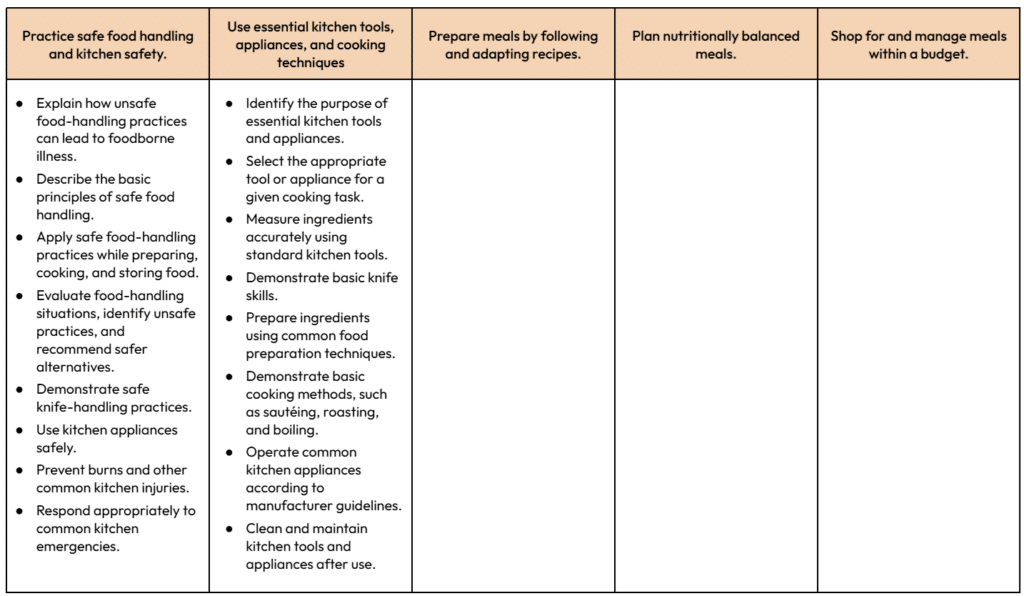
To visualize this structure, consider a hypothetical eight-week community education course titled Cooking Fundamentals, designed for adults learning independent living skills. The instructor begins by defining five broad course goals—the equivalent of state standards. Underneath each goal lies a sprawling network of specific subtopics, tools, and techniques.
For instance, the second standard—utilizing essential kitchen tools, appliances, and cooking techniques—might encompass 15 to 30 distinct appliances, alongside numerous safety rules and preparation skills. Without a curriculum to organize this data into manageable units, the sheer volume of information would overwhelm both teacher and student.
Chronology: The Evolution of Backwards Design
The instructional planning process outlined here is deeply rooted in backward design, a pedagogical framework popularized by educational theorists Grant Wiggins and Jay McTighe in their seminal 1991 publication, Understanding by Design.

Historically, many teachers fell into the trap of forward planning: they drafted daily lessons (sometimes the night before teaching them) and subsequently cobbled together a final exam based loosely on whatever content was covered. Backward design completely reverses this traditional, reactive workflow.
The Three-Phase Chronology of Unit Planning
When constructing a unit using backward design, educators follow a strict, sequential three-step process:
- Phase 1: Setting Measurable Objectives. The educator identifies the specific standards the unit will address and translates them into observable, measurable student outcomes.
- Phase 2: Designing the Summative Assessment. Before drafting a single lesson plan, the teacher designs the final evaluation. This ensures that the destination of the learning journey is crystal clear before mapping the route.
- Phase 3: Planning Daily Lessons. Finally, the instructor builds the daily learning activities, direct instruction, and formative checks that systematically propel students toward success on the final assessment.
Supporting Data: Implementing the Framework in Real Time
To understand how this framework functions in a practical classroom environment, let us return to the Cooking Fundamentals example. Out of the six units mapped out for the course—ranging from grocery budgeting to nutrition—the shortest and most foundational is Food Safety.
Spanning a tight window of three to four days, this micro-unit serves as a pristine laboratory for testing the backward design process.
Step 1: Establishing Measurable Objectives
The first step requires the instructor to look at the course chart under the broad heading of "Practice safe food handling and kitchen safety" and distill it into precise, observable objectives.
A common pitfall in objective writing is the use of non-observable mental verbs, such as "understand," "learn," or "appreciate." Because cognitive processes occur inside a student’s mind, teachers cannot directly measure them without external proof. Therefore, objectives must feature active, observable verbs (e.g., identify, demonstrate, compare, list).
For the Safe Food Handling unit, the instructor establishes four precise, measurable objectives. By the end of the unit, students will be able to:
- Identify the temperature danger zone for perishable foods.
- Demonstrate proper handwashing and cross-contamination prevention techniques.
- Distinguish between safe and unsafe thawing methods for frozen meats.
- Correctly interpret expiration and sell-by dates on food packaging.
To anchor these objectives in a broader conceptual framework, the instructor assigns a unit title—Safe Food Handling—and frames the learning around a central essential question: "How do your choices in the kitchen affect the safety of the food you prepare?" This question transforms a dry list of rules into an engaging inquiry-driven exploration.
Step 2: Crafting the Summative Assessment
With clear objectives established, the instructor moves to Step 2: designing the final assessment. The core question at this stage is not, "What topics did I cover today?" but rather, "What evidence do I need to see to know the students have mastered these objectives?"
Because the Safe Food Handling unit is brief, a lengthy project is impractical. Instead, the instructor designs an open-response scenario test. This assessment presents students with realistic vignettes of individuals preparing meals, intentionally embedding several food safety violations within each story.
Students must:
- Identify the specific safety errors made in the scenario.
- Explain why each error creates a biological or health hazard.
- Propose the correct procedure that should have been used.
This assessment moves beyond rote memorization, challenging students to transfer their newly acquired knowledge to novel, real-world cooking scenarios. (Note: While students will also be evaluated on safe food handling during a comprehensive cooking performance task at the end of the semester, this specific unit test isolates and measures the hygiene and safety objectives directly).
Step 3: Sequencing Daily Lessons
Only after the objectives are written and the assessment is designed does the teacher begin mapping out the daily lessons. Every activity, lecture, and lab in the three-to-four-day sequence is intentionally engineered to prepare students for the scenario-based test.
By ensuring absolute alignment between standards, assessments, and daily instruction, the teacher eliminates "busywork" and maximizes instructional efficiency.
Official Responses and Expert Perspectives
While backward design is widely celebrated in academic literature, it frequently encounters healthy debate among classroom practitioners. A common critique voiced by educators encountering the method for the first time is whether backward design amounts to "teaching to the test."
In traditional educational discourse, "teaching to the test" carries a heavily negative connotation. It implies that instructors are drilling students on arbitrary, external standardized exams that educators have no voice in creating, stripping away authentic learning in favor of test-prep gymnastics.
However, instructional experts emphasize a vital distinction when applying backward design:
- The External Test Paradigm (Negative): Teaching to a high-stakes, institutional test created by outside agencies, which often forces teachers to narrow the curriculum and abandon genuine inquiry.
- The Backward Design Paradigm (Positive): "Teaching to the test" when the test is a meticulously crafted, performance-based assessment designed by the teacher to measure high-quality learning objectives.
When an educator designs an authentic, rigorous assessment aligned directly with meaningful standards, engineering daily lessons to ensure student success on that assessment is not only valid—it is a hallmark of exceptional teaching. It guarantees that the assessment functions as an effective tool for learning rather than merely an administrative hurdle.
Implications for Modern Classrooms
The implications of adopting a structured, backward-designed unit planning process extend far beyond individual lesson organization. When schools embrace systematic unit design, several institutional benefits emerge:
- Reduced Teacher Burnout: Planning units in advance drastically reduces the late-night scramble for daily lesson ideas, lowering stress levels and mitigating educator burnout.
- Equitable Learning Outcomes: When instructional objectives and assessments are clearly defined from the outset, teachers can more easily identify learning gaps and provide targeted interventions for struggling students.
- Enhanced Professional Longevity: While this framework is essential for pre-service and early-career teachers striving to master their craft, it offers equal value to veteran educators. Over time, even experienced teachers can drift from foundational best practices. Re-engaging with structured unit planning helps veterans audit their curricula, eliminate redundant materials, and strengthen weak instructional links.
Moving Forward with Professional Development
For educators seeking to dive deeper into this methodology, structured resources are increasingly accessible. Programs like the newly introduced Mastering the Lesson Plan online course offer self-paced modules designed to walk teachers through every nuance of unit construction, from drafting foundational standards to executing differentiated daily lessons.
Ultimately, effective teaching is not an accident of intuition; it is the result of deliberate, backward-mapped architecture. By setting clear objectives, designing meaningful assessments first, and building intentional daily pathways, educators can transform their classrooms into environments of genuine, lasting student understanding.