The Digital Paper Trail: Why the Future of Online Exam Security Depends on Knowing When to Delete
GLOBAL DIGITAL EDUCATION — The quiet, sweeping migration from brick-and-mortar exam halls to virtual testing environments has unlocked unprecedented scalability for schools, universities, and professional certification bodies worldwide. Yet, beneath the veneer of modern convenience lies a pressing, under-discussed crisis: a massive, rapidly compounding data management challenge.
Traditional, paper-based examinations operated under a straightforward, low-friction lifecycle. Test papers were distributed, completed, stored in filing cabinets according to strict institutional policies, and eventually shredded when they were no longer legally or administratively required.
Online assessments, by contrast, leave an expansive, highly sensitive digital footprint. Beyond standard answers and final scores, modern online testing platforms vacuum up a wealth of invasive metrics. To maintain academic integrity and flag suspicious behavior, institutions now routinely collect biometric identity data, continuous video and audio feeds, live screen captures, room scans, keystroke dynamics, and specialized proctoring telemetry.
Faced with affordable cloud storage and the psychological comfort of keeping everything “just in case” a student appeals a grade, many educational institutions have adopted a dangerous philosophy: data hoarding. However, cyber security and privacy experts warn that hoarding student surveillance data is not a viable strategy. Instead, it creates sprawling compliance liabilities, escalates operational costs, and turns schools into high-value targets for relentless cybercriminal syndicates.
The Evolution of Assessment: From Paper Halls to Digital Surveillance
To understand how modern educational institutions arrived at this regulatory crossroads, it helps to examine the chronological evolution of testing administration and its accompanying security models.
- The Pre-Digital Era (Pre-2000s): Assessments were entirely physical. Security relied on physical proctors, locked storage rooms, and manual ID checks. Data retention policies were simple and bound by physical space constraints; once an appeal window closed, papers were pulped.
- The Early LMS Boom (2000s–2010s): Learning Management Systems (LMS) digitized multiple-choice quizzes and essay submissions. While this reduced physical paper use, data footprints remained relatively small, mostly consisting of text files, timestamps, and IP addresses.
- The Remote Proctoring Explosion (2020–2022): The COVID-19 pandemic forced a global, overnight shift to remote learning. To combat perceived rampant cheating in unsupervised home environments, institutions rapidly deployed automated and live-monitored remote proctoring software. This era normalized the continuous recording of students’ private living spaces, web-browsing habits, and biometric identifiers on a mass scale.
- The Post-Pandemic Reckoning (2023–Present): As remote and hybrid testing solidify into permanent fixtures of education and professional credentialing, institutions are waking up to the long-term legal, financial, and ethical consequences of retaining years’ worth of deeply intrusive surveillance archives.
The Fallacy of Maximum Monitoring: More Surveillance Does Not Equal More Security
Academic integrity is undeniably vital. Institutions must have verifiable proof that the candidate sitting behind the screen is the registered student, and that they completed the exam fairly without unauthorized assistance.
However, a dangerous industry trend has emerged wherein institutions equate the volume of data collected with the strength of their security posture. This "more is better" mindset is fundamentally flawed.
Every additional data point harvested—especially high-definition video recordings capturing a student’s face, voice, minors in the background, and private living quarters—creates a new digital asset that must be managed, encrypted, access-controlled, and eventually purged. Video files, in particular, are exceptionally hazardous because they represent a treasure trove of Personally Identifiable Information (PII).
This reality forces educational leaders and assessment providers to confront a difficult question: Just because technology allows us to record, track, and store a student’s entire testing environment, does compliance and ethics dictate that we must?
The Global Regulatory Landscape
Legislators around the globe are increasingly answering that question with a resounding "no." A complex web of federal and international privacy statutes mandates that institutions restrict data collection to what is strictly necessary:
- United States: Statutes such as the Family Educational Rights and Privacy Act (FERPA) and the Children’s Online Privacy Protection Act (COPPA) strictly regulate how student data is gathered, used, and shared, requiring explicit consent and clear minimization protocols.
- Australia: The Privacy Act 1988 enforces strict Australian Privacy Principles (APPs), requiring entities to destroy or de-identify personal information when it is no longer needed for any authorized purpose.
- Singapore: The Personal Data Protection Act (PDPA) sets rigorous frameworks governing the collection, use, and disclosure of individuals’ personal data.
- South Africa: The Protection of Personal Information Act (POPIA) mandates that personal information must be collected for a specific, explicitly defined purpose and not retained longer than necessary to achieve that purpose.
A truly secure examination strategy must pivot away from indiscriminate surveillance. It must be able to justify the existence of every piece of proctoring data and clearly define the exact sunset date when that data ceases to hold administrative value.
The Forgotten Half of Exam Security: Data Lifecycle Management
While proctoring software vendors frequently face fierce public scrutiny over privacy concerns, the internal management of that data by the educational institutions themselves deserves equal oversight.
Consider a standard institutional workflow: A high-stakes professional certification exam is administered. The results are published, and a formal academic appeal or investigation window is established—typically lasting anywhere from 30 to 90 days. Once that window slams shut, what happens to the terabytes of associated video recordings, keystroke logs, and room scans?
In far too many cases, the answer is nothing. The data sits passively in cloud storage, forgotten, unmanaged, and vulnerable.
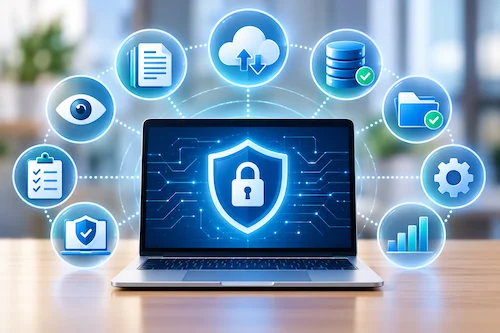
Indefinite storage is not synonymous with robust data governance. Forward-thinking institutions are realizing that online assessment frameworks must be engineered around the complete information lifecycle:
- Collection: Gathering only the minimum data required to verify identity and ensure compliance.
- Access: Restricting data visibility strictly to authorized personnel under multi-factor authentication protocols.
- Storage: Utilizing encrypted, secure repositories aligned with institutional risk frameworks.
- Retention: Maintaining data only for the duration of active appeals, audits, or legal mandates.
- Permanent Deletion: Executing cryptographic erasure or secure data purging once retention periods expire.
Becoming "Data Purge-Ready"
To achieve this, institutions must transition to becoming data purge-ready. A purge-ready organization maintains an exhaustive data inventory: it knows precisely what information it holds, the specific regulatory or operational justification for holding it, and the exact calendar date on which different categories of data are scheduled for automated destruction.
Once the relevant appeal or investigation periods conclude, non-essential proctoring data is securely scrubbed, while core academic transcripts and essential completion records are retained in compliance with institutional archiving rules. Under this model, data deletion ceases to be an irregular, panic-driven IT cleanup project and becomes an automated, routine component of the assessment ecosystem.
The Heavy Financial and Security Toll of Data Hoarding
Beyond regulatory compliance and ethical imperatives, there is a powerful practical argument for restraint: data hoarding is expensive and inherently risky.
While a single online exam generates a seemingly modest amount of digital information, compounding those recordings, audio logs, and monitoring telemetry across tens of thousands of candidates, multiple annual testing cycles, and a multi-year retention window causes storage footprints to explode exponentially.
The financial and operational consequences are severe:
- Inflated Infrastructure Costs: Escalating cloud storage fees, backup expenses, and long-term archiving costs.
- Increased Administrative Burden: IT and cybersecurity teams are forced to monitor, patch, and manage exponentially larger volumes of sensitive data.
- Magnified Breach Impact: The larger the data pool, the more catastrophic the fallout when (not if) a security breach occurs.
The education and professional training sectors are facing an unrelenting wave of cyber attacks. According to recent threat intelligence research from Check Point Research, the education and research sector remains the most heavily targeted industry globally by cybercriminals.
In this hostile threat landscape, aggressive data minimization is no longer merely a legal tick-box exercise. It is a critical architectural and operational defense mechanism designed to reduce attack surfaces, trim administrative complexity, and fortify institutions against catastrophic data breaches.
Official Responses and Industry Insights
As the friction between technological capability and data privacy intensifies, educational technology leaders and legal experts are sounding the alarm.
Chief Information Security Officers (CISOs) across major universities are increasingly pushing back against software vendors who advocate for default, long-term cloud retention of student biometric and video feeds.
"For years, the ed-tech market operated under the assumption that more data equaled more trust," notes an anonymous Chief Information Security Officer at a major North American research university. "We are realizing that the exact opposite is true. Every gigabyte of unnecessary video footage we hold of a student’s bedroom is a liability we didn’t need to accept in the first place. Trust is built on restraint, transparency, and absolute control over our digital borders."
Legal scholars specializing in educational privacy echo these sentiments, emphasizing that institutions failing to establish rigorous, auditable data-purge protocols face severe exposure under emerging global privacy torts and regulatory enforcement actions. Regulatory bodies have made it clear that possessing data that an institution has no legal basis to keep is itself a compliance violation.
Implications: Governance Will Separate Leaders from Laggards
Online assessments are here to stay. Whether in higher education, medical licensing boards, or corporate upskilling programs, remote and hybrid testing models offer unmatched accessibility and scale. Consequently, questions regarding how these platforms handle personal data can no longer be brushed aside.
Institutions and assessment providers must be held to a higher standard, capable of answering five fundamental questions regarding every examination they administer:
- What precise information are we collecting?
- What is our legal and operational justification for needing it?
- Who is authorized to access it, and under what controls?
- How long will we retain it before it loses its administrative value?
- Can we demonstrate a verifiable, auditable trail proving that the data was permanently and securely deleted when that retention window closed?
The next evolution of online assessment will not be defined solely by the sophistication of its monitoring algorithms or the intrusiveness of its proctoring software. Instead, it will be defined by the quality of the information governance surrounding those systems.
Ultimately, true institutional integrity does not stem from collecting the maximum amount of surveillance data possible. It stems from demonstrating rigorous stewardship over the minimal amount of data that genuinely needs to exist. In the modern era of secure online testing, knowing when to press delete is rapidly becoming every bit as important as knowing when to press record.