The Double-Edged Sword: Why AI in the Classroom Is a Tale of Two Extremes
As artificial intelligence rapidly integrates into the global educational landscape, school administrators and policymakers are grappling with a fundamental question: Is AI a transformative engine for student success or an inadvertent catalyst for academic decline?
New research from the University of Maryland, spearheaded by Jing Liu, director of the Center for Educational Data Science and Innovation, suggests that the answer is far from binary. In a pair of groundbreaking studies released this past October, Liu presented a jarring contrast: an AI-powered math tutor that appeared to boost middle school performance, and a university-level AI assistant that correlated with a measurable drop in student engagement and final grades.
These findings, rather than serving as a verdict on the technology itself, act as a cautionary tale about the nuances of implementation, the "five-percent problem" of student engagement, and the unintended psychological effects of AI integration in higher education.
The Core Conflict: A Tale of Two Studies
The two studies, released simultaneously by design, were intended to move the conversation beyond the reductive "all good" versus "all bad" narrative that often dominates ed-tech debates. Liu argues that the field is currently in a "design-and-discovery" phase, where the focus must shift from the technical capabilities of the software to the behavioral responses of the human beings on the other side of the screen.
In the middle school experiment, researchers tracked 6,000 students in Deer Valley, Arizona, as they interacted with an AI platform dubbed "Goblins." In the university experiment, 1,100 students were subjected to a custom-built AI course assistant, with results compared against a control group of 1,200 peers. The findings from these two environments suggest that AI’s efficacy is heavily dictated by age, pedagogical structure, and the nature of the task at hand.
Chronology of the Research
Phase I: The Middle School Intervention (2025-26 School Year)
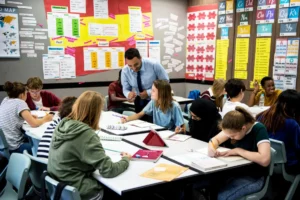
The Goblins project was commissioned by the nonprofit research organization Accelerate to determine if AI could provide scalable, high-quality tutoring. The deployment began at the start of the 2025-26 academic year. Teachers were given autonomy to integrate the platform into their curriculum, using it as a supplemental tool for struggling students. The software offered a multi-modal experience: text-based chat, virtual whiteboards, and, crucially, a voice-enabled cartoon avatar capable of conversing in Spanish and six other languages.
Phase II: The University-Wide Deployment (Fall 2025)
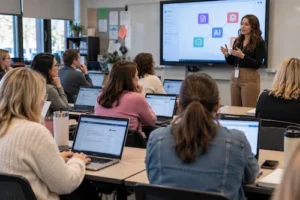
Concurrently, the University of Maryland, under the direction of Provost Jennifer King Rice, initiated a pilot program for an AI assistant integrated into the Canvas learning management system. Liu oversaw a randomized trial involving 30 professors. Half the group was instructed to utilize the AI assistant, which was fed course-specific syllabi, lecture notes, and assignments. The assistant was available 24/7 to answer questions, explain concepts, and guide students through complex material.
Supporting Data: By the Numbers
The "Goblins" Effect in Middle School
The data from the Deer Valley study yielded positive, though nuanced, results. Students who completed at least two problems per week—totaling 50 problems over the school year—demonstrated a statistically significant improvement in year-end standardized math assessments. Accelerate calculated this gain at 0.11 standard deviations, which they equate to roughly three months of additional learning.
However, the researchers were quick to add a caveat: correlation does not equal causation. It is highly probable that the students who voluntarily engaged with the tool were inherently more motivated, potentially confounding the results. Furthermore, while the platform helped reach traditionally underserved demographics, including English learners and students with disabilities, it did not solve the "five-percent problem." Only 6 percent of students achieved the recommended dosage of 30 minutes of usage per week.
The Declining Grades in Higher Education
The university study provided a sobering counterpoint. Students in classes with the AI assistant saw their grades drop by an average of 0.11 points on a 4.0 scale. While a shift from a 3.0 to a 2.9 may seem marginal, the underlying behavioral data was more alarming.
Students with access to the AI assistant were demonstrably less likely to engage with class materials, less likely to participate in online discussion boards, and notably absent from office hours. Perhaps most concerning was the finding that first-generation students—a group historically reliant on proactive instructor engagement—suffered the most significant negative outcomes.
Official Responses and Expert Perspectives
Jing Liu, the primary investigator, has been adamant that these results are not an indictment of AI, but rather a reflection of "unintended usage."
"It was like talking to your own teacher," Liu said of the Goblins platform, noting that the ability to converse with an avatar was a key driver of adoption for students who typically shy away from traditional software.
On the university side, Provost Jennifer King Rice expressed deep concern regarding the potential for technology to exacerbate existing inequalities. "AI tools could exacerbate inequities in learning outcomes," Rice noted in a university publication. "That is particularly troubling to me."
The university’s decision to publish these findings proactively has been lauded by education researchers. By admitting that their home-grown tool—meant to aid students—had the opposite effect, the administration provided a vital service to the broader academic community, demonstrating the importance of "pre-deployment testing."
Implications: The "Five-Percent Problem" and Beyond
The Persistence of Disengagement
The "five-percent problem" remains the most persistent barrier to successful ed-tech integration. For years, platforms like Khan Academy and IXL have struggled with the same reality: a tool can be theoretically perfect, but if only a small fraction of the student body engages with it, its impact on institutional-level outcomes will be negligible. The Goblins study highlights that engagement is often tied to human connection; the cartoon avatar’s ability to speak in a student’s native language acted as a bridge that traditional, static software failed to build.
The Psychology of "Offloading"
The decline in college-level grades poses a more existential question: Are students using AI to learn, or are they using it to bypass the struggle of learning? Liu and Rice hypothesize that the presence of an AI assistant acts as a "permission structure." Even if the university-provided assistant was meant for guidance, its existence on the course page may have signaled that AI is the preferred path to completing assignments.
This leads to the "offloading" of critical thinking. If students utilize an AI to summarize a reading or solve a problem, they skip the cognitive friction necessary for long-term retention. When the AI does the "heavy lifting," the student’s brain is effectively left on the sidelines, leading to the observed drop in final assessment performance.
Future Directions: Designing for Human Behavior
The path forward, according to the research, is not to banish AI from the classroom, but to rethink its design.
- Teacher Agency: The success of the Goblins program was at least partially attributed to teacher control. When instructors curate the problems and integrate the AI into their existing lesson plans—rather than treating it as an autonomous, "all-knowing" tutor—the tool becomes a scaffold for learning rather than a replacement for it.
- Pedagogical Guardrails: The university experiment suggests that AI should not be a "black box" that provides final answers. Future designs must prioritize "Socratic" AI, which refuses to provide direct answers and instead guides the student through the process of inquiry.
- Addressing Equity: Educators must be acutely aware of how tools impact different student populations. If a tool requires a high degree of self-regulation to be effective, it will naturally benefit those with the most existing support structures and harm those who are already struggling.
As we look toward the 2026-27 academic year and beyond, the University of Maryland’s dual-study approach serves as a blueprint for responsible innovation. We are learning that the most important variable in the AI-education equation is not the model’s parameter count or its processing speed; it is the human behavior it triggers. Whether AI becomes a bridge to deeper understanding or a shortcut that leads to intellectual atrophy will depend on our ability to design systems that demand engagement, not just efficiency.