The Radical Pivot: How Unity Environmental University Rewrote the Rules of Higher Education
In an era defined by declining enrollment, soaring operational costs, and an existential crisis regarding the relevance of degrees, the traditional American college model is under siege. While many institutions cling to legacy structures, hoping for a return to the pre-pandemic status quo, one institution in rural Maine has taken a different, more disruptive path.
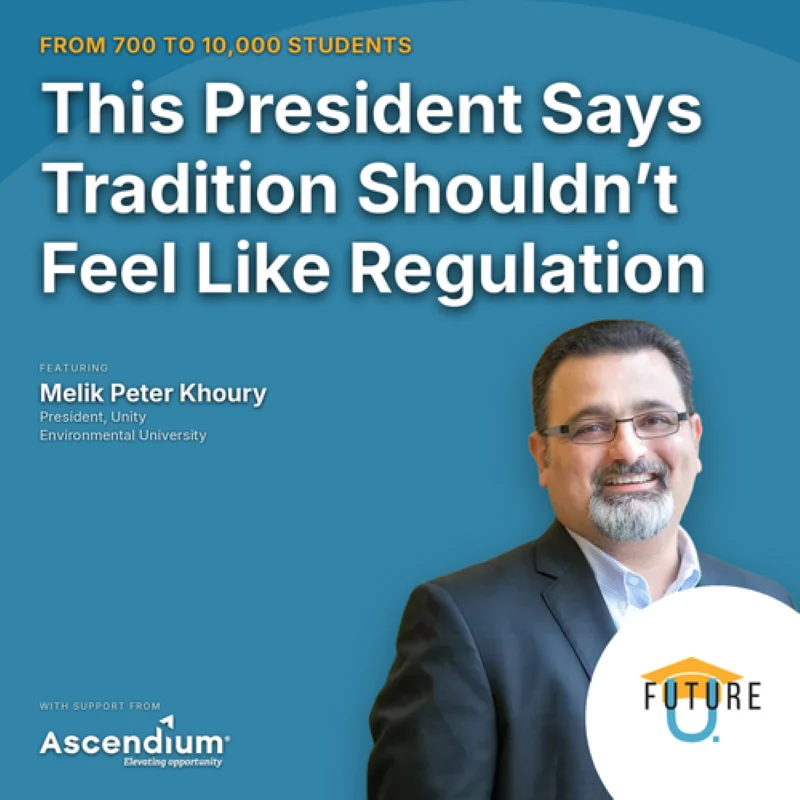
In a recent episode of the Future U podcast, hosts Michael Horn and Jeff Selingo sat down with Melik Peter Khoury, the president of Unity Environmental University. The conversation provided a deep dive into how Khoury orchestrated a dramatic turnaround, transforming a struggling, brick-and-mortar college with a modest enrollment of 700 students into a thriving, online-centric powerhouse serving over 10,000 learners. This shift was not merely a technological upgrade; it was a fundamental deconstruction of the academic status quo.
The State of the Union: Main Facts of the Transformation
At the heart of the Unity story is a rejection of "tradition as regulation." For decades, higher education has been governed by rigid faculty hierarchies, seat-time requirements, and a preoccupation with physical campus expansion. Khoury’s strategy centered on a core philosophical shift: prioritizing the needs of the student over the comfort and preservation of existing institutional employees.
The transformation involved three primary pillars:
- Technological Integration: Moving away from the physical campus as the sole center of gravity to a scalable, hybrid, and online model.
- Structural Agility: Dismantling legacy governance models that often impede rapid decision-making in the face of shifting market demands.
- Faculty Reimagining: Shifting the role of the faculty from traditional gatekeepers of knowledge to facilitators of student success in an AI-integrated economy.
By decoupling the university’s growth from its physical footprint, Khoury was able to achieve what many institutional leaders consider impossible: financial stability paired with rapid, sustainable scale.
Chronology of a Turnaround: From Rural Outpost to Digital Leader
The path to Unity’s current success was not an overnight success story, but a calculated series of strategic pivots.
Phase I: The Recognition of Stagnation
Prior to the pivot, Unity was typical of many small, rural colleges: highly dependent on residential enrollment, facing mounting debt, and operating within a siloed academic structure. Khoury recognized early on that the demographic cliff—the impending decline in the number of 18-year-olds in the U.S.—would render the traditional "residential-only" model obsolete.
Phase II: The Strategic Pivot to Online
The first major hurdle was cultural. Khoury moved to transition the institution’s focus toward online programming, a move that was met with internal skepticism. By diversifying their educational delivery methods, the university began to tap into a national, rather than regional, market. This allowed them to reach working professionals, mid-career switchers, and learners who were geographically isolated.
Phase III: Dismantling Traditional Governance
Khoury’s most controversial, yet effective, move was the restructuring of university governance. He argued that the traditional faculty-senate-heavy model often prioritized the "status quo" over institutional longevity. By streamlining decision-making processes, the leadership team was able to launch new programs, adapt curriculum to industry needs, and scale operations in months rather than years.
Phase IV: Embracing the AI Era
The final phase of the transformation—and the one that continues today—is the integration of Artificial Intelligence. Rather than banning or fearing the technology, Unity has moved to embed AI literacy into its operational and pedagogical frameworks, positioning the university as a leader in the ethical deployment of machine learning in higher education.
Supporting Data: Scaling in a Volatile Market
The efficacy of Khoury’s approach is reflected in the numbers. Moving from 700 to 10,000 students represents a growth trajectory that defies the current downward trends seen in higher education.
| Metric | Pre-Pivot Status | Post-Pivot Status |
|---|---|---|
| Enrollment | 700 Students | 10,000+ Students |
| Delivery Model | Residential-centric | Online/Hybrid-centric |
| Operational Focus | Employee preservation | Student-success outcomes |
| Governance | Traditional/Hierarchical | Agile/Market-responsive |
The financial implications of this shift are equally stark. By reducing the overhead costs associated with maintaining a large, aging physical campus and moving toward a modular, online-first model, the university has been able to lower its "cost-per-student" ratio, allowing for more competitive pricing and reinvestment into academic technology.
Official Responses and Philosophical Shifts: The AI Question
Perhaps the most compelling part of the dialogue between Khoury, Horn, and Selingo was the discussion regarding the role of higher education in the age of Artificial Intelligence.
Khoury holds a contrarian view to many of his peers in the ivory tower. While many universities are currently embroiled in debates regarding plagiarism, academic integrity, and the death of the essay, Khoury suggests that this focus is misplaced. "We in higher ed have an obligation to stop being afraid of it," Khoury noted during the podcast.
He argues that the university’s primary role should be to serve as an objective research hub for AI. By understanding the technology—its limitations, its biases, and its potential—the university can provide a service to society that is currently lacking: a neutral, evidence-based assessment of AI.
"Start to become the organization that has the objectivity to research it, understand it, embrace it so that we can be the folks who can say without question, when is AI dangerous and when it isn’t," Khoury stated. This is not just an academic stance; it is a branding strategy that positions Unity as a forward-thinking institution that is not merely "teaching" students, but "preparing" them for a reality where AI is a constant companion in the workforce.
Implications: The Future of the "Unity Model"
The success of Unity Environmental University raises profound questions for the rest of the higher education sector. Can this model be replicated by larger, more entrenched research universities? Or is this a "small college" advantage that cannot be scaled to the Ivy League or the massive state systems?
The Death of "Academic Exceptionalism"
Khoury’s approach implicitly challenges the concept of academic exceptionalism—the idea that universities are immune to the market forces that reshape every other industry. By applying principles of business agility, lean operations, and customer-centric design, Khoury has proven that institutions can survive without sacrificing their mission.
The Faculty-Student Contract
The most challenging implication is the shift in the faculty-student contract. By prioritizing student needs over "employee preservation," Khoury has ignited a necessary debate about the role of the professor. Is the professor a content curator, a researcher, or a mentor? In a world where content is abundant and AI can provide immediate, personalized tutoring, the role of the faculty must evolve. At Unity, the faculty are being asked to adapt to a model where their value lies in human-to-human connection and high-level synthesis, rather than the rote delivery of lecture material.
A New Standard for Sustainability
Finally, Unity is proving that institutional sustainability is directly tied to the ability to iterate. In an environment where the "half-life" of a skill is shrinking, universities cannot afford to keep curricula static for five or ten years. The Unity model suggests that the university of the future must be a living, breathing, adaptive organism.
Conclusion: A Blueprint for the Bold
As the higher education landscape continues to contract, the story of Unity Environmental University serves as both a case study and a warning. It is a case study in how to survive by embracing the inevitability of digital transformation and agile governance. It is a warning to those who believe that prestige alone will insulate them from the coming wave of closures and consolidations.
Melik Peter Khoury’s tenure at Unity has been characterized by a willingness to be unpopular in the short term for the sake of institutional viability in the long term. By dismantling the "regulation" of tradition, he has allowed his university to do what many others have failed to do: thrive in the face of uncertainty. For those in the academic sector, the message is clear—the future belongs to those who stop fearing the change and start building the architecture to support it.
The episode of Future U featuring Khoury is a mandatory listen for anyone interested in the future of education. It provides not just a roadmap for change, but a necessary challenge to the complacency that has long defined the American university experience. Whether or not other institutions have the courage to follow suit remains the defining question of the next decade in higher education.