Bridging the Gap: How Empathy, Dialogue, and Community Tracking Turn Vaccine Hesitancy into Lifesaving Action in Nigeria
Introduction: The Anatomy of Vaccine Hesitancy
For nearly two decades, the concept of childhood immunization was a bridge too far for Mrs. Favour, a resident and hairdresser in the Yenegwe community of Bayelsa State, Nigeria. While public health campaigns celebrated incremental victories in disease eradication across the globe, Mrs. Favour’s household remained a silent fortress against modern medicine. By the time her youngest child, a baby girl named Rejoice, reached the age of one, she had never received a single drop of polio vaccine, a single injection of the pentavalent vaccine, or any other preventative antigen. Rejoice was a statistical reality that haunts global health agencies: a "zero-dose" child.
Zero-dose children—those who have not received the initial dose of diphtheria, pertussis, and tetanus (DPT1) vaccine—represent the most vulnerable fraction of the global population. They are the primary targets of vaccine-preventable diseases, living at the ragged edge of health equity. Yet, as Mrs. Favour’s story illustrates, zero-dose status is rarely a reflection of parental negligence or outright malice. Instead, it is almost universally rooted in real, unaddressed fear, born out of past trauma, systemic communication failures, and a vacuum of empathetic guidance.
On June 10, 2026, during a routine outreach session conducted by the Yenegwe Primary Health Center with technical and logistical support from JSI (John Snow, Inc.), that longstanding wall of mistrust crumbled. It did not fall to mandates, coercion, or bureaucratic pressure. It fell to a single, empathetic conversation. This feature explores the journey of Baby Rejoice and her mother, examining how active listening, community health mobilization, and robust defaulter-tracking systems are transforming immunization landscapes in rural Nigeria.
Main Facts: The Stakes of Zero-Dose Children in Bayelsa State
The global public health community recognizes that reaching zero-dose children is the single most effective strategy for reducing under-five mortality and achieving universal health coverage. In Nigeria, despite substantial investments by federal and state governments alongside international developmental partners, pockets of vaccine hesitancy persist. These hesitations are frequently localized, deeply cultural, and heavily influenced by historical encounters with adverse events following immunization (AEFI).
When Mrs. Favour had her first child—now 19 years old—the infant experienced a severe reaction following routine immunizations. The baby suffered from high fevers, persistent restlessness, and acute intestinal distress. Although the child eventually recovered, the terrifying episode left an indelible psychological scar on the young mother. In the absence of medical guidance or follow-up counseling, Mrs. Favour drew a catastrophic conclusion: immunizations were dangerous poisons disguised as medicine.
For the next two decades, this fear dictated her maternal decisions. She refused vaccines for all five of her children.
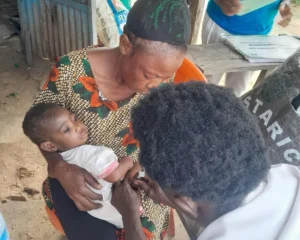
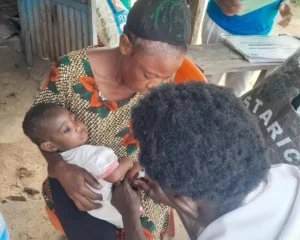
The turning point arrived at the Yenegwe outreach session, where JSI’s Bayelsa State advocacy, communication, and social mobilization (ACSM) officer, Esogenwune Nwabueze, identified Baby Rejoice as a zero-dose child. Rather than treating the mother as an obstacle to be overcome, the ACSM officer treated her as a partner whose concerns deserved validation.
Through patient, evidence-based counseling, Nwabueze explained the mechanics of AEFIs. He clarified that common post-vaccination reactions—such as mild fever or local swelling—are not necessarily causal failures or toxic poisoning, but rather the normal immune system responding and building strength. He outlined specific danger signs to watch for and detailed the exact, actionable steps a caregiver should take if complications arise.
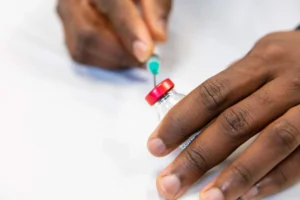
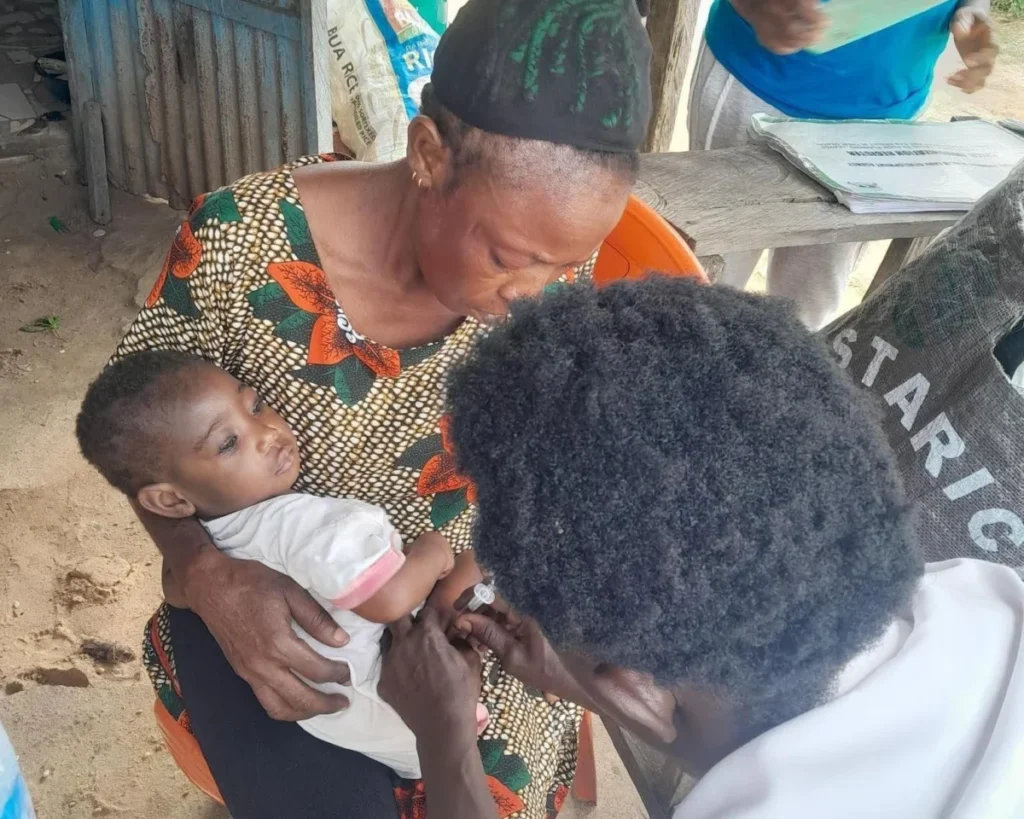
Armed with accurate information for the first time in 19 years, Mrs. Favour made an informed, voluntary decision. Baby Rejoice received six life-saving vaccines in a single session, protecting her against a battery of deadly diseases:
- Tuberculosis (TB)
- Poliomyelitis (Polio)
- Hepatitis B
- Diphtheria
- Pertussis (Whooping cough)
- Tetanus
- Pneumonia
- Rotavirus
- Meningitis
Chronology of an Intervention: From First Contact to Complete Protection
The transformation of Mrs. Favour’s household did not happen in a vacuum; it was executed through a carefully coordinated sequence of events, home visits, and institutional tracking mechanisms that span several weeks.
Phase 1: The Initial Breakthrough (June 10, 2026)
During the Yenegwe Primary Health Center outreach session supported by JSI, field officers actively scanned the community for unimmunized infants. Baby Rejoice was flagged. Esogenwune Nwabueze approached Mrs. Favour, who was naturally defensive given her history. By practicing active listening and showing genuine empathy toward her past trauma, Nwabueze dismantled her objections. Mrs. Favour consented, and Baby Rejoice received her foundational batch of antigens.
Phase 2: Reinforcing Confidence (June 11, 2026)
Recognizing that the hours immediately following vaccination are critical for anxious parents—and that early anxiety can cause caregivers to default on subsequent visits—Nwabueze executed a follow-up home visit the very next day. He checked on Baby Rejoice, confirmed she was managing normal post-vaccination symptoms well, and answered lingering questions. Simultaneously, he integrated Rejoice’s profile into the local health infrastructure, sharing her details with the Yenagoa immunization officer and the primary health facility team to ensure continuous institutional support.
Phase 3: The Missed Appointment and Defaulter Tracking (July 2026)
Despite the initial success, the road from hesitancy to complete acceptance is notoriously non-linear. Baby Rejoice was scheduled to return for her next round of vaccinations exactly one month later, but she missed the appointment. In many health systems, a missed appointment marks the permanent loss of a child to the defaulter pool.
However, because the Yenagoa immunization office had been looped into the case, the system activated its safety net. Immunization officers visited Mrs. Favour directly at her home. They reassured her that the upcoming vaccines were age-appropriate, necessary, and designed to close her child’s immunity gap rather than harm her.
Phase 4: Closing the Immunity Gap (August 2026)
Buoyed by the reassuring home visit, Mrs. Favour brought Baby Rejoice back to the clinic the following month. The infant successfully received her remaining missed antigens, including subsequent doses of Penta 2, Polio 2, rotavirus, and crucially, malaria prevention antigens. The loop was closed, and Rejoice was firmly placed on the path to a fully immunized childhood.
Supporting Data and Perspectives from the Field
The success in Yenegwe is emblematic of broader strategic shifts occurring across Bayelsa State under the leadership of the Bayelsa State Primary Health Care Board (BSPHCB) and international partners like JSI. Public health statistics consistently demonstrate that community-based interpersonal communication significantly outperforms mass-media-only campaigns when dealing with deeply entrenched vaccine hesitancy.
According to health workers on the ground, zero-dose concentrations are frequently found in marginalized communities where access to health infrastructure is intermittent, and where misinformation travels faster than verified medical facts.
Esogenwune Nwabueze, the JSI Bayelsa ACSM officer who counseled Mrs. Favour, articulated the core philosophy driving their fieldwork:
"Every caregiver deserves accurate information so they can make informed decisions for their children. Many vaccine refusals are rooted in fear, misinformation, or past experiences. Listening is often the first step toward building trust."
This sentiment is echoed by institutional leadership at the highest levels of the state’s health governance. Dr. Williams Appah, Executive Secretary of the Bayelsa State Primary Health Care Board, emphasized the collaborative nature of this victory:
"No child is beyond reach when communities, health workers, and partners like JSI work together. At the Bayelsa State Primary Health Care Board, we remain committed to identifying and reaching every zero-dose and under-immunized child with life-saving vaccines."
Implications for Public Health Policy and Future Outreach
The case of Baby Rejoice and Mrs. Favour offers critical lessons for public health strategists, policymakers, and non-governmental organizations operating in similar developing contexts across Sub-Saharan Africa.
1. Moving Beyond Coercion to Empathetic Counseling
Historically, public health initiatives in low-resource settings have sometimes relied on top-down directives, scolding parents, or threatening social penalties for non-vaccinating families. The Yenegwe intervention proves that empathetic, non-judgmental dialogue yields infinitely better results. When health workers validate a parent’s past trauma—such as Mrs. Favour’s experience with her eldest child—they dismantle the adversarial dynamic between the state and the citizen.
2. The Critical Need for Defaulter-Tracking Infrastructure
Identifying a zero-dose child during an outreach session is only the first step. The real test of a health system lies in its ability to prevent default. Baby Rejoice’s missed appointment in July could easily have resulted in her slipping back into unimmunized obscurity. The seamless communication channel established between the JSI mobile mobilization officer and the Yenagoa fixed facility immunization officer transformed a potential drop-out into a retention success story. Strengthening data-sharing networks and assigning explicit accountability for follow-up visits must become standard operating procedure across all primary healthcare centers.
3. Addressing AEFIs Proactively
A significant driver of secondary vaccine hesitancy is the phenomenon of AEFIs. When children develop fevers or swellings and parents are left uninformed, imaginations run wild, and rumors spread like wildfire through tight-knit communities. Public health programs must institutionalize pre-vaccination counseling regarding normal side effects. If every caregiver is told before the injection what symptoms to expect and how to manage them at home, the panic that fuels long-term refusals can be preempted.
Conclusion: A Mother’s Reversal as a Beacon of Hope
For Mrs. Favour, the journey from a 19-year-long boycott of immunizations to holding a vaccinated, protected baby girl was transformative. Reflecting on her shift in perspective, she shared:
"After my experience with my first child, who is 19 years old, I refused vaccines for all my children because I believed immunization was dangerous. Nobody had explained to me that those reactions could happen and what to do about them. Today, they listened and answered my questions. This gave me the confidence to allow Baby Rejoice to be vaccinated."
Mrs. Favour’s testimonial stands as a powerful indictment of past communication failures, but more importantly, it serves as a beacon of hope for public health workers. It proves that no mind is permanently closed to science when approached with patience, respect, and truth. As Bayelsa State continues its tireless campaign to track, reach, and protect every zero-dose child, stories like Baby Rejoice’s light the way forward—proving that trust, once broken, can always be rebuilt one conversation at a time.