The New Frontier: Why University Research Must Evolve Beyond the Federal Safety Net
The landscape of American higher education is undergoing a quiet, seismic shift. For nearly eighty years, the relationship between the federal government and the nation’s research universities has been defined by a symbiotic, post-World War II compact. However, as the global economy accelerates and technological disruptions like artificial intelligence reshape the industrial landscape, that foundation is showing signs of deep structural fatigue.
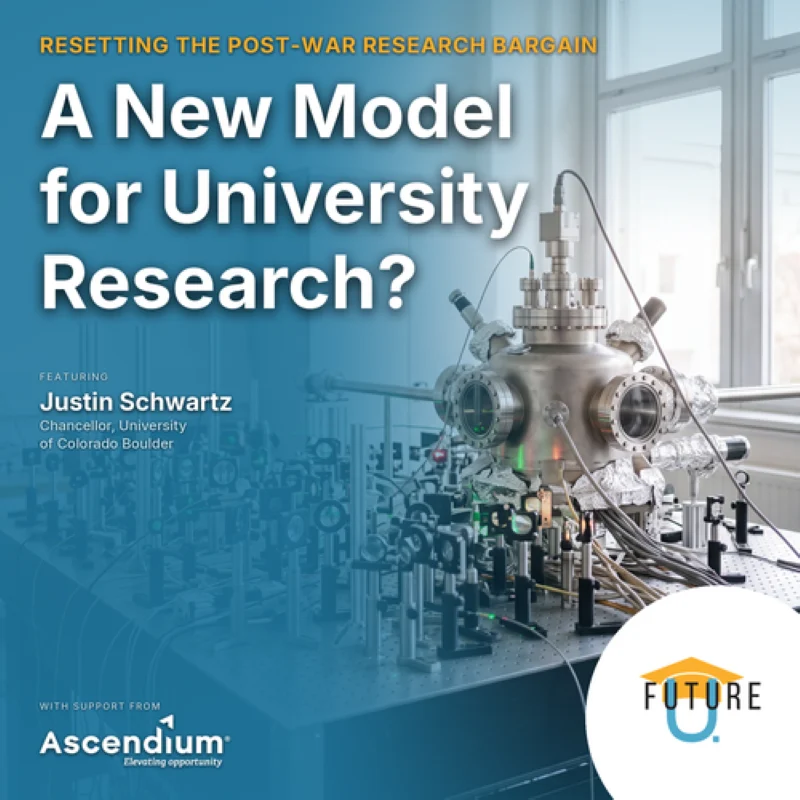
In a recent episode of the Future U podcast, hosts Michael Horn and Jeff Selingo sat down with Justin Schwartz, the Chancellor of the University of Colorado Boulder, to dissect this shifting paradigm. The conversation explored a critical reality: the days of automatic federal funding as the primary engine for academic discovery are waning. To remain relevant, universities must pivot from being passive recipients of government grants to becoming proactive engines of economic and societal impact.
The Main Facts: A Post-War Model in Flux
For generations, the "Bush model"—named after Vannevar Bush’s 1945 report, Science, The Endless Frontier—has served as the gold standard for American research. It established that the federal government would fund basic research at universities, which would then lead to commercial applications, societal progress, and national security.
However, Chancellor Justin Schwartz suggests that this model is no longer sufficient. Three primary factors are destabilizing this arrangement:
- The Stagnation of Federal Appropriation: While federal funding remains significant, it has not kept pace with the rising costs of laboratory infrastructure, specialized personnel, and the sheer scale of modern interdisciplinary research.
- The Rise of Private Industry: Corporations are increasingly encroaching on the territory once held exclusively by academia. With their massive data sets and rapid development cycles, private entities are demanding more direct, translational research rather than the long-term, theoretical "blue-sky" research historically championed by universities.
- The AI Disruptor: Artificial intelligence has fundamentally altered the R&D process. It allows for high-speed simulation and data synthesis, reducing the time from hypothesis to prototype. This acceleration forces universities to move faster or risk being left behind by industry labs.
Schwartz argues that the fundamental problem is one of mindset. Universities have spent decades operating under the assumption that the federal government owes them a baseline level of support. In the current fiscal climate, that expectation is no longer a viable strategy for survival or innovation.
Chronology: From the Manhattan Project to the AI Era
To understand the urgency of Schwartz’s argument, one must look at the historical timeline of university-government relations.
The Foundation (1945–1960s)
The post-WWII era saw the birth of the National Science Foundation and a massive influx of Department of Defense funding. Universities were viewed as the intellectual arm of the state. This period cemented the "publish or perish" culture, where academic prestige was detached from commercial utility.
The Era of Commercialization (1980–2000s)
The Bayh-Dole Act of 1980 was a turning point. It allowed universities to retain ownership of inventions created with federal funding, incentivizing tech transfer offices and patent filing. This era saw universities begin to act more like incubators.
The Fiscal Squeeze (2010–2020)
As the national debt grew and political polarization increased, the predictability of federal grants began to erode. Research universities faced "sequestration" and budget volatility, leading to a scramble for alternative revenue streams.
The Modern Pivot (2024 and Beyond)
Today, we are in the era of "Value Demonstration." Chancellor Schwartz notes that the current environment requires universities to prove their worth not just in scholarly citations, but in tangible economic outcomes. The integration of AI into every facet of research has made this evolution a matter of urgency rather than a luxury.
Supporting Data: The Funding Gap
While the rhetoric surrounding university research often focuses on prestige, the cold, hard data paints a more complex picture. According to the National Science Foundation’s Higher Education Research and Development (HERD) Survey, while total expenditures continue to climb, the percentage of that funding derived from federal sources has seen a slow, steady decline over the last three decades.
Conversely, industry-sponsored research has grown as a percentage of total university portfolios. Universities like CU Boulder and others in the Association of American Universities (AAU) are increasingly leaning on:
- Public-Private Partnerships (P3s): Long-term agreements where corporations fund specific labs in exchange for proprietary access to research outcomes.
- Philanthropic Endowments: Shifting the burden of long-term "moonshot" projects onto private donors rather than the taxpayer.
- State-Level Economic Development Grants: Tailoring research to address specific regional needs—such as water conservation in the West or renewable energy in the Midwest—to unlock state-level budget support.
The data suggests that the institutions thriving today are those that have successfully diversified their funding portfolios, moving away from a reliance on the "federal grant cycle" toward a more resilient, multi-stakeholder model.
Official Responses and Strategic Shifts
Chancellor Justin Schwartz’s vision for CU Boulder serves as a blueprint for this transition. His approach is not to abandon federal funding, but to reframe the university’s value proposition.
"How do we get away from this mindset of a built-in expectation that the federal government has to do this?" Schwartz asks. His answer lies in "impact-based storytelling." Universities, he argues, must clearly articulate how their research translates into local jobs, healthcare breakthroughs for the state, and solutions to global climate challenges.
Other academic leaders are echoing this sentiment. The consensus among university presidents is shifting toward:
- Translational Research: Prioritizing projects that have a clear path to market or public policy implementation.
- Interdisciplinary Clusters: Breaking down departmental silos to focus on "wicked problems" that require cross-functional teams, which are more attractive to private and foundation donors.
- Entrepreneurial Ecosystems: Creating on-campus incubators that keep talent and intellectual property within the university’s orbit for as long as possible.
Implications: The Future of the Research University
The shift toward a new model of university research carries profound implications for the future of higher education and society at large.
1. The Threat to Basic Research
The primary danger of moving away from federal support is the potential erosion of "blue-sky" research—the kind of curiosity-driven inquiry that doesn’t have an immediate profit motive but often leads to the greatest breakthroughs. If universities become beholden to industry, will they still be free to explore the fundamental mysteries of the universe that do not promise an immediate return on investment?
2. A New Standard of Academic Accountability
Universities will likely face increased scrutiny regarding their research outcomes. The days of "publish and walk away" are ending. If a university takes funding from a state or a private partner, it must now demonstrate how that research benefits the stakeholder. This shift will require a change in how faculty are tenured and promoted, moving beyond mere citation counts to include societal impact metrics.
3. Regional Inequality
There is a risk that this new model will exacerbate the divide between wealthy, well-connected research institutions and smaller, regional universities. If funding is tied to proving economic impact, institutions in thriving urban hubs will have a distinct advantage over those in rural or economically depressed areas.
4. The AI Imperative
As Schwartz emphasizes, AI is not just a tool; it is a catalyst. Universities that fail to integrate AI into their research workflows will find their costs too high and their speeds too slow to remain competitive. The race is now on to see which universities can build the necessary computational infrastructure to remain the primary drivers of innovation in an AI-driven economy.
Conclusion: A Call to Action
The era of the "entitled university"—one that assumes its value is self-evident and its funding guaranteed—is coming to a close. Chancellor Justin Schwartz’s assessment is a wake-up call to the academy. By shifting the focus toward clear, tangible, and localized impact, universities have an opportunity to redefine their relationship with the public and private sectors.
The transition will not be easy. It requires a cultural shift within faculty senates, a change in how institutions interact with the private sector, and a new level of transparency regarding the value of academic research. However, the alternative—a slow decline into obsolescence as the rest of the world speeds ahead—is far less palatable.
As we look toward the future, the universities that thrive will be those that embrace their roles as dynamic, responsive, and essential components of the broader global economy. The frontier is still endless, but the path to get there has changed forever.
To hear the full conversation with Chancellor Justin Schwartz, listeners can access the Future U podcast at futureupodcast.com.