
Beyond the Handbook: Why K-12 School Districts Must Move Past Blanket AI Policies to Ensure Classroom Equity
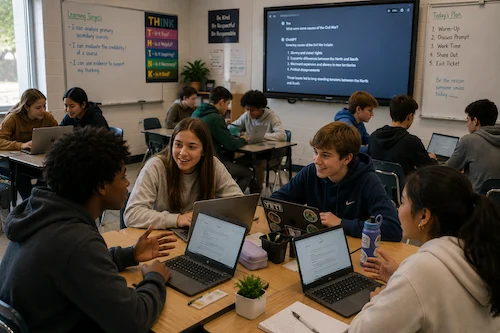
By Chelsie Thielen, Winona State University
Published by eSchool News
Main Facts: The Illusion of Neutrality in Classroom AI
Artificial intelligence has officially crossed the threshold from a futuristic novelty to an everyday operational reality in K-12 education. Across the United States, students use Large Language Models (LLMs) to brainstorm essay topics, debug computer code, and translate complex texts. Simultaneously, teachers leverage automated systems to draft lesson plans, summarize formative assessments, and personalize reading interventions.
However, as the adoption rate accelerates, a growing body of educational research reveals a sobering truth: current generative AI tools are fundamentally unequipped to manage the nuanced realities of diverse classrooms. Lacking genuine common sense, moral reasoning, and real-time awareness of individual classroom dynamics, LLMs frequently replicate, amplify, and entrench systemic biases.
Despite these high-stakes risks, most school districts continue to address artificial intelligence through passive, generalized policy statements. Frequently inspired by high-level guidance from state agencies—such as the Minnesota Department of Education’s Guiding Principles for AI in Education—these frameworks offer an important starting point. Yet, they remain largely non-binding and structurally detached from the messy, fast-paced realities of daily instruction.
A vague disclaimer embedded in a district handbook or tacked onto the bottom of a course syllabus will not protect student agency, nor will it close the widening digital equity gaps. Ethical AI implementation cannot be solved with a one-time administrative memo. Instead, it demands rigorous technical scrutiny, expansive stakeholder collaboration, and continuous, accessible professional development for every educator and administrator in the building.
Chronology: The Evolution of K-12 AI Integration and Policy
To understand where educational technology stands today, it is essential to trace how K-12 systems have reacted to the rapid evolution of generative artificial intelligence:
- Late 2022: The public release of OpenAI’s ChatGPT triggers panic across the educational landscape. Fearing widespread academic dishonesty and the death of traditional essay writing, hundreds of school districts across the country implement immediate, reactionary bans on AI tools, blocking access on school networks and personal devices.
- 2023: As students easily bypass network-level restrictions using personal smartphones and home internet connections, educators realize that outright bans are entirely unsustainable. Districts begin shifting from prohibition to containment, encouraging teachers to figure out "unofficial" rules for AI use on a classroom-by-classroom basis.
- Early to Mid-2024: State departments of education recognize the regulatory vacuum and begin issuing advisory frameworks. Documents such as Minnesota’s Guiding Principles for AI in Education provide high-level ethical considerations, data privacy checklists, and broad recommendations regarding academic integrity.
- Late 2024 to 2025: Researchers and classroom practitioners begin documenting the unintended consequences of uncritical AI adoption. Studies highlight how generic LLM outputs disadvantage English Language Learners (ELLs), misinterpret neurodivergent student writing styles, and perpetuate socio-cultural stereotypes. Non-binding state frameworks prove too abstract to help teachers navigate daily instructional dilemmas.
- Present Day: Educational experts and researchers—drawing from advanced equity frameworks like M. Lockwood’s Equity Bias Framework—argue for a pivot. Schools are urged to abandon passive compliance models in favor of active, three-part operational equity practices that position teachers and administrators as active auditors of educational technology.
Supporting Data and Underlying Risks: Unmasking Hidden Pitfalls
To successfully govern AI in schools, educational leaders must first acknowledge that technology is never neutral. When school districts adopt off-the-shelf commercial LLMs without rigorous vetting, they inherit a host of structural, socio-cultural, and pedagogical risks:
1. Cultural Homogenization and Linguistic Bias
Commercial LLMs are trained on vast, internet-scale datasets that disproportionately reflect Western, middle-class, Standard American English norms. When students submit writing that incorporates regional dialects, African American Vernacular English (AAVE), or multilingual sentence structures, LLMs frequently flag these authentic expressions as "grammatically incorrect" or "low quality." Relying on AI to grade, revise, or evaluate student writing risks penalizing students for their cultural and linguistic heritage, pushing them toward a homogenized, algorithmic standard of expression.
2. The Illusion of Objectivity and Cognitive Offloading
Students—and occasionally educators—tend to treat AI outputs as authoritative, objective facts rather than probabilistic guesses generated by statistical models. When students blindly trust AI-generated summaries or research outlines, they engage in passive cognitive offloading. They bypass the critical struggle of synthesizing information, evaluating source credibility, and constructing independent arguments. Over time, this erosion of critical thinking diminishes student agency and deepens academic dependency on proprietary software.
3. Exacerbating the Digital and Resource Divide
Affluent school districts and well-resourced private schools are rapidly purchasing specialized, enterprise-grade AI platforms equipped with robust privacy safeguards, tailored prompt libraries, and dedicated instructional coaching. Conversely, underfunded rural and urban districts often rely on free, consumer-grade tools that monetize user data, offer weaker privacy protections, and lack localized pedagogical support. This discrepancy creates a two-tiered educational system where privileged students are taught to be sophisticated "AI co-pilots," while marginalized students face restricted access or unmonitored exposure to algorithmic bias.
Official Responses and Perspectives: Bridging Policy and Practice
The debate surrounding AI governance in schools has galvanized educational leaders, state policymakers, and classroom researchers.
State departments of education have defended their initial guidance documents as necessary foundational steps. Representatives from regional educational service agencies emphasize that state-level frameworks are intentionally designed to be flexible, allowing local school boards the autonomy to craft policies that reflect their specific community values. State officials argue that rushing to mandate rigid, statewide technological mandates could stifle grassroots innovation and leave schools legally liable as rapidly updating software outpaces static legislation.
However, classroom practitioners and educational researchers argue that this administrative caution leaves teachers stranded on the front lines. Chelsie Thielen, a veteran educator and doctoral researcher at Winona State University, notes that the gap between state-level theory and classroom reality is widening:
"The issues classroom teachers are facing will not be solved from a vague, general statement placed in a district handbook or tacked at the bottom of a syllabus. Ethical AI implementation in schools is an active, ongoing practice that demands technical scrutiny, broad stakeholder input, and accessible, timely professional development for educators and administrators to protect student agency and equity."
Researchers adapting M. Lockwood’s Equity Bias Framework (arXiv:2604.21907) argue that moving beyond passive compliance requires operationalizing equity through a continuous, three-part technical scrutiny cycle:
- Auditing Intent and Training Data: Before introducing any AI tool into a curriculum, instructional teams must interrogate the tool’s design origins. Who built it? What datasets were prioritized, and whose cultural perspectives were systematically omitted?
- Evaluating Real-Time Interaction and Output: Educators must continuously monitor how the tool interacts with diverse student populations during active assignments, looking specifically for algorithmic microaggressions, cultural misinterpretations, and biased grading tendencies.
- Refining Human-in-the-Loop Oversight: Ensuring that final evaluative judgments, disciplinary decisions, and instructional feedback remain firmly in the hands of trained human educators, treating AI strictly as a subordinate assistant rather than an autonomous authority.
Implications: The Roadmap for Responsible AI Governance
Transforming high-minded ethical guidelines into concrete, daily classroom practices requires a deliberate action plan. School districts must equip educators with the institutional support, technological tools, and professional training required to govern artificial intelligence responsibly.
1. Shift from Prohibition to Active Literacy
Banning artificial intelligence out of fear of plagiarism is short-sighted and deeply counterproductive. Today’s students will enter a global workforce where human-AI collaboration is already the baseline expectation. Their international peers are receiving rigorous, systematic training in these technologies. To remain competitive, American students must master AI’s limits, recognize its blind spots, and practice ethical utilization. Prohibiting the tool only ensures that students learn to use it in secret, devoid of critical guidance.
2. Implement Continuous, Job-Embedded Professional Development
One-shot professional development workshops held at the beginning of the school year are wholly inadequate for a technology that updates weekly. Districts must invest in ongoing, collaborative learning communities where teachers can share prompts, dissect biased AI outputs, and co-design equity-centered lesson plans. Administrators must participate alongside teachers to understand the technical realities and limitations of the software they mandate.
3. Establish Broad Stakeholder Governance Councils
District AI policies should never be drafted behind closed doors by an isolated group of IT administrators. Effective governance requires broad stakeholder input, including classroom teachers from diverse disciplines, special educators, English language specialists, parents, community members, and—crucially—students themselves. By centering the voices of those most vulnerable to technological marginalization, schools can build accountability measures that truly protect equity.
Conclusion
Artificial intelligence holds immense potential to personalize learning, reduce administrative burnout, and prepare students for a complex future. Yet, realizing this potential requires shedding the comforting illusion that a simple paragraph in a district handbook can solve deep-seated technological inequities.
If we are going to prepare our students for the reality of a global, AI-driven workforce, we must first master these tools ourselves. By moving past superficial bans and passive compliance policies, educational leaders can build an everyday practice grounded in rigorous technical scrutiny, uncompromising human judgment, and a steadfast commitment to educational equity.