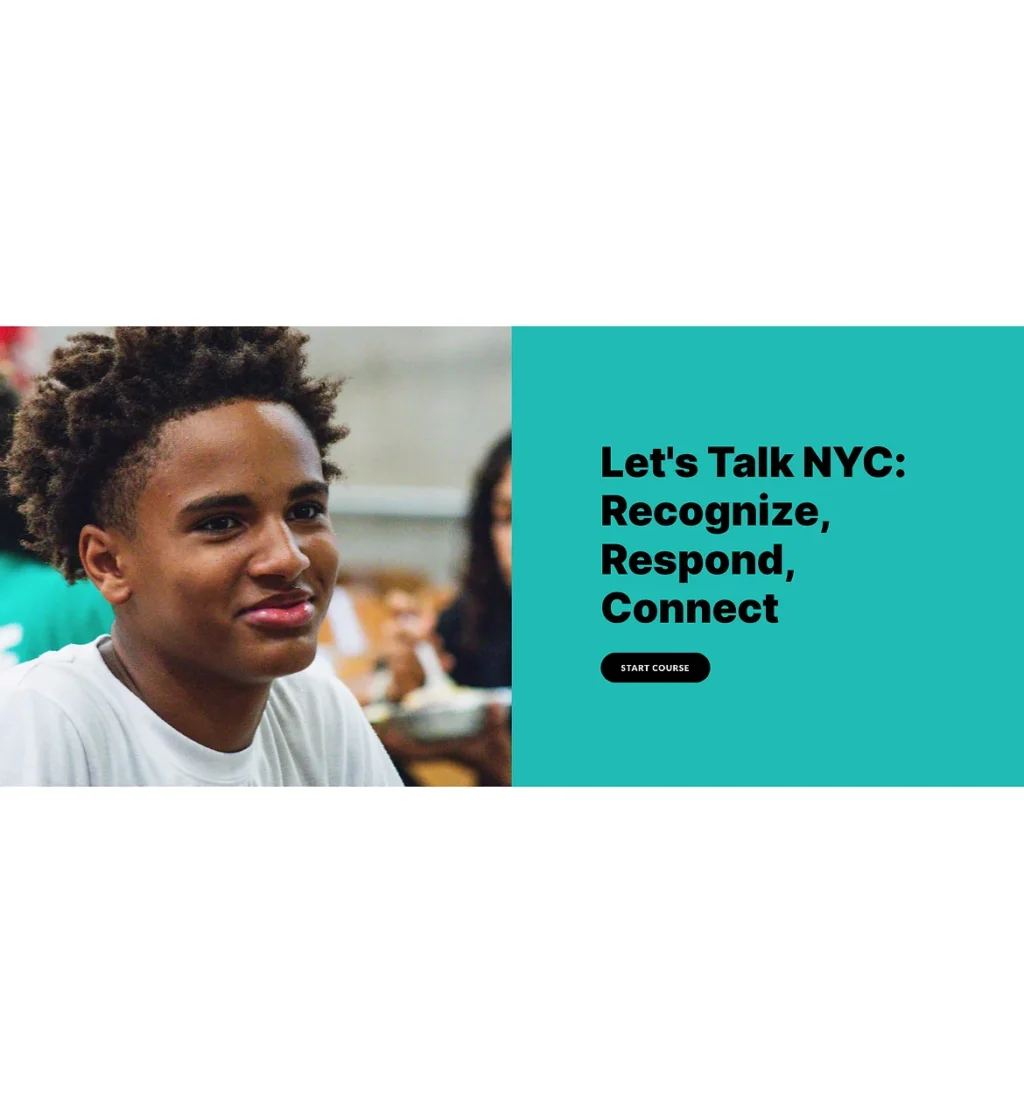
NEW YORK CITY — In an aggressive push to address a lingering youth mental health crisis, New York City Public Schools (NYCPS), the New York City Health Department’s Office of School Health (OSH), and The Jed Foundation (JED) officially announced the launch of the revamped Let’s Talk NYC: Recognize, Respond, Connect online professional learning course.
Unveiled today, this updated virtual curriculum expands significantly upon the framework laid by the initial 2021 Let’s Talk NYC public awareness campaign. While the original campaign focused primarily on broad community awareness, reducing stigma, and encouraging students to seek help from trusted adults, the newly minted course transitions those goals into a high-impact, practical professional development program.
The initiative targets middle and high school educators, school leaders, specialized support staff, and personnel from community-based organizations working directly within NYCPS secondary schools. By giving trusted adults concrete tools to identify distress and bridge the gap to professional care, city leaders hope to transform every classroom into a supportive environment where students feel seen, safe, and connected.
Main Facts: What the Let’s Talk NYC Revamp Entails
The Let’s Talk NYC: Recognize, Respond, Connect curriculum is built to arm non-clinical school staff—the "everyday adults" in a student’s daily life—with the confidence and competence needed to address emerging emotional and psychological distress.
Target Audience: Middle and high school educators, administrators, support staff, and community-based youth workers operating within New York City Public Schools.
Core Objectives: Equipping adults to understand their specific roles in student mental health, recognize early warning signs of emotional distress, and effectively connect struggling students to appropriate care networks.
Format: A flexible, engaging online professional learning course designed for easy access by busy educators and school personnel.
Financial and Organizational Backing: The curriculum is funded by Wellness Classroom and Gotham Gives, and is sustained through the ongoing collaboration between NYCPS, OSH, and The Jed Foundation.
Pilot surveys of the curriculum have already yielded positive feedback. Participants praised the course for its user-friendly format, practical learning reinforcements, and the ease with which non-clinical personnel could digest and apply its principles in real-world school settings.
Chronology of Collaboration: Building a Citywide Safety Net
The launch of Let’s Talk NYC: Recognize, Respond, Connect does not happen in a vacuum; it represents the latest milestone in a multi-year, strategic partnership between New York City’s educational and public health agencies and national mental health experts.
2021: NYCPS, the Mayor’s Office of Community Mental Health, the NYC Department of Health and Mental Hygiene, The Jed Foundation, and Ogilvy Health officially launch the original Let’s Talk NYC campaign. The initiative focuses on destigmatizing mental health issues, raising public awareness, and encouraging open dialogues within school communities.
2024: Recognizing a critical need for specialized intervention in medical settings within schools, NYCPS, the Department of Health, and JED develop and scale a standardized suicide prevention training program specifically for NYCPS school nurses. Rolled out across more than 1,800 pre-K through grade 12 public schools, the training ultimately reaches over 3,870 school nurses, vastly improving their capacity to screen, identify, and refer at-risk students to life-saving resources.
Late 2025/Early 2026: Public health data reveals persistent mental health struggles among local youth, prompting city leaders to push for a more expansive, preventive approach targeting middle and high school classrooms.
November 10, 2026: NYCPS, OSH, and JED formally debut the revamped Let’s Talk NYC: Recognize, Respond, Connect online course just as the academic year moves into full swing, bridging the gap between general awareness and active intervention.
Supporting Data: The Urgency of Youth Mental Health Interventions
City officials emphasize that the rollout of the Let’s Talk NYC training course is driven by alarming statistical realities regarding the emotional well-being of New York City’s youth.
According to data compiled heading into the recent academic cycles, more than 30% of local middle and high school students reported persistent feelings of sadness and hopelessness. These metrics reflect a broader, nationwide youth mental health crisis that has taxed traditional clinical resources and placed an unprecedented burden on educational institutions.
Because young people spend a significant portion of their waking hours in schools, educational facilities and their surrounding community partners are uniquely positioned to serve as the first line of defense. By training the adults who interact with students daily—teachers, coaches, counselors, and administrators—the city can intercept mental health crises long before they escalate to emergencies.
The success of the 2024 school nurse initiative serves as a precedent for this community-wide approach. With nearly 3,900 nurses trained to handle suicide risk assessment and intervention across pre-K through 12 settings, scaling a complementary program for classroom educators and school leaders is viewed as a logical and necessary expansion of the city’s safety net.
Official Responses: Leaders Emphasize Shared Responsibility
The collaboration between municipal agencies and advocacy groups has drawn high-level praise from city leaders, who view student mental health as foundational to academic achievement and long-term community resilience.
"Our students learn best when they feel safe, seen, and supported, and the adults in our schools are often the first to notice when a young person is struggling,"said Schools Chancellor Kamar Samuels."We’re proud of this partnership and look forward to reaching as many school-based staff as possible so that every classroom in New York City is a place where students feel they belong and know where to turn for help."
Public health officials echoed these sentiments, highlighting the preventative power of trusted adult relationships within school walls.
"Data continues to show that too many of New York City’s young people are struggling, and we have a responsibility to step up,"said NYC Health Commissioner Dr. Alister F. Martin."Equipping trusted adults in schools with the tools they need to help students navigate their mental health opens more doors to care. We’re grateful for our partners at New York City Public Schools and JED for their commitment to supporting the wellbeing of the next generation of New Yorkers."
National experts working directly on the initiative underscored the importance of empowering non-clinical staff to take proactive measures.
"Student wellness is a shared responsibility, and schools play an integral role in creating environments where students feel seen, valued, and celebrated,"said Dr. Tony Walker, JED’s senior vice president of school programs and consulting."When educators, school staff, and community leaders have the understanding and assurance to notice a young person in distress and respond early, they can make a meaningful difference in a student’s life. Together with New York City Public Schools, we’re helping build stronger systems that promote student well-being and reduce suicide risk."
Implications and Broader City Resources
The introduction of Let’s Talk NYC: Recognize, Respond, Connect is part of a broader, systemic effort across New York City to streamline mental health access for residents of all ages.
For individuals seeking comprehensive mental health services across the five boroughs, the city recently launched Mental Health Connect, a virtual tool designed to help residents easily navigate and explore care options tailored to their specific needs.
Additionally, youth-facing organizations in New York City aiming to enhance their crisis response capabilities and build community resilience can enroll in free Guiding Youth Through Intervention, Diversion, and Empowerment (GYRIDE) workshops offered directly through the NYC Health Department.
Getting Involved
Educational professionals, school leaders, and community-based organizations interested in learning more about the Let’s Talk NYC: Recognize, Respond, Connect training course can access program details via the official informational website or reach out to program administrators directly via email.
About the Partner Organizations
New York City Public Schools (NYCPS)
As the largest public school system in the United States, NYCPS serves a vibrant, diverse population of approximately 1 million students across more than 1,600 schools in all five boroughs. Supported by a network of over 75,000 teachers, the system is deeply committed to fostering dynamic learning environments that reflect the cultural richness and resilience of New York City.
New York City Office of School Health (OSH) School Mental Health Program (SMHP)
The SMHP designs, implements, and coordinates comprehensive mental health support systems across municipal school districts. By bridging communication between school personnel, community-based providers, and city and state agencies, the program ensures sustainable, high-quality mental health resources for students and their families.
The Jed Foundation (JED)
The Jed Foundation is a national nonprofit dedicated to protecting emotional health and preventing suicide among teens and young adults. JED partners with high schools, colleges, districts, and youth organizations to strengthen mental health protocols, substance misuse education, and suicide prevention systems, while empowering young people with the skills to support themselves and their peers.