The Human Equation: Why AI Adoption in Higher Education Hinges on Trust, Not Tech
In the rapidly evolving landscape of 21st-century higher education, the integration of Artificial Intelligence (AI) has shifted from a peripheral interest to an urgent, systemic challenge. While university boards and administrators scramble to invest in cutting-edge software suites and high-powered computational infrastructure, a growing consensus suggests that the true bottleneck for successful implementation is not hardware, but human psychology.
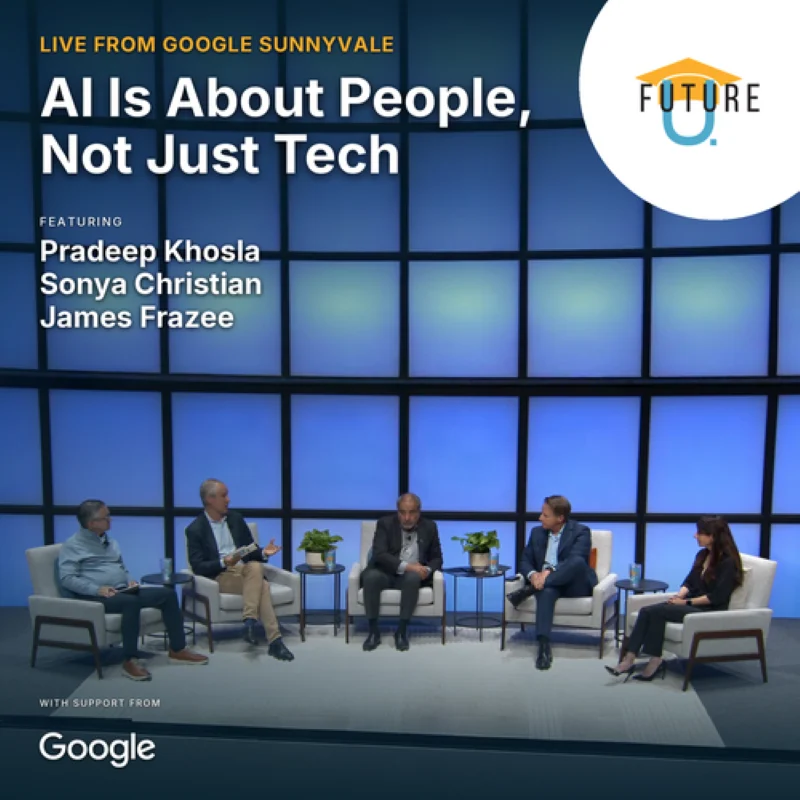
In a recent live recording of the Future U podcast, hosted at Google’s Sunnyvale campus, education experts Michael Horn and Jeff Selingo dissected this disconnect. Their central thesis—that AI integration depends fundamentally on human trust rather than technical sophistication—strikes at the heart of the current pedagogical crisis. As students and faculty navigate a landscape of conflicting policies and mounting uncertainty, the industry is discovering that the most significant risks of the AI era are social, not technological.
The Core Conflict: Infrastructure vs. Implementation
The primary challenge facing universities today is the "innovation gap." Institutions are pouring millions into AI-ready infrastructure, yet the classroom experience remains fractured. Horn and Selingo argue that while technical investment is a prerequisite, it is merely the foundation. Without a cultural framework that fosters trust, these tools risk becoming instruments of anxiety rather than conduits for learning.
The disconnect arises when institutional vision—often driven by a desire to appear forward-thinking—clashes with the lived reality of the classroom. When AI policies are implemented from the top down without clear, consistent communication, they create an environment of ambiguity. This environment directly impacts the core mission of the university: to provide a stable, equitable environment for intellectual growth.
Chronology: The Rapid Evolution of AI in the Classroom
To understand the current state of panic, one must look at the accelerated timeline of AI adoption:
- Late 2022: The public release of ChatGPT acted as a "Sputnik moment" for higher education. Universities were caught off guard, with many initially responding with blanket bans to prevent academic dishonesty.
- Early 2023: The "wait and see" phase. Institutions began to realize that bans were unenforceable and counterproductive, leading to a fragmented landscape of localized policy.
- Late 2023: The pivot toward institutional AI task forces. Universities began investing in enterprise-grade AI tools, hoping to provide safe, controlled environments for students and faculty.
- 2024 to Present: The "Trust Crisis." As noted in the Sunnyvale discussions, the focus has shifted from how to deploy AI to why and where to deploy it. The conversation is now dominated by the psychological toll on students and the need for standardized ethical frameworks.
Supporting Data: The Cost of Ambiguity
The data regarding AI adoption in higher education reveals a troubling trend. According to recent surveys mentioned by industry experts, a significant majority of students report feeling "deeply anxious" about their academic standing due to the lack of clear AI guidelines.
The issue is not just the presence of AI, but the lack of consistency. When a student is encouraged to use Large Language Models (LLMs) to brainstorm for a creative writing assignment in one department, only to face potential disciplinary action for using the same tools to debug code in an engineering course, the resulting confusion is profound. This "policy whiplash" erodes the student’s trust in the academic system.
James Frazee, Vice President and Chief Innovation Officer at San Diego State University (SDSU), highlights the absurdity of this reality: "They can go into their 9 o’clock class and be encouraged to use AI, and they could be expelled for doing the exact same thing in their 10 o’clock class. And that’s causing a great deal of anxiety and stress among our students."
Official Perspectives: The Case for Coherence
The panel at Google Sunnyvale underscored that the solution is not to dial back technology, but to lean into communication. Frazee’s perspective is emblematic of a broader shift in administrative thinking: the need for "principled flexibility."
The Role of Faculty-Student Relationships
At the heart of the academic enterprise is the faculty-student relationship. When professors and students are on different pages regarding the use of AI, that relationship breaks down. The suspicion that AI might be used for plagiarism creates an adversarial dynamic that stifles mentorship.
The Need for Standardized Guidance
Administrators are now tasked with the difficult job of providing "guardrails" that are broad enough to allow for pedagogical innovation but specific enough to eliminate student fear. This requires:
- Departmental Transparency: Clearly stated policies in every syllabus.
- Pedagogical Alignment: Ensuring that assessment methods are designed for an AI-integrated world, rather than forcing old assessment models to fit new technology.
- Ongoing Dialogue: Creating forums where students can express their concerns about AI-induced stress without fear of retribution.
Implications: The Long-Term Impact on Higher Education
The implications of failing to solve the "trust problem" are severe. If universities continue to leave students in a state of perpetual uncertainty, several long-term consequences are likely to emerge:
1. Erosion of Academic Integrity
When rules are perceived as arbitrary or inconsistent, students are more likely to ignore them entirely. A lack of trust in the policy leads to a decline in respect for the institution’s ethical standards. If students believe that the "AI rules" are just another hoops-jumping exercise, they will treat them as such, undermining the very idea of an academic honor code.
2. Widening Inequality
Students who have access to external, paid AI tools may gain a significant advantage over those who rely solely on institutional access, especially if institutional guidelines remain vague. A lack of clear guidance exacerbates existing socio-economic disparities in education.
3. Stunted Innovation
If faculty members are afraid to experiment with AI because of potential policy violations or student backlash, the university loses its status as a site of innovation. A risk-averse culture—born from fear of the unknown—is the antithesis of the academic mission.
Building a Path Forward
The consensus from the Future U podcast is clear: the technology is here, and it is not going away. The path forward for higher education lies in shifting the focus from the tools to the people.
Cultivating Human Trust
Trust is built through transparency and consistency. Universities must move toward a model where AI policy is not a "gotcha" mechanism, but a collaborative agreement. This means:
- Faculty Training: Equipping professors with the skills to incorporate AI in ways that enhance learning rather than replace critical thinking.
- Student Agency: Involving students in the creation of AI policies so they feel like partners in the process rather than subjects of it.
- Administrative Courage: Recognizing that clear, even if imperfect, guidelines are better than the current state of chaotic silence.
The Future of the Classroom
As AI becomes an embedded part of the workforce, universities have a responsibility to prepare students for a world where AI is a collaborator, not an enemy. This preparation cannot happen in a vacuum of confusion. It requires a stable, high-trust environment where the use of technology is an extension of the student’s own intellectual development.
Ultimately, the lesson from the Google Sunnyvale discussion is that the human element is the ultimate arbiter of success. Technology is a tool of efficiency, but education is a process of human connection. If universities can bridge the gap between their technical aspirations and their pedagogical realities, they will be well-positioned to lead in the age of AI. If they fail, they risk alienating the very generation they are intended to empower.
The path forward is not found in a new software update or an increased IT budget. It is found in the difficult, human-centric work of communication, alignment, and the steady building of trust within the classroom. By prioritizing this human connection, institutions can turn the current crisis of anxiety into a catalyst for a more meaningful, efficient, and ethical era of higher education.
For more insights into the intersection of technology and the future of learning, you can listen to the full episode of the Future U podcast here.