The Radical Transformation of Higher Education: How Unity Environmental University Defied the Odds
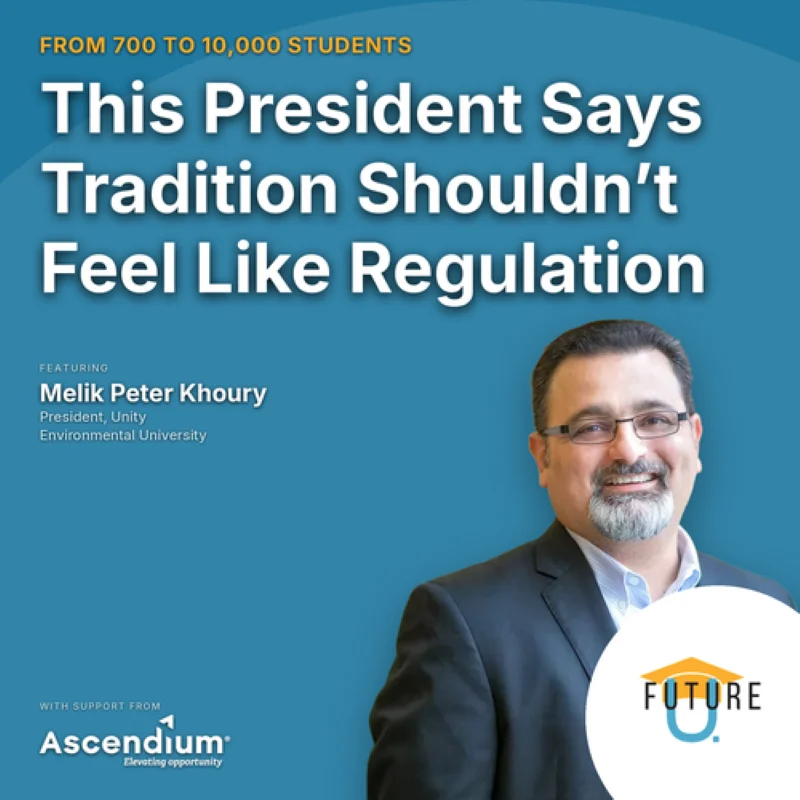
In an era defined by declining enrollment, rising tuition costs, and a skeptical public, the traditional American college model is under siege. Many small, rural liberal arts institutions have shuttered their doors, unable to reconcile their legacy structures with the demands of a digital-first economy. However, Unity Environmental University, nestled in the quiet landscape of rural Maine, has emerged as a beacon of institutional survival. Under the leadership of President Melik Peter Khoury, the university has undergone a radical metamorphosis, pivoting from a struggling college of 700 students to a powerhouse of online education serving over 10,000 learners.
In a recent episode of the Future U podcast, hosted by Michael Horn and Jeff Selingo, Khoury articulated a vision for higher education that prioritizes agility, student-centricity, and a fearless embrace of artificial intelligence. His strategy—one that often clashes with the entrenched norms of academia—serves as a compelling blueprint for any institution looking to remain relevant in the 21st century.
Main Facts: The Unity Transformation
The core of Unity’s success lies in its willingness to discard the "sunk cost fallacy" that plagues higher education. For years, the institution faced the same existential threats as its peers: geographic isolation, a shrinking demographic of high school graduates in the Northeast, and the exorbitant costs associated with maintaining a residential campus.
Khoury’s intervention was not merely a rebranding exercise; it was a structural overhaul. By shifting the university’s primary focus to online education, Khoury decoupled the quality of the education from the physical capacity of the campus. This allowed Unity to scale rapidly, serving a diverse demographic of non-traditional students who require flexibility. Key to this shift was the dismantling of traditional governance models—a move that ruffled feathers but ultimately secured the university’s fiscal health. By prioritizing the needs of students over the preservation of existing faculty and staff roles, Khoury created an environment where resources could be reallocated toward technological infrastructure and scalable pedagogy.
Chronology of a Turnaround
The trajectory of Unity Environmental University was not an overnight success story; it was a deliberate, multi-year process of deconstruction and reconstruction.
Phase 1: Identifying the Existential Crisis
Before the digital pivot, the university operated on a traditional residential model. The data was clear: the market for small, rural, high-cost residential colleges was shrinking. Faced with stagnant enrollment, the administration realized that the institution’s long-term sustainability could not depend on a 19th-century campus model.
Phase 2: Structural Dismantling
Khoury began by challenging the "tradition as regulation" mindset. He argued that just because a policy or a tenure track had existed for decades did not mean it was serving the current student body. The university began to consolidate roles and streamline its administrative layers, removing the bloat that often stifles innovation in higher education.
Phase 3: The Digital Expansion
With the administrative house in order, Unity launched an aggressive expansion into the online space. This was not just about putting lectures on a screen; it was about building a robust, accessible, and high-quality online curriculum that mirrored the rigor of their environmental programs while offering the convenience of asynchronous learning.
Phase 4: Scaling to 10,000
The final, and ongoing, phase involved marketing, accessibility, and retention. By expanding its reach to non-traditional students across the country—and eventually the world—Unity reached the 10,000-student milestone, proving that an institution’s mission does not have to be tied to a zip code.
Supporting Data: Why the Traditional Model Fails
The necessity of Khoury’s reforms is supported by broader trends in the higher education sector. According to the National Center for Education Statistics (NCES), enrollment at small private colleges has seen a steady decline over the last decade. Many of these institutions operate with a "cost-plus" pricing model, where the tuition is determined by the cost of operation rather than the value provided to the student.
Unity’s success provides a counter-narrative to this trend. By focusing on online delivery, the university significantly lowered its cost of instruction per student, allowing for a more competitive price point. Furthermore, by focusing on a specific niche—environmental studies—Unity carved out a unique brand identity that resonates with a growing generation of students concerned with climate change and sustainability. This specialized focus provided the "stickiness" required to attract students in a crowded online marketplace.
Official Responses and Philosophical Shifts
The discourse surrounding Khoury’s leadership is often divided between those who view him as a pragmatic savior and those who worry about the erosion of the "campus experience." Critics often cite the potential loss of community and the dilution of the faculty voice in governance. However, in his conversation with Horn and Selingo, Khoury pushed back against these concerns, framing his decisions as a moral obligation to the students.
"We in higher ed have an obligation to stop being afraid of [AI]," Khoury stated. "And start to become the organization that has the objectivity to research it, understand it, embrace it."
This philosophy extends to the broader operational model of the university. Khoury suggests that "tradition shouldn’t feel like regulation." By this, he means that if a process exists only to maintain the status quo at the expense of student success, it is a failed policy. His approach is characterized by a "student-first" metric, where faculty roles are evaluated based on their ability to facilitate learning rather than their role as gatekeepers of traditional academic norms.
Implications for the Future of Higher Education
The implications of Unity’s journey are far-reaching. As the industry faces a "demographic cliff"—a sharp decline in the number of 18-year-olds expected to enter college by 2025—institutions must decide whether to adapt or risk obsolescence.
1. The Death of Geographic Exclusivity
Unity has demonstrated that a small, rural institution does not need to be physically present in a major metropolitan area to have a national impact. By leveraging digital infrastructure, universities can effectively "import" students from across the globe, neutralizing the disadvantages of rural locations.
2. AI as an Essential Competency
Khoury’s stance on AI is particularly prescient. Higher education has historically been slow to adopt new technologies, often treating them as threats to academic integrity. By positioning the university as a place to research and understand AI, Khoury is shifting the narrative from "AI as a tool for cheating" to "AI as a tool for societal progress." This pivot is essential for preparing students for a workforce where AI literacy will be as fundamental as reading or writing.
3. Governance Reform as a Survival Strategy
Perhaps the most difficult lesson for other university presidents is the necessity of disrupting internal governance. The traditional "shared governance" model, while valuable for protecting academic freedom, can often lead to gridlock. Unity’s model suggests that for a university to survive, leadership must have the authority to make rapid, decisive changes without being hampered by bureaucratic inertia.
Conclusion: A Blueprint for Resilience
The story of Unity Environmental University is more than just a case study in business management; it is a testament to the power of mission-driven innovation. Melik Peter Khoury has shown that when an institution is willing to shed the weight of outdated traditions, it can unlock new levels of growth and service.
As higher education enters a period of profound uncertainty, the lessons from Unity are clear: institutions must prioritize the needs of the learner over the comfort of the organization. They must embrace technological shifts—especially AI—as tools for empowerment rather than threats to authority. And, perhaps most importantly, they must recognize that their value lies in the knowledge they impart and the students they empower, not in the physical halls they occupy.
For those watching the landscape of higher education, Unity remains a vital example of what is possible when an institution dares to reinvent itself. The question remains: how many other colleges will follow this lead, and how many will choose the safety of tradition until it is too late? As the digital age continues to reshape our world, the "Unity model" may well become the standard for the next generation of resilient universities.
To explore these insights further and hear President Melik Peter Khoury’s full perspective, listen to the latest episode of the Future U podcast here.