Demystifying Instruction: A Masterclass in Effective Unit Planning for Modern Educators

WASHINGTON — In the ever-evolving landscape of modern education, the fundamental mechanics of instructional design often get overshadowed by shifting educational technologies, administrative demands, and standardized testing pressures. Yet, the bedrock of successful student learning remains anchored in a deceptively simple question: How do we effectively plan a unit of instruction from start to finish?
To address this enduring challenge, educational platforms and pedagogical experts are returning to basics. A comprehensive new instructional series and accompanying self-paced online course, Mastering the Lesson Plan, aims to strip away the guesswork of curriculum design. By offering a structured, step-by-step framework, the initiative provides both novice and veteran educators with a reliable blueprint to craft units that foster genuine comprehension rather than rote memorization.
Main Facts: The Anatomy of Instructional Planning
Planning an instructional unit from scratch is universally recognized as one of the most daunting tasks teachers face. Whether an educator is designing a curriculum for a brand-new course or completely overhauling a legacy unit that has consistently underperformed, the structural approach requires clarity, intentionality, and a macro-to-micro perspective.
At its core, effective planning distinguishes clearly between three foundational pillars of education:
- Standards: The broad goals or state-mandated benchmarks outlining what students should know and be able to do by the end of a course.
- Curriculum: The overarching roadmap that organizes and sequences these standards into logical clusters known as units.
- Units: Cohesive collections of individual daily lessons—spanning anywhere from a few days to several weeks—designed around specific topics or themes.
While some educators are provided with fully scripted, ready-made curricula containing textbooks and pre-determined materials, many others must exercise significant autonomy. They are tasked with structuring raw standard documents into coherent learning experiences.

To bridge this gap, instructional designers advocate for backward design—a methodology popularized by Grant Wiggins and Jay McTighe in their seminal 1991 text, Understanding by Design. Unlike traditional planning, which often involves mapping out daily activities first and testing students on whatever was covered, backward design forces educators to begin with the end in mind. Teachers first establish clear learning objectives, design a rigorous summative assessment to measure those objectives, and then work backward to build the daily lessons.
Chronology: The Evolution of a Unit Plan
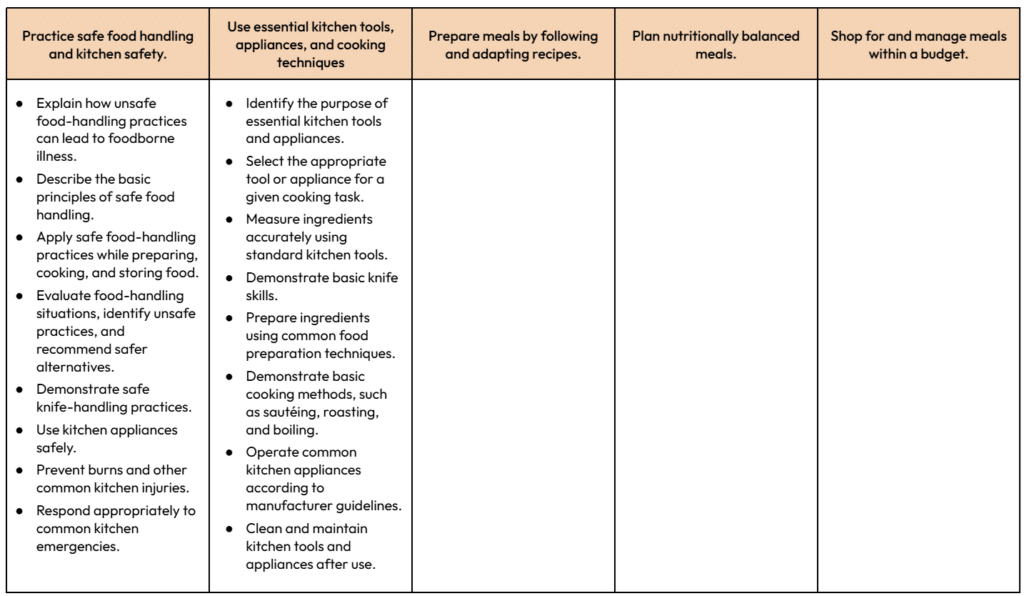
To understand how backward design operates in practice, educational experts use a hypothetical eight-week community education course titled Cooking Fundamentals. The chronological progression of building a single unit within this course highlights the methodical nature of instructional design.
Phase 1: Establishing the Big Picture
The planning process begins by establishing broad course goals, which function as institutional standards. For the cooking course, five macro-goals are set, ranging from mastering kitchen safety to executing everyday meal preparation. Each broad goal is then broken down into granular subtopics, knowledge requirements, and technical skills.
Phase 2: Organizing into Units
Rather than teaching topics haphazardly, the instructor groups these subtopics into six distinct units: food safety, kitchen tools and appliances, food prep techniques, everyday meal preparation, nutrition, and grocery shopping and budgeting.
Phase 3: The 3-Step Unit Design Process
Focusing specifically on the shortest unit—Safe Food Handling (designed to span three to four days)—the educator applies a rigorous three-step design framework:
- Step 1: Set Measurable Objectives. The instructor writes precise, observable objectives. Instead of relying on vague mental processes like "understanding food safety," objectives are framed around observable behaviors, such as identifying cross-contamination risks or properly washing produce. The unit is also anchored by an "essential question" to maintain thematic purpose: "How do your choices in the kitchen affect the safety of the food you prepare?"
- Step 2: Design the Summative Assessment. Before writing a single lesson plan, the educator determines how student mastery will be evaluated. Because the unit is brief, the assessment avoids time-consuming hurdles, utilizing instead an open-response test featuring real-world scenarios. Students must spot food safety violations, explain why they are hazardous, and propose corrective actions.
- Step 3: Plan the Daily Lessons. With the destination locked in, the instructor finally designs the day-to-day learning activities, ensuring every lesson directly serves the overarching unit objectives and prepares students for the final assessment.
Supporting Data: Why Systematic Planning Matters
The necessity for structured unit planning is underscored by persistent educational data regarding teacher burnout and student retention. According to various educational research initiatives, lack of curricular clarity and heavy lesson-planning burdens are primary drivers of early-career teacher attrition.
- Curriculum Alignment: Studies in instructional efficacy show that student achievement increases significantly when daily classroom activities are explicitly aligned with well-defined learning objectives and formative assessments.
- Cognitive Load: Breaking vast standard documents down into manageable, thematic units reduces cognitive overload for both teachers and students, creating predictable learning rhythms.
- Universal Applicability: While pre-service and new teachers benefit immensely from foundational planning frameworks, educational data suggests that seasoned educators also experience enhanced instructional consistency when periodically auditing and refining their legacy unit plans through structured frameworks like backward design.
Official Responses and Expert Perspectives
Proponents of the backward design model emphasize that "teaching to the test"—a phrase traditionally viewed with disdain in education—is entirely redefined when teachers design high-quality assessments themselves.
"When people first hear about backward design, they sometimes ask whether this is simply ‘teaching to the test,’" pedagogical researchers note. "We generally think of that as a bad thing because it implies training students for an arbitrary, out-of-control metric. But with backward design done well, we are technically teaching to the test, yes—yet that test is a well-designed assessment we created ourselves based on high-quality learning objectives."
Furthermore, educational advocates stress that these frameworks are not meant to stifle teacher creativity, but rather to liberate it. By establishing clear guardrails through objectives and assessments, educators gain the structural freedom to innovate within their daily lessons, knowing their instructional path remains anchored to meaningful student outcomes.
To support educators navigating these methodologies, professional development initiatives—such as the newly released self-paced course Mastering the Lesson Plan—have emerged to offer deep dives into each phase of the instructional design process, providing practical tools, templates, and strategies for classrooms of all grade levels.
Implications for the Future of Classroom Instruction
As schools nationwide continue to grapple with learning recovery, shifting curricula, and diverse student populations, the implications of deliberate unit planning are profound.
When teachers move away from ad-hoc, night-before lesson planning and embrace systematic frameworks like backward design, several transformative shifts occur:
- Increased Equity and Transparency: Students gain a clear understanding of what success looks like, as objectives and assessment criteria are demystified from day one.
- Reduced Teacher Stress: A cohesive, pre-planned unit mitigates the daily panic of scrambling for materials or wondering whether classroom activities actually target required standards.
- Enhanced Long-Term Retention: By connecting daily lessons to broad essential questions and authentic summative assessments, students transition from memorizing isolated facts to applying complex skills in real-world contexts.
Ultimately, the return to basic, high-integrity planning principles signals a maturing profession. By treating instructional design as both an art and a rigorous science, educators can build learning environments where both teaching and student success are engineered with purpose.