Federal Fiscal Pivot: Analyzing the President’s FY 2027 Budget Request and Emerging Legislative Challenges
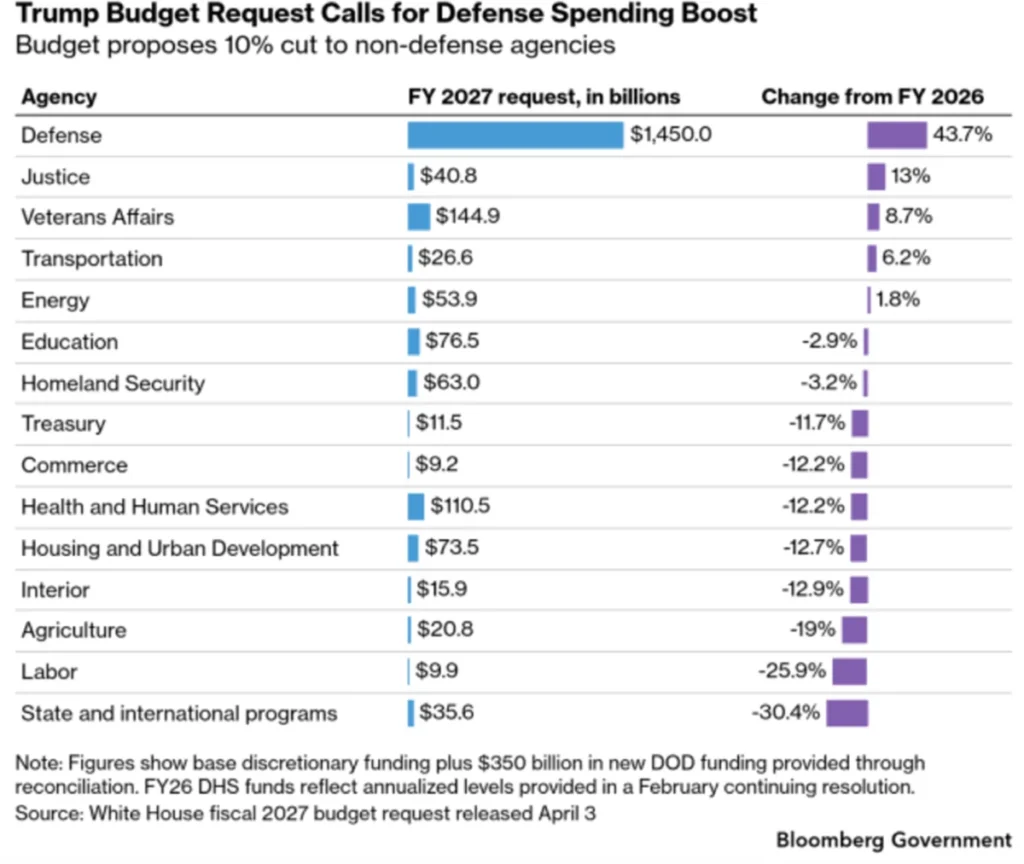
April 15, 2026 — In a move that signals a definitive shift in the federal government’s strategic priorities, the White House released its Fiscal Year (FY) 2027 budget request on April 3. The proposal, which serves as a blueprint for the Administration’s vision of governance, demands a total of $2.2 trillion in discretionary spending. The request highlights a stark dichotomy in federal allocation: a significant expansion in defense and national security funding juxtaposed against deep, systemic cuts to domestic social programs.
As the Administration pushes to consolidate its influence over the federal apparatus, the proposal has ignited a fresh debate in Washington regarding the role of government, the efficacy of the current bureaucracy, and the long-term fiscal health of the United States.
Main Facts: The Anatomy of the FY 2027 Request
The FY 2027 budget request is characterized by an aggressive pursuit of national security and energy independence. President Trump has requested a massive infusion of capital into defense-related sectors, explicitly asking Congressional Republicans to utilize the reconciliation process to enact $350 billion of his proposed $1.5 trillion defense budget. This procedural maneuver would allow the Administration to bypass the traditional filibuster in the Senate, underscoring the urgency with which the White House views its military and security posture.
Conversely, non-defense discretionary spending faces a rigorous contraction. The Administration has proposed $660 billion for all non-defense agencies, representing a 10 percent reduction from FY 2026 enacted levels. For several specific departments, the proposed cuts exceed 20 percent, signaling a targeted attempt to downsize the federal footprint.
However, it is vital to note the constitutional reality: the President’s budget is a statement of intent, not law. Under Article I of the U.S. Constitution, the "power of the purse" rests firmly with Congress. Lawmakers are under no obligation to adopt the President’s recommendations, and the upcoming budget negotiations are expected to be contentious as competing visions for the nation’s future collide.
Chronology of Fiscal Developments
- March 26, 2026: The AARP Public Policy Institute publishes its landmark report, Valuing the Invaluable 2026, shedding light on the critical economic contributions of family caregivers.
- Early April 2026: Persistent deadlock in the House and Senate regarding funding for the Department of Homeland Security (DHS) leads to a continued partial government shutdown, which remains unaffected by international geopolitical stressors like the conflict in Iran.
- April 3, 2026: The White House formally submits the FY 2027 budget request to Congress, prioritizing defense and energy while proposing a 10 percent cut to non-defense discretionary spending.
- Early April 2026: Chairman Tim Walberg (R-MI) introduces the Stronger Workforce for America Act of 2026 in the House Education and Workforce Committee, signaling a major legislative push to reform the Workforce Innovation and Opportunity Act (WIOA).
- April 15, 2026: Congressional Budget Office (CBO) releases long-term projections (2026-2036), warning of a rising federal debt-to-GDP ratio and spiraling healthcare costs.
The Education Landscape: Dismantling or Reforming?
The Department of Education (ED) faces a request of $76.5 billion for FY 2027, a reduction of $2.3 billion. While this represents a significant decrease, it is notably less aggressive than the previous year’s proposal of $66.7 billion, which would have slashed the department by 15 percent.
The Administration remains transparent about its goals: to "dismantle the Federal education bureaucracy." This strategy involves reducing staff levels and offloading various functions to other agencies deemed more capable of delivering efficient results. Despite this overarching rhetoric of decentralization, the budget proposal contains nuances. It seeks to protect funding for specific administration priorities, most notably by addressing the Pell Grant deficit and bolstering support programs for students with disabilities. This suggests a targeted, rather than total, approach to dismantling the ED, focusing on bureaucratic overhead while preserving core support mechanisms.
The Health Sector: The Rise of the "AHA"
Perhaps the most significant structural change within the health sector is the Administration’s persistent attempt to reorganize the U.S. Department of Health and Human Services (HHS). The budget proposes $111.1 billion in discretionary funding for HHS and introduces the Administration for a Healthy America (AHA).

This reorganization is a cornerstone of the "Make America Healthy Again" (MAHA) agenda. The proposal calls for the consolidation of various sub-agencies and programs under the new AHA umbrella. While this reorganization plan was previously rejected by Congress for the FY 2026 cycle, the Administration has signaled its intent to keep the proposal on the table. The implications for the health sector are profound; by shifting resources and restructuring reporting lines, the Administration hopes to exert greater influence over public health priorities, though the move faces skepticism from lawmakers concerned about the disruption of established healthcare infrastructure.
Legislative Updates: WIOA Reauthorization
The introduction of the Stronger Workforce for America Act of 2026 by Chairman Tim Walberg marks a pivotal moment for labor and education policy. The bill aims to modernize the Workforce Innovation and Opportunity Act (WIOA) to reflect the demands of the modern economy.
The legislation focuses on employer-driven training systems designed to bridge the gap between job seekers and industry requirements. However, advocacy groups have raised concerns regarding the potential for "limited guaranteed access" to services. A critical component of this transition involves moving Career Services, including Vocational Rehabilitation (VR), from the Department of Education to the Department of Labor. While proponents argue this will streamline job placement, critics warn that without robust oversight and intentional inclusion, individuals with disabilities—who have traditionally relied on the protections and specialized support of the ED—may find it increasingly difficult to navigate the new system. As of mid-April, the bill lacks a Democratic counterpart in the House and a companion bill in the Senate, suggesting a long road to potential passage.
Supporting Data: The Long-Term Fiscal Outlook
The Congressional Budget Office’s (CBO) recent release, Budget and Economic Outlook 2026-2036, provides a sobering backdrop to the current budget debates. The projections indicate that the federal deficit for FY 2026 will hit $1.9 trillion, with the federal debt projected to balloon to 120 percent of GDP by 2036.
The data highlights a significant fiscal challenge: healthcare spending. By 2036, federal spending on Medicare, Medicaid, CHIP, and premium tax credits is projected to reach $3.1 trillion, effectively doubling over the next decade. This demographic and fiscal reality is the primary driver behind the Administration’s desire to reform social programs. If current trends hold, the U.S. will face an era of unprecedented pressure on its social safety net, requiring either massive tax increases, significant program cuts, or fundamental structural reform.
Implications: The Road Ahead
The current political and fiscal climate presents three major implications for the nation:
- Bureaucratic Contraction: The Administration’s explicit goal of shrinking the federal workforce and offloading programs to other departments or the private sector will fundamentally alter the federal government’s role in public life. If successful, the move could lead to leaner, but potentially less accessible, federal services.
- Increased Polarization: The deadlock over the Department of Homeland Security, coupled with the aggressive defense-spending-first approach, suggests that bipartisan cooperation will be in short supply. As the Administration continues to test the limits of executive power through budget blueprints and proposed reorganizations, the friction between the White House and the legislative branch is likely to intensify.
- The Vulnerability of Social Services: The consolidation of health programs and the proposed shift of vocational services to the Department of Labor place essential services for the most vulnerable populations at a crossroads. Advocacy groups like TASH and the AARP are highlighting the necessity of keeping the needs of caregivers and individuals with disabilities at the forefront of these discussions. As the AARP’s "Valuing the Invaluable" report illustrates, the informal caregiving economy provides billions of dollars in unpaid value to the nation; any policy change that does not account for this reality risks severe long-term consequences for the American healthcare system.
As the budget process moves through the Congressional committees, stakeholders across the country will be watching to see which elements of the President’s vision are embraced, which are modified, and which are discarded in the crucible of the legislative process. The debate over the FY 2027 budget is, ultimately, a debate over the character of the American state in the late 2020s.