The New Frontier of Public Education: How AI is Redefining Classroom Instruction and Empowering Educators
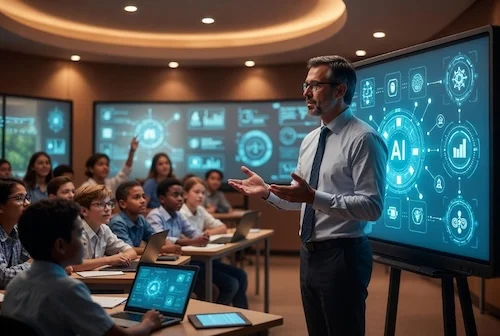
VAN BUREN, AR — Public education stands at a pivotal and historic crossroads, driven by rapid technological advancement and an unprecedented explosion of digital information. As school districts across the United States grapple with the integration of emerging technologies, pioneering educational leaders are asserting that generative artificial intelligence (AI) is not a threat to the teaching profession, but rather the most powerful tool for classroom empowerment since the printing press.
At the forefront of this educational shift is Dr. Harold Jeffcoat, Superintendent of the Van Buren School District in Arkansas and a member of the National Governing Board of AASA, The School Superintendents Association. Drawing on a career spanning more than a decade in district leadership, school principalship, and classroom teaching, Dr. Jeffcoat argues that the current era represents the most promising time in history to be an educator.
By removing long-standing administrative and logistical constraints, AI is enabling school districts to move away from the traditional, industrial-era "one-size-fits-all" model toward highly personalized, mastery-based learning.
Chronology: The Evolution of Classroom Technology
To understand the magnitude of the current AI-driven shift, it is essential to trace how classroom instruction and educational technology have evolved over the past several decades.
+--------------------------------------------------------------------------------+
|                         CHRONOLOGY OF CLASSROOM TECHNOLOGY                     |
+--------------------------------------------------------------------------------+
|                                                                                |
|  [19th - Mid-20th Century] The Industrial Model                                |
|  - Rote memorization, physical textbooks, uniform pacing.                      |
|  - Severe constraints on individualizing student instruction.                  |
|                                                                                |
|  [Late 20th - Early 2000s] The Digital Integration Era                         |
|  - Introduction of personal computers, smartboards, and early internet.        |
|  - Increased access to information, but administrative workloads doubled.      |
|                                                                                |
|  [2010s - 2020] The 1:1 Device and LMS Era                                     |
|  - Chromebooks and Learning Management Systems (LMS) become standard.          |
|  - Data collection increases, but analyzing student gaps remains slow.         |
|                                                                                |
|  [2020 - 2022] The Pandemic Disruption                                         |
|  - Forced transition to emergency remote and hybrid learning.                  |
|  - Highlighted the limitations of passive screens and digital divides.         |
|                                                                                |
|  [Late 2022 - Present] The Generative AI Revolution                            |
|  - Launch of ChatGPT and specialized educational AI tools.                     |
|  - Shift from technology as a passive repository to an active co-pilot.        |
|                                                                                |
+--------------------------------------------------------------------------------+
The Industrial Model (19th to Mid-20th Century)
For generations, public education operated under an industrial framework designed for standardization. Dedicated educators strove to meet the individual needs of every child, but physical and structural realities forced compromises. Pacing guides were rigid, instructional materials were uniform, and assessments were summative—often arriving too late in the school year to allow for meaningful intervention.
The Digital Integration Era (Late 20th Century to Early 2000s)
The introduction of desktop computers, basic internet access, and interactive whiteboards promised a classroom revolution. While these tools expanded access to information, they frequently increased the administrative burden on teachers, who had to manage physical and digital systems simultaneously without a corresponding increase in prep time.
The 1:1 Device and LMS Era (2010s to 2020)
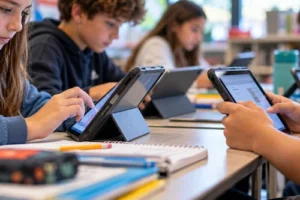
The widespread adoption of Chromebooks, tablets, and Learning Management Systems (LMS) digitized student workflows. Educators gained the ability to collect vast amounts of student performance data. However, translating this data into actionable, differentiated lesson plans remained a labor-intensive process that took days or weeks of manual planning.
The Pandemic Disruption (2020–2022)
The COVID-19 pandemic forced an immediate, global transition to emergency remote learning. While this period highlighted the critical importance of digital infrastructure, it also exposed the limits of passive screen time and underscored the irreplaceable value of face-to-face teacher-student relationships.
The Generative AI Revolution (Late 2022 to Present)
The launch of advanced large language models (LLMs) and generative AI tools marked a paradigm shift. Rather than acting as passive repositories of information, modern technological tools can now generate content, analyze complex patterns, and assist with cognitive tasks in real time. This capability has effectively removed historical constraints around instructional personalization.
Supporting Data: Quantifying the AI Shift in K-12 Classrooms
The rapid adoption of AI in education is backed by emerging national data, illustrating both the growing demand for these tools and their measurable impact on classroom efficiency.
- Accelerated Teacher Adoption: According to a national survey conducted by the Walton Family Foundation, over 50% of K-12 teachers report using ChatGPT or similar generative AI tools for school-related work, a significant increase from early 2023. Of those utilizing the technology, 88% report that AI has had a positive impact on their classrooms.
- Mitigating Teacher Burnout: Research from the EdWeek Research Center indicates that the average K-12 teacher works roughly 54 hours per week, but only 46% of that time is spent actively teaching students. The remainder is consumed by grading, administrative documentation, and lesson planning. Early pilot studies suggest that teachers utilizing generative AI for administrative prep save an average of 5 to 10 hours per week, allowing them to redirect that time toward direct student engagement.
- The Power of Personalized Learning: Educational research has long established the "Bloom’s 2 Sigma Problem," which demonstrates that students who receive one-on-one tutoring perform two standard deviations better than those in a traditional classroom setting. AI-driven adaptive platforms are bridging this gap, making scalable, high-quality personalized tutoring financially and logistically viable for public school districts.
Precision Diagnostics and Scalable Personalization
In practice, the integration of generative AI into daily instruction manifests in two primary pedagogical advancements: rapid diagnostic intervention and hyper-personalized learning plans.
                  TRADITIONAL vs. AI-ENABLED CLASSROOMS

    Traditional Classroom                  AI-Enabled Classroom
+----------------------------+         +----------------------------+
|  One-size-fits-all pacing  |         |   Dynamic, custom pacing   |
+----------------------------+         +----------------------------+
|  Manual grading & delayed  |         |  Real-time error analysis  |
|     feedback (1-2 weeks)   |         |      and instant data      |
+----------------------------+         +----------------------------+
| Single-level instructional |         |  Multi-tiered resources    |
|   materials for 30 kids    |         | tailored to student levels |
+----------------------------+         +----------------------------+
Rapid Diagnosis of Learning Gaps
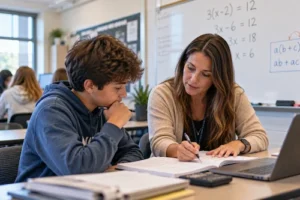
Traditionally, identifying a student’s specific academic misconception required weeks of formative assessment and manual grading. By the time a learning gap was officially identified, the class had often moved on to more complex topics, compounding the student’s frustration.
With modern AI integration, teachers can analyze patterns in student work instantaneously. AI tools can evaluate a classroom’s written responses or mathematics exercises, pinpointing the exact step where a misconception occurs—whether it is a fundamental reading comprehension issue or a specific procedural error in multi-digit division.
By surfacing these indicators in moments rather than weeks, teachers can intervene immediately, preserving student confidence before learning gaps widen.
Hyper-Personalization at Scale
Once a learning gap or advanced capability is identified, the challenge shifts to differentiation. In a standard classroom of 25 to 30 students, manually creating separate lesson plans, reading levels, and practice sets for varying skill levels is an overwhelming task.
Generative AI resolves this logistical bottleneck. Using targeted prompting, a teacher can quickly generate:
- A single science article rewritten at three distinct reading grade levels.
- Scaffolded math worksheets that gradually increase in complexity based on real-time student performance.
- Interest-based extensions, such as tailoring a word problem to a student’s passion for space exploration or athletics.
- Formative adaptive quizzes and progress trackers aligned precisely to state standards and the specific skills being taught.
The Irreplaceable Human Element: "Pilot vs. Co-Pilot"
Despite the extraordinary capabilities of artificial intelligence, educational leaders emphasize that technology must remain secondary to human instruction. Dr. Jeffcoat advocates for a clear framework: technology is the co-pilot, but the teacher must always remain the pilot.
"A teacher’s discernment, empathy, cultural competence, ability to build trusting relationships, and professional judgment are completely irreplaceable," Dr. Jeffcoat notes. "AI can generate a thousand variations of a lesson, but only a skilled, compassionate educator can decide which variation will inspire a specific child, on a specific day, in a specific community."
This distinction is crucial for easing the anxieties of veteran educators who may fear technological displacement. Rather than rendering teachers obsolete, AI serves as an intellectual force multiplier. By automating repetitive administrative tasks—such as draft grading, email templates, and initial lesson scaffolding—AI liberates teachers to focus on the deeply human aspects of education: mentoring, building emotional resilience, sparking curiosity, and fostering critical thinking.
Official Responses and Implementation: The Van Buren Strategy
Under the leadership of Dr. Jeffcoat, the Van Buren School District in Arkansas is actively pioneering a structured framework for responsible AI adoption. Rather than banning or ignoring these tools, the district’s strategy focuses on proactive integration built upon three main pillars:
1. High-Quality Professional Development
The district is investing in ongoing training to build "AI fluency" among its teaching staff. Educators are taught how to construct effective prompts, evaluate AI-generated outputs for bias and inaccuracies, and integrate these tools naturally into their existing pedagogical practices.
2. Ethical and Responsible Use Guidelines
Van Buren Schools are developing clear, practical guardrails to address data privacy, student confidentiality, and academic integrity. This includes ensuring compliance with the Family Educational Rights and Privacy Act (FERPA) and teaching students how to use AI as a tool for learning rather than a shortcut for cheating.
3. Equitable Access
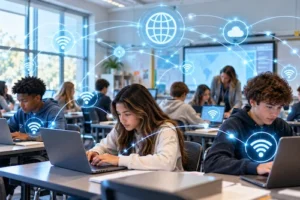
To prevent the emergence of a new "digital divide," the district is working to ensure that all students and teachers—regardless of socioeconomic status—have access to high-quality, verified AI resources and stable classroom connectivity.
At the national level, organizations like AASA are championing similar balanced approaches. School superintendents across the country are advocating for federal and state policies that support technology funding while protecting student data privacy and maintaining high standards for teacher-led instruction.
Implications: The Future of Public Education
The systemic integration of artificial intelligence into public school systems has profound implications for the future of the nation’s workforce and the teaching profession itself.
- Addressing Teacher Retention: By significantly reducing the administrative workload that contributes to widespread burnout, AI integration could emerge as a critical factor in stabilizing the teacher pipeline and retaining experienced, high-performing educators.
- Preparing Students for an AI-Driven Economy: As industries worldwide adopt automation and machine learning, students who learn to collaborate ethically and effectively with AI in the classroom will be uniquely positioned for success in the future job market.
- Redefining Educational Equity: By making personalized learning scalable, public school districts can provide high-tier academic interventions to historically underserved student populations, helping to close long-standing achievement gaps.
"The future of education is not something happening to us," says Dr. Jeffcoat. "It is something we are actively building—together—right now. When we combine the timeless art of great teaching with the new science of artificial intelligence, we create classrooms where every student can truly thrive."