Rethinking the Algebra Equation: How New Data and Objective Benchmarks Are Reshaping Middle School Math Placement
Across school districts nationwide, middle school administrators face one of the most consequential academic choices of a student’s educational career: deciding which students should enroll in Algebra 1 during the eighth grade, and which would benefit from foundational reinforcement before tackling high-school-level coursework.
For decades, Algebra 1 has functioned as the gateway course to advanced mathematics, college-preparatory tracks, and long-term success in Science, Technology, Engineering, and Math (STEM) fields. Yet, striking the right balance has proven elusive. Placing students into algebra prematurely can lead to severe academic frustration and undermine student confidence, while holding back prepared students can stunt their academic trajectory and limit future opportunities.
New research from the NWEA research team reveals systemic flaws in how these placement decisions are made. By examining massive national datasets and establishing objective readiness benchmarks, education experts argue that schools must move away from subjective, ad-hoc placement methods and adopt equitable, evidence-based systems.
Main Facts: The High Stakes of Eighth-Grade Algebra
The debate surrounding eighth-grade algebra is rooted in its role as a critical academic gateway. Mastery of algebraic concepts unlocks advanced courses such as Geometry, Algebra II, Precalculus, Advanced Placement (AP) Calculus, and AP Statistics. Students who complete algebra by the end of eighth grade are positioned to take higher-level math classes in high school, making them far more competitive candidates for college admissions and STEM careers.
However, the NWEA study highlights a glaring disconnect between academic readiness and course enrollment. The findings reveal that nearly 25% of students who demonstrate clear academic readiness for eighth-grade algebra never actually enroll in the course, even when it is readily available at their school.
This gap exposes deep-seated flaws in traditional placement practices. For generations, districts have relied heavily on subjective criteria:
- Teacher recommendations
- Parent advocacy and lobbying
- Historical course enrollment patterns
- Informal classroom observations
While these metrics can offer valuable context, they frequently introduce systemic bias and inconsistency. Highly capable students from marginalized or under-resourced backgrounds are often overlooked because they lack aggressive advocates, while less-prepared students may gain entry simply due to parental pressure.
Chronology: The Evolution of "Algebra Readiness"
To understand how education systems arrived at the current placement dilemma, it is necessary to trace the shifting definitions of "algebra readiness" over time.

Historically, readiness was measured almost exclusively by passing grades in seventh-grade math or arbitrary scores on local quizzes. In the late 1990s and 2000s, as the push for universal college-and-career readiness gained momentum, many states and districts rushed to enroll all eighth graders in algebra, regardless of their foundational skills. This "algebra for all" movement often backfired, leading to soaring failure rates and widespread remediation needs in high school.
In response, many districts swung the pendulum back, delaying algebra enrollment or implementing rigid, gatekeeping prerequisites.
Recently, the NWEA research team introduced a modernized, data-driven definition of readiness. Rather than relying on simple course grades or single-test cutoffs, researchers defined readiness as the estimated likelihood that a student will meet the proficiency standard on a state Algebra 1 end-of-course (EOC) assessment. Specifically, a student is categorized as "ready" if predictive modeling shows they possess at least a 50% probability of reaching state proficiency after taking the course.
Supporting Data: What the Numbers Tell Us
To test the real-world impact of algebra timing, NWEA researchers analyzed a national sample of approximately 55,000 students. They compared math outcomes for peers with similar achievement profiles who took Algebra 1 in either the eighth grade or the ninth grade.
The data dismantled two of the most persistent assumptions in middle school math education.
1. The Myth of Waiting for Ready Students
A common argument for delaying algebra is that giving students an extra year to mature will naturally strengthen their foundational math skills. However, the data shows the opposite for academically prepared students.
Students in the upper half of the prior-achievement distribution consistently performed better when they took algebra in eighth grade rather than waiting. This advantage was most pronounced among the highest-achieving students. For these learners, delaying access did not improve outcomes; instead, it dampened their trajectory and delayed their entry into advanced high school mathematics.
2. The Myth of Time as a Cure-All for Struggling Students
Conversely, educators often assume that students struggling with math will automatically benefit from postponing algebra for a year.

The study found that students in the lower half of the prior-achievement distribution performed similarly whether they took algebra in eighth grade or ninth grade. Crucially, these struggling learners generally remained below the algebra proficiency benchmark regardless of when they took the course.
The takeaway for educators is clear: simply delaying enrollment is not an intervention. Students who lack foundational readiness do not catch up simply by waiting a year; they require targeted academic interventions, curriculum alignment, enhanced instructional supports, and dedicated learning time.
Official Responses and Standardized Benchmarks
In light of these findings, educational researchers and assessment leaders are pushing for standardized, objective benchmarks to guide school districts.
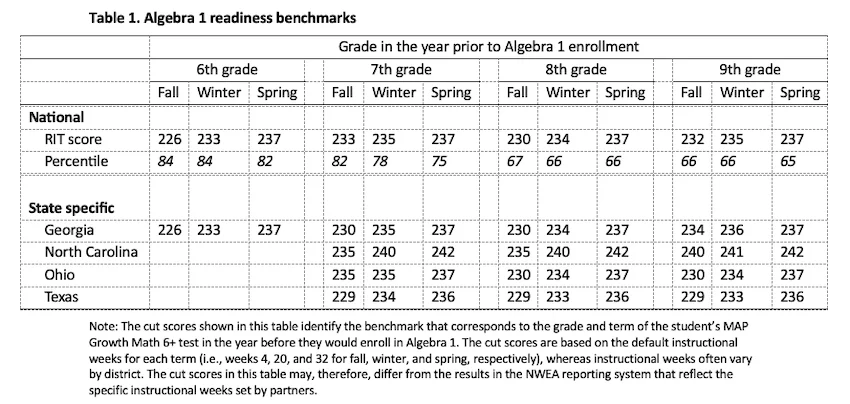
The MAP Growth Algebra 1 Placement Guide offers a framework by establishing concrete RIT score benchmarks that correlate with a 50% or higher probability of passing state algebra assessments. Because state tests vary significantly in rigor, NWEA has established state-specific linking studies for regions like Georgia, North Carolina, Ohio, and Texas, alongside a generalized national benchmark for other states.
For example, a student being evaluated in the spring of seventh grade for eighth-grade algebra would look at specific national and state RIT score thresholds (such as 237 nationally, 236 in Texas, and 242 in North Carolina).
Educational authorities emphasize that these benchmarks are not rigid barriers. Readiness benchmarks are intended to supplement local decision-making, not replace human judgment. A student meeting the benchmark is not guaranteed success, and a student falling slightly below it can still thrive if provided with appropriate scaffolding and support.
Implications for School Leaders and Policymakers
The implications of the NWEA research extend far beyond administrative scheduling. Algebra placement is fundamentally an issue of equity and opportunity.
- Move Beyond Subjective Gatekeeping: Districts must dismantle placement systems reliant on informal teacher recommendations and parent lobbying. Implementing objective, validated readiness metrics ensures that qualified students from all demographic backgrounds are identified and enrolled.
- Target Interventions Effectively: For students who fall below readiness thresholds, school leaders must invest in robust intervention programs rather than relying on delayed enrollment as a default strategy.
- Expand Access Proactively: Schools need systemic audits to ensure that every student who meets readiness criteria is actively encouraged—and scheduled—to take Algebra 1 in the eighth grade, closing the persistent 25% enrollment gap identified in the research.
Ultimately, reshaping math placement requires districts to combine objective data tools like MAP Growth with holistic student evaluations. By doing so, educational leaders can build transparent, equitable pathways that ensure every student has a fair shot at reaching their full mathematical potential.