The Trust Deficit: Why AI Integration in Higher Education Hinges on Human Connection, Not Just Code
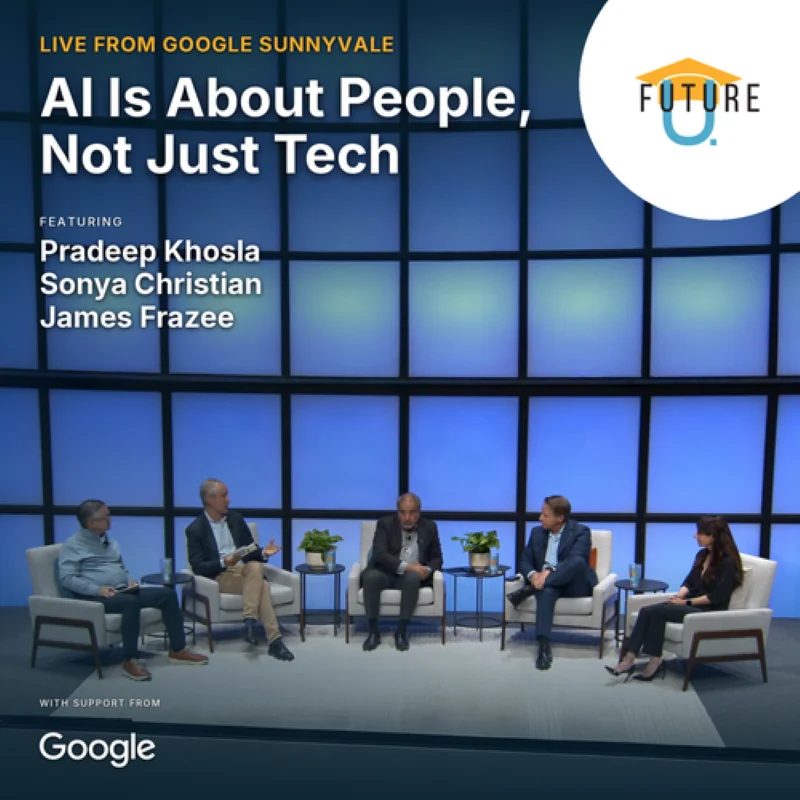
In the hallowed halls of academia, the rapid emergence of generative artificial intelligence has triggered a seismic shift in pedagogical philosophy. However, a recent live recording of the Future U podcast, hosted by Michael Horn and Jeff Selingo at Google’s Sunnyvale campus, suggests that the primary obstacle to successful AI adoption is not a lack of processing power or software sophistication. Instead, the discourse has pivoted toward a more fundamental, human-centric dilemma: the erosion of trust between institutions, faculty, and the student body.
As universities scramble to update their syllabi and governance policies, the disconnect between top-down technological investment and bottom-up classroom application has created a volatile environment. The experts gathered at the Google event argued that without a unified, transparent, and empathetic framework for AI integration, higher education risks alienating the very students it intends to prepare for a digital-first future.
Main Facts: The Great Pedagogical Divide
The central tension identified by Horn and Selingo lies in the disparity between the "tech-first" mindset of administrative boards and the "human-first" reality of the lecture hall. While universities are pouring millions into AI-integrated learning management systems and high-end hardware, the actual pedagogical application remains fractured.
Key takeaways from the session include:
- The Trust Paradox: Technology is readily available, but its adoption is stalled by a pervasive lack of clear, institution-wide guidelines.
- The Policy Vacuum: When policies are left to the discretion of individual professors without departmental oversight, students are forced to navigate a minefield of conflicting rules.
- The Human Variable: The efficacy of AI as a tool is predicated entirely on the relationship between educator and learner. If that foundation is built on fear or ambiguity, the tool becomes a point of contention rather than an asset.
Chronology: From Novelty to Necessity
The timeline of AI in academia has accelerated at an unprecedented rate, moving from a niche curiosity to a core governance crisis in less than two years.
Phase 1: The Sudden Disruption (Late 2022 – Early 2023)
The release of ChatGPT in late 2022 caught most higher education institutions flat-footed. Initial responses were largely reactive, characterized by a wave of reactionary bans and a fear-driven narrative focused on plagiarism and the death of the traditional essay.
Phase 2: The Period of Administrative Reckoning (Mid 2023)
As the dust settled, universities began to realize that bans were unenforceable. This period saw the formation of "AI Task Forces" across major campuses. Investment shifted toward enterprise licenses for AI tools, as administrators sought to gain control over the technology by formalizing its presence on campus.
Phase 3: The Current Disconnect (2024 – Present)
We are currently in the phase of "Integration Anxiety." As highlighted by Horn and Selingo, the tech is now ubiquitous, yet the human implementation is fraught with inconsistency. The focus has shifted from whether to use AI to how to use it without fracturing the academic integrity of the institution.
Supporting Data: The Cost of Inconsistency
While the qualitative reports from faculty are alarming, they are supported by a growing body of anecdotal and institutional data suggesting that current strategies are failing students.
The "9-to-10 O’Clock" Dilemma
James Frazee, Vice President and Chief Innovation Officer at San Diego State University (SDSU), offered a poignant illustration of the current landscape. "Students can go into their 9 o’clock class and be encouraged to use AI to brainstorm and structure their arguments," Frazee noted. "They could then walk into their 10 o’clock class and be expelled for doing the exact same thing."
This lack of parity creates a "compliance tax" on students. When students must spend more time deciphering individual professor preferences than engaging with the course material, their cognitive load increases, leading to a measurable decline in learning outcomes.
The Anxiety Metric
Internal surveys from various institutions suggest that students are experiencing heightened levels of "AI-related stress." This stress stems from three primary factors:
- Academic Jeopardy: The fear that a misinterpretation of a vague policy could lead to disciplinary action.
- Professional Uncertainty: The anxiety that they are either falling behind by not using AI or cheating themselves by relying on it too heavily.
- Relational Strain: The erosion of the student-faculty bond, as the relationship transforms from one of mentorship to one of surveillance.
Official Responses and Strategic Shifts
During the panel, experts emphasized that the solution lies in "Clear, Consistent Guidance." The current strategy of leaving AI policy to individual faculty autonomy is no longer tenable in a hyper-connected, AI-driven curriculum.
The San Diego State University Approach
James Frazee’s work at SDSU serves as a potential blueprint for other institutions. The university is moving toward a model that emphasizes:
- Transparency by Default: Requiring faculty to include a standardized "AI Syllabus Statement" that clearly defines where and when tools are permitted.
- Institutional Literacy: Moving away from punitive measures toward a broader curriculum that teaches "AI Literacy" as a fundamental skill, akin to information literacy or critical thinking.
- Faculty Empowerment: Providing professors with the training to redesign assessments so that they are "AI-resistant" or "AI-inclusive," rather than merely trying to "catch" students in the act of using the technology.
The Role of Leadership
Horn and Selingo argue that university leadership must take a more active role in setting the tone. If an institution claims to be "AI-ready," that readiness must be reflected in the infrastructure, the support services for faculty, and the clarity of the student handbook.
Implications: The Future of the University
The long-term implications of this "Trust Deficit" are significant. If universities fail to harmonize their AI policies, they risk losing their status as the definitive arbiters of knowledge.
1. The Erosion of the Academic Contract
The university experience is predicated on a social contract: the student provides effort, and the institution provides guidance and credentials. When AI policies are arbitrary, that contract is broken. Students may begin to view the university as an obstacle to their career goals rather than a partner in their success.
2. The Skills Gap
If faculty members are too afraid to teach with AI, or if they forbid it out of a misplaced sense of tradition, they are effectively rendering their graduates ill-equipped for the modern workforce. The goal of higher education is to prepare students for the reality of the professional world—a world that is currently undergoing a radical, AI-fueled transformation.
3. The Human-Centric Turn
Ultimately, the panelists concluded that the most important "technology" in the classroom remains the educator. AI is an amplifier. It can amplify the brilliance of a well-structured course, or it can amplify the confusion of a poorly managed one. The path forward requires a move away from "surveillance-based" pedagogy toward a "relationship-based" pedagogy.
In this new model, faculty must be transparent about the limitations and the utility of AI, treating students as partners in a collaborative experiment. As Frazee noted, "That element of trust is really important." Without it, the best hardware and the most advanced software in the world will do little to improve the quality of education.
Conclusion: A Call for Unified Governance
As the Future U podcast highlights, the AI revolution in education is not a technological problem; it is a human problem. The divide between the classroom and the executive office is being bridged by confusion, and the result is a student body that feels caught in the middle of an institutional identity crisis.
To survive and thrive, universities must abandon the fractured, department-by-department approach. They must embrace a unified vision that prioritizes clarity, consistency, and the restoration of trust. Only by creating a transparent framework can institutions ensure that AI serves as a bridge to the future rather than a wedge that drives students and faculty apart. The technology is here to stay; the question is whether the institutions themselves are prepared to evolve alongside it.
For those interested in the full discussion, the recording is available via the Future U Podcast.