The Era of Everything-to-Everyone is Over: Higher Education’s Existential Pivot
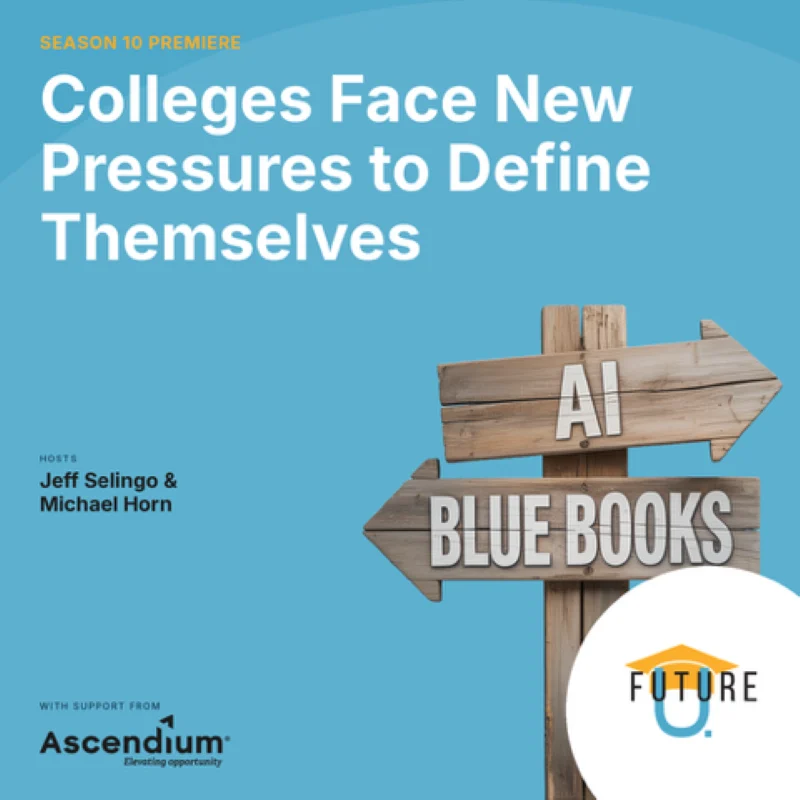
As the higher education landscape enters a new academic year, it faces a convergence of pressures unlike any seen in the modern era. Marking the 10th anniversary of their influential Future U podcast, hosts Michael Horn and Jeff Selingo have opened the season with a stark prognosis: the era of the “comprehensive university” is reaching a definitive, and perhaps painful, conclusion.
For decades, the standard strategy for growth in higher education has been one of accumulation. Institutions sought prestige and enrollment by mirroring their neighbors, adding endless degree programs, and attempting to serve every demographic under the sun. Today, however, the combination of demographic cliffs, the disruptive force of generative artificial intelligence (AI), and a cooling public sentiment regarding the return on investment (ROI) of a traditional degree has forced a reckoning. Colleges, the hosts argue, can no longer afford to be everything to everyone. To survive, they must embrace a rigorous, often uncomfortable, process of defining their core identities.
Main Facts: The Strategic Necessity of Contraction
The central thesis presented by Horn and Selingo is that higher education is moving from an age of expansion to an age of strategic contraction. For years, universities operated under a "keeping up with the Joneses" mentality. If a peer institution launched a master’s program in a trendy field, others followed suit—not necessarily because they possessed a comparative advantage, but because they feared being left behind in the rankings.
This model is now buckling under the weight of several compounding financial realities:
- Revenue Stagnation: With fewer high school graduates entering the pipeline, the competition for the shrinking pool of traditional-aged students is creating a zero-sum game.
- Operational Bloat: The cost of maintaining sprawling, redundant academic infrastructures is no longer sustainable when tuition growth is capped by affordability concerns.
- The AI Disruption: Artificial intelligence is fundamentally altering the value proposition of certain degrees. As AI automates entry-level cognitive tasks, the "generalist" degree is losing market appeal, forcing institutions to prove that their specific programs provide unique human-centric value.
Chronology: From Growth-at-All-Costs to Essentialism
The evolution of the modern university can be mapped through three distinct phases, each shaping the current crisis:
1. The Expansionist Era (1990–2010)
During this period, higher education enjoyed a period of relative prosperity. Enrollment was climbing, state funding was more consistent, and there was a broad societal consensus that a college degree was the "golden ticket" to middle-class stability. Universities grew by diversifying their portfolios, adding niche majors and expensive auxiliary services to attract students.
2. The Credential Inflation Era (2010–2020)
As the economy recovered from the 2008 financial crisis, institutions began to professionalize and specialize in an attempt to capture specific job-market segments. However, this often led to programmatic overlap. Colleges were operating as conglomerates, offering everything from advanced engineering to obscure humanities programs regardless of whether they had the regional demand or faculty expertise to lead in those fields.
3. The Era of Accountability (2020–Present)
The COVID-19 pandemic served as an accelerant for existing structural weaknesses. The rapid shift to remote learning stripped away the "campus experience" veneer, forcing students and parents to interrogate the cost of their tuition. Now, in the mid-2020s, the focus has shifted from "How many students can we enroll?" to "What is our unique, defensible contribution to the labor market?"
Supporting Data: Why the Current Model Fails
The data surrounding higher education suggests that the current "comprehensive" strategy is not just inefficient; it is increasingly perilous.
Demographic Headwinds
According to the WICHE (Western Interstate Commission for Higher Education) data, the "demographic cliff"—a decline in the number of high school graduates—is no longer a theoretical concern. It is a reality that is currently hitting the Northeast and Midwest hardest. Universities that relied on a high volume of regional students to sustain their diverse, sprawling course catalogs are now facing significant revenue gaps.
The Value Gap
Recent surveys by organizations like the Strada Education Foundation indicate a widening disconnect between student expectations and institutional outcomes. While students increasingly prioritize career outcomes, many universities remain tethered to an older, liberal arts-heavy model that—while valuable—is not being effectively communicated as a pathway to professional success. When public scrutiny over "degree value" reaches the halls of Congress, institutions that cannot articulate their specific impact are the first to be targeted by regulatory and fiscal pressure.
Administrative Overhead
As enrollment plateaued, the ratio of administrative staff to faculty continued to climb. Many of these administrative roles were created to manage the complexity of being an "everything-to-everyone" institution. By shedding these layers and narrowing their focus, colleges could potentially reclaim the financial flexibility needed to invest in high-impact, core academic programs.
Official Responses and Institutional Shifts
The reaction from institutional leaders to these pressures has been mixed, characterized by a tension between the traditional desire for prestige and the new necessity of fiscal survival.
The "Niche" Pivot
Some forward-thinking institutions are already beginning to drop peripheral programs. We have seen recent examples of flagship state universities consolidating humanities departments or shuttering low-enrollment master’s programs to double down on high-growth fields like data science, nursing, and cybersecurity.
Administrative Transparency
In response to public scrutiny, institutions are increasingly adopting "outcomes-based reporting." By publishing granular data on employment rates, salary premiums, and debt-to-income ratios for specific majors, universities are attempting to reclaim the narrative on value. This transparency is a direct result of the pressure Horn and Selingo describe: if a program cannot demonstrate its worth, it becomes an easy target for elimination.
Faculty and Board Dynamics
Faculty unions and board members remain divided. While boards are often eager to pursue the "contraction" strategy to balance budgets, faculty members often resist the loss of academic breadth, arguing that a university’s role is to preserve knowledge across all domains. The result is a stalemate at many institutions, which Horn and Selingo argue is the most dangerous position of all.
Implications: The Future of the "Core-Competency" University
What does the future hold for the college that decides to stop being everything to everyone?
1. The Rise of Institutional Identity
We are likely to see a bifurcation of the market. On one end, elite, highly endowed institutions will continue to offer a broad "comprehensive" experience because they have the capital to subsidize less-profitable programs. On the other end, the vast majority of public and regional private colleges will need to identify their "core competency." A university might become a regional hub for healthcare training, or a specialized research institute for sustainable agriculture. By narrowing their focus, they gain depth, reputation, and financial stability.
2. Collaboration over Duplication
Instead of every college trying to offer a full suite of services, we will likely see an increase in "academic consortia." If College A is the local expert in engineering, and College B is the expert in the fine arts, they may begin to share resources, credits, and even faculty. This horizontal integration is a mature response to the inefficiency of the current competitive, duplication-heavy model.
3. The AI-Enhanced Curriculum
As AI takes over the "transfer of knowledge" role, the value of the physical campus will shift toward high-touch experiences: mentorship, collaborative research, and hands-on laboratory work. Universities that lean into this shift—and abandon the pretense that they are simply "content providers"—will survive the current technological disruption.
4. A Hard Truth for Leadership
The primary implication for university presidents is the necessity of "courageous subtraction." It is far easier to add a program than to cut one. However, the leadership that defines the next decade will be characterized by the ability to tell stakeholders that certain programs are no longer central to the mission. As Selingo noted, the era of mirroring rankings-based trends is over. The institutions that define themselves by what they do not do will be the ones that emerge with the strongest value proposition in the long run.
Conclusion: Defining the Path Forward
The warning issued by Horn and Selingo is not one of impending doom, but of a necessary evolution. The "comprehensive university" model was a product of a specific economic era—one of growth, relative abundance, and unchecked optimism. That era has passed.
In its place, a new model of higher education must emerge. It will be more intentional, more focused, and ultimately, more accountable. The colleges that survive will be those that possess the clarity to define their core mission and the discipline to shed the weight of unnecessary complexity. For students, this could mean a more focused, high-value educational experience. For institutions, it represents a chance to stop chasing the ghost of the "ideal" university and start being the best version of their own unique selves.
The challenge for the next decade is not growth for growth’s sake, but the difficult, essential work of choosing what matters most. As the higher education sector navigates this pivot, the question for every dean, provost, and president remains: If you had to build your institution from scratch today, which programs would you keep, and which would you leave behind? The answer to that question is the roadmap for the future.