Beyond the Red Pen: Why Educators Must Shift Focus from Final Drafts to the Writing Process
By Educational Insights Staff
Published: October 2024
Main Facts
Educational research in pedagogy is undergoing a quiet revolution, shifting focus away from traditional assessments of the final written product and toward the complex, cognitive journey of how students actually write. Grounded in decades of psychological and educational theory—dating back to the foundational cognitive process model introduced by Linda Flower and John Hayes in 1981—experts are increasingly urging educators to provide targeted formative feedback directly on the writing process.
Recent studies emphasize that writing is inherently recursive rather than linear. Rather than moving rigidly from outlining to drafting, editing, and final publishing, proficient writers fluidly cycle through planning, executing, and reviewing. By offering constructive guidance during these developmental stages, teachers can foster vital self-regulation skills, accommodate the unique strategies of multilingual learners, cultivate growth mindsets, and build vital trust with students. Ultimately, shifting feedback upstream to the drafting and revising phases ensures that students retain and transfer critical writing skills to future academic and professional tasks.
Chronology: The Evolution of Writing Models
To understand why modern pedagogy advocates for process-oriented feedback, it is essential to trace how our understanding of writing has evolved over the past several decades.
- The Pre-1981 Era (The Linear Model): For generations, writing instruction was taught through a rigid, sequential assembly line. Students were expected to outline, write a first draft, edit, and produce a final second draft in a strict, predictable order. Little regard was given to the messy internal cognitive shifts happening behind the scenes.
- 1981 (The Recursive Breakthrough): Researchers Linda Flower and John Hayes upended conventional wisdom by proposing the recursive model of writing. Their research demonstrated that writers constantly shuttle back and forth between planning, drafting, and reviewing, driven by self-generated goals that evolve as they discover new ideas through the act of writing itself.
- 1981–Present (Iterative Refinement): The original Flower and Hayes model proved so influential that it spawned over a dozen alternative frameworks, including four subsequent revisions by the authors themselves. This historical trajectory underscores a vital pedagogical lesson: educational theories—much like writing itself—are iterative.
- The Digital Age (Modern Integration): In recent years, the integration of digital tools, word processors, and artificial intelligence has further reshaped how students draft and edit. Modern data indicates that digital writing aids yield the greatest benefits when they prompt students to self-monitor and build independent problem-solving strategies rather than simply auto-correcting errors.
Supporting Data and Research Insights
A robust body of educational research supports the transition from summative product grading to formative process feedback.
1. The Power of Self-Regulation
Proficient writing is inextricably linked to self-regulation—the cognitive ability to manage one’s thoughts, emotions, and environment. Educational psychologists break writing self-regulation down into interacting cyclic loops where students constantly monitor their strategies. Traditional grading methods often short-circuit this loop, whereas dialogue-based reflections restore a student’s agency.

2. Tailoring Support for Multilingual Learners
Data highlights distinct differences in how multilingual learners approach composition. Leveraging their full linguistic repertoires—including strategies like translanguaging—helps them navigate the complexities of writing in English. Furthermore, a meta-analysis of 25 studies discovered that non-native English speakers often benefit more from peer feedback and varied feedback modalities (oral, digital, and written) than from traditional teacher-led corrections. Crucially, coaching these students on revision strategies yields deeper structural improvements than marking isolated grammatical mistakes.
3. The Psychology of Framing and Mindset
Not all feedback is created equal. While formative feedback integrated into everyday learning drives profound growth, poorly framed comments can have a neutral or even negative impact. A notable study involving seventh-grade students demonstrated that adding a simple handwritten sticky note reading, "I’m giving you these comments because I have very high expectations and I know that you can reach them," increased essay revision rates by 40% among minority students compared to control groups. This simple act of relational trust transformed how students perceived corrections, moving them away from viewing critiques as a sign of failure and toward recognizing them as proof of potential.
Official Responses and Expert Frameworks
Educational leaders and curriculum developers have responded to these findings by designing new paradigms to guide classroom instruction.
Renowned educators Douglas Fisher and Nancy Frey have introduced the "4 C’s of Feedback" framework—focusing on Care, Credibility, Clarity, and Communication. This model addresses core environmental and psychological barriers, helping teachers build the foundational trust required for students to actively implement revisions.
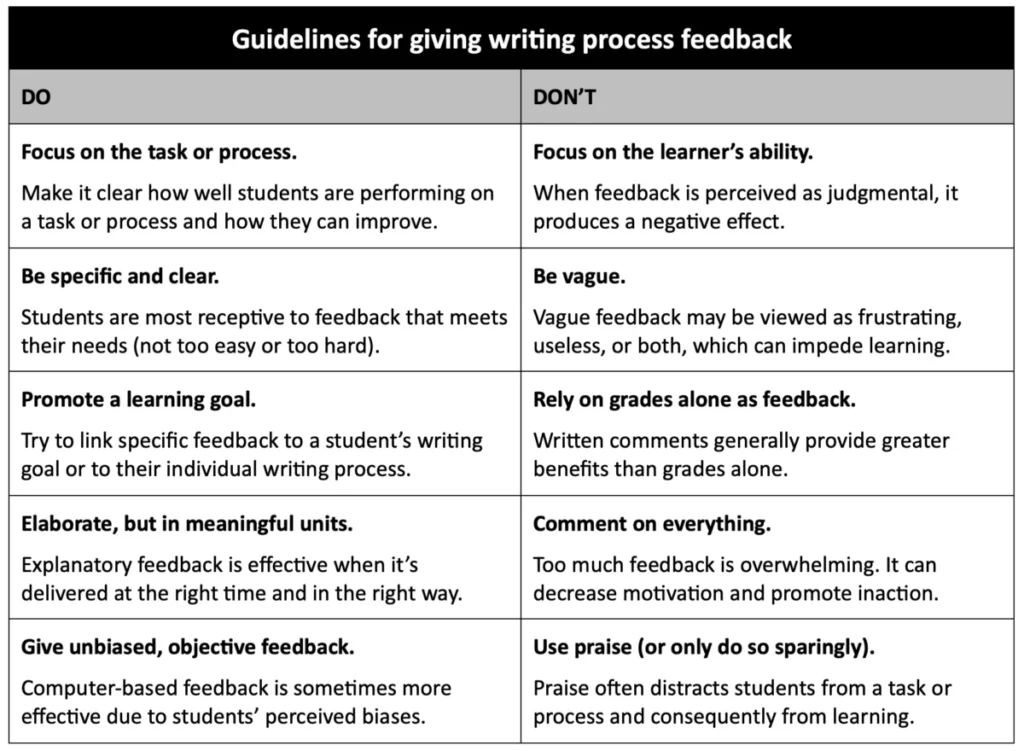
Furthermore, educational experts emphasize adherence to evidence-based "dos and don’ts" when structuring feedback:
- Do: Focus on the writing task and process, provide specific and clear commentary, promote learning goals, elaborate constructively, and maintain objective feedback.
- Don’t: Focus solely on inherent learner ability, rely on vague statements, depend entirely on letter grades as feedback, comment on every single error simultaneously, or overuse empty praise.
Teachers are encouraged to implement simple diagnostic tools, such as four-point scale self-assessment inventories ("I statements"), allowing students to track their own progress in planning, maintaining focus, and seeking help over the course of the academic year.

Implications for the Future of Classrooms
The paradigm shift toward process-oriented feedback carries profound implications for schools, teachers, and students alike.
For educators, the transition requires moving away from the exhausting burden of exhaustive red-pen corrections on final drafts. Instead, teachers must act as facilitators of cognitive strategies during writing conferences, guiding students through the messy, recursive stages of thought generation and revision.
For students, this approach reframes writing from a high-stakes performance test into a dynamic journey of discovery. When mistakes are reframed as natural milestones in a growth mindset framework, students develop higher expectations for their own capabilities. They learn to view a discarded draft not as a failure, but as a vital stepping stone toward finding their true voice.
As emerging technologies—including AI writing assistants—continue to enter classrooms, the core human element of writing instruction remains unchanged. Technology and teacher mentorship must work hand-in-hand to encourage self-monitoring, strategic planning, and recursive thinking. Ultimately, by investing in the process of writing rather than just the final ink on the page, educators equip students with transferable cognitive skills that will serve them well beyond the classroom walls.